Coin Community Family of Web Sites Join Thousands of Coin, Bullion, & Money Collectors
Vancouvers #1 Coin and Paper Money Dealer Royal Canadian Mint products, Canadian, Polish, American, and world coins and banknotes. 300,000 items to help build your collection! Coin, Banknote and Medal Collectors's Online Mall Specializing in Modern Numismatics Shop for APMEX Bullion on eBay!Join Thousands of Coin, Bullion, & Money Collectors


Username:
Password:
Save Password
Forgot your Password?


This page may contain links that result in small commissions to keep this free site up and running.

Welcome Guest! Registering and/or logging in will remove the anchor (bottom) ads. It's Free!

Women Of Rome - Julia Paula, First Wife Of Elagabalus

To participate in the forum you must log in or register.
Author Previous TopicReplies: 9 / Views: 4,760Next Topic  
Pillar of the Community
lrbguy's Avatar
United States
949 Posts
 Posted 04/26/2017  1:20 pm Show Profile   Bookmark this topic Add lrbguy to your friends list Get a Link to this Message Number of Subscribers
To introduce Julia Cornelia Paula I have chosen to bring together two historical descriptions to round out the introduction of the women of Elagabalus, including his grandmother, mother, and wives. We start with Wikipedia and follow through with a piece I found from Heritage Classical Coin News. I found that entertaining, if not a bit fanciful:

(most recent purchase)
Women-Of-Rome-–-Julia-Paula,-First-Wife-Of-Elagabalus


http://www.coinweek.com/ancient-coi...-elagabalus/
By Lorie Ann Hambly - Heritage Classical Coin News 10/11/13

Julia Cornelia Paula was Empress of Rome from 219-220.Cornelia Paula was a member of the gens Cornelia through her maternal line. Her father, Julius Paulus, was a Roman Nobleman of Greek descent and a historically noted jurist active throughout the Severan Dynasty becoming a praetorian prefect in Rome. She was thus of both Patrician Roman and Greek descent and as such was a scion of the established upper Roman aristocracy.

In early 219, Julia Maesa, eldest sister of Roman Empress Julia Domna, arranged for Cornelia Paula to marry her grandson, the new emperor Elagabalus. Their wedding was lavishly celebrated in Rome. Cornelia Paula became Elagabalus' first wife and was given the honorific title of Augusta and the family name "Julia".

The marriage was arranged by the emperor's powerful grandmother, Julia Maesa, who wished to make the reign of a 15-year-old Syrian youth of ambiguous sexuality palatable to the Roman populace. The wedding was accompanied by extravagant public spectacles and Julia Paula was immediately granted the title of Augusta, or empress, making her one of three women bearing the title in the female-dominated regime, the other two being Julia Maesa and the emperor's mother, Julia Soaemias. (q.v.)

But the marriage soon foundered as Elagabalus found his new bride's sexual mores too conventional for his liking. Elagabalus, you see, was a cross-dressing, sun-worshipping exotic dancer who chose his counselors based on the size of their, um, male sexual equipment. He took little interest in actual governing, leaving this to his ferocious grandmother.

Julia Paula, to all appearances, was a very traditional Roman virgin from a good family; nothing could be more dull to a young man of Elagabalus' tastes. He summarily divorced her late in AD 220 or early in 221, only to turn around and marry the Vestal Virgin Aquilia Severa, a move which scandalized the Roman world all the more.

Julia Paula retired from public life and seems to have survived the chaotic and comical reign of her former husband with her virtue and reputation intact.

Elagabalus would also divorce Aquilia Severa a few months later and take one more crack at conventional matrimony with Annia Faustina, a descendant of Marcus Aurelius. This match also foundered quickly and the never-satisfied emperor returned briefly to Aquilia Severa before being murdered by the Praetorians and dumped into a latrine, along with his mother, on March 11, AD 222.


Since Julia Paula was Augustus for but a single year, it should be no surprise that all her coinage is covered in a single issue, 219-220 AD.
However, her coinage was produced at two mints; Rome and Antioch. Both used the same obverse legend for all her denarii: IVLIA PAVLA AVG. However, there is some variety in the reverse types and legends.


AT ROME:

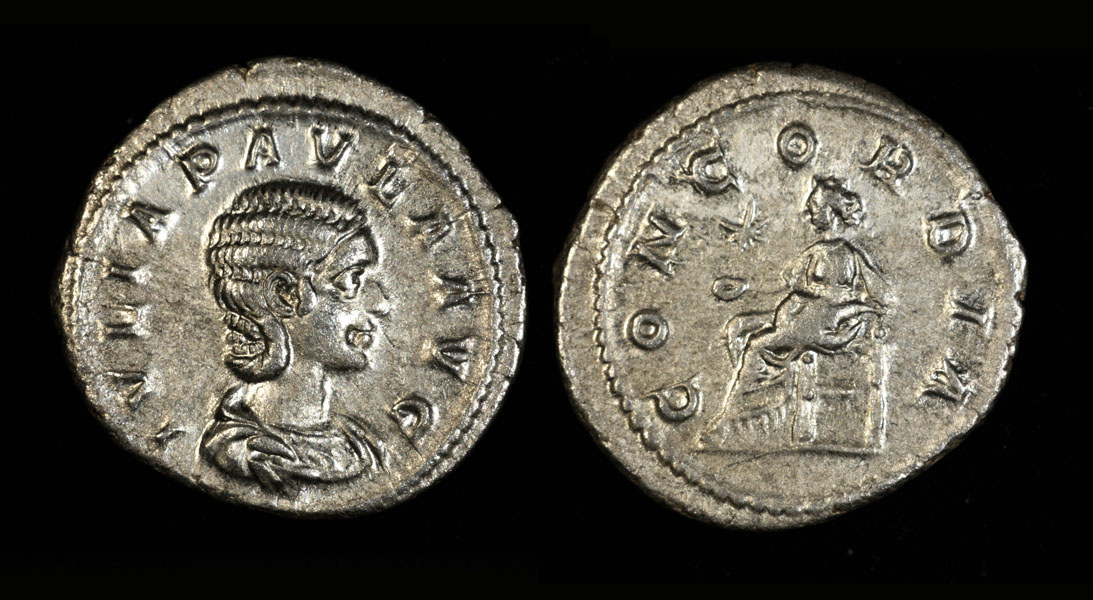
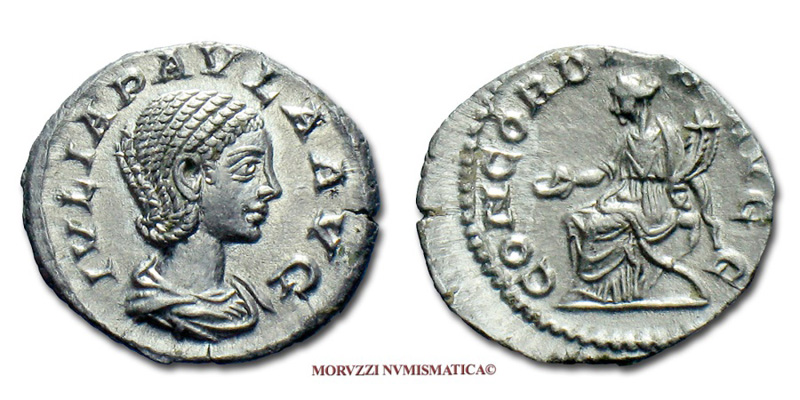
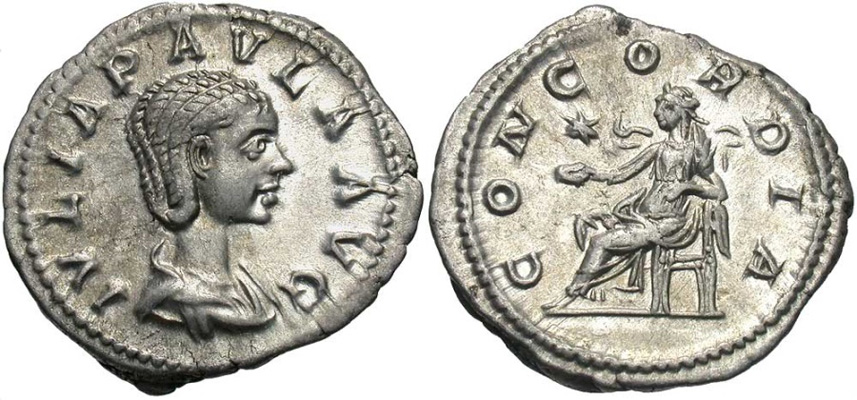
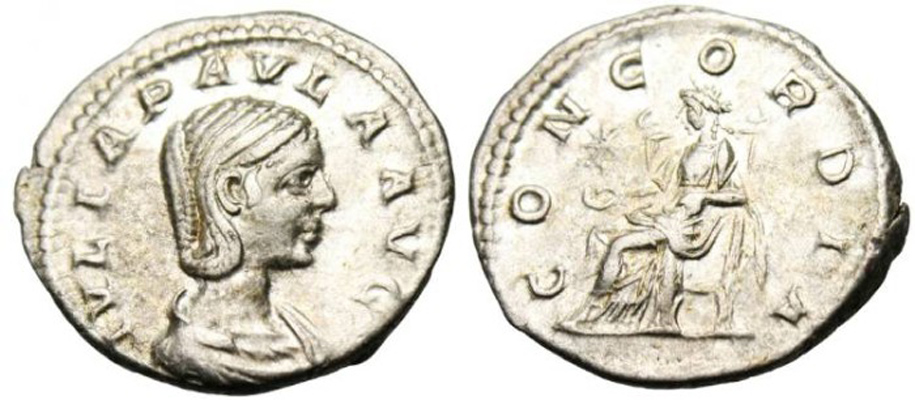
Of the five reverse types issued at Rome, by far the most frequently encountered is the CONCORDIA reverse featuring Concordia draped and seated l on throne holding patera in extended r. arm, l arm on side of throne, elbow bent, fold of drapery over l. arm. In addition a star is to be found in the right field or high or low in the left field.

The obverse image is pretty uniform noting: "hair in waves, nearly vertical, fastened in queue at back, two ridges." Given the small number of "ridges" it is important to note that at Rome the waves of the hair run nearly vertically, but the "ridges" run horizontally. This is an important description, because it differs from what is seen at Antioch. So the hairstyle can be used to distinguish coins for Paula by mint.

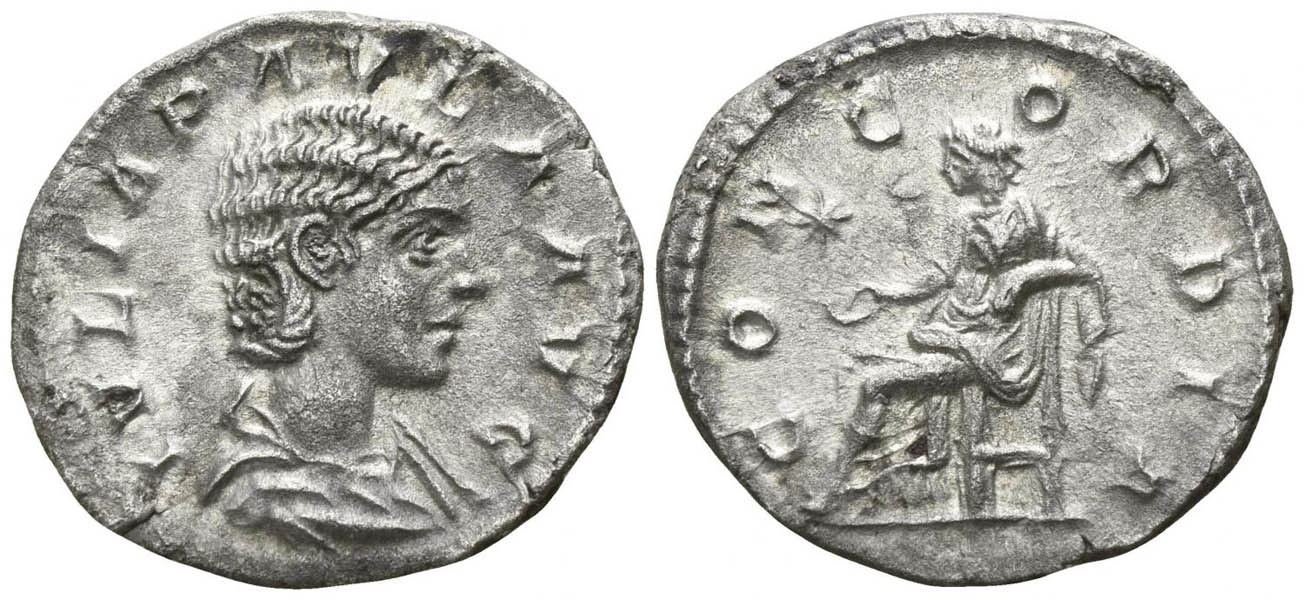
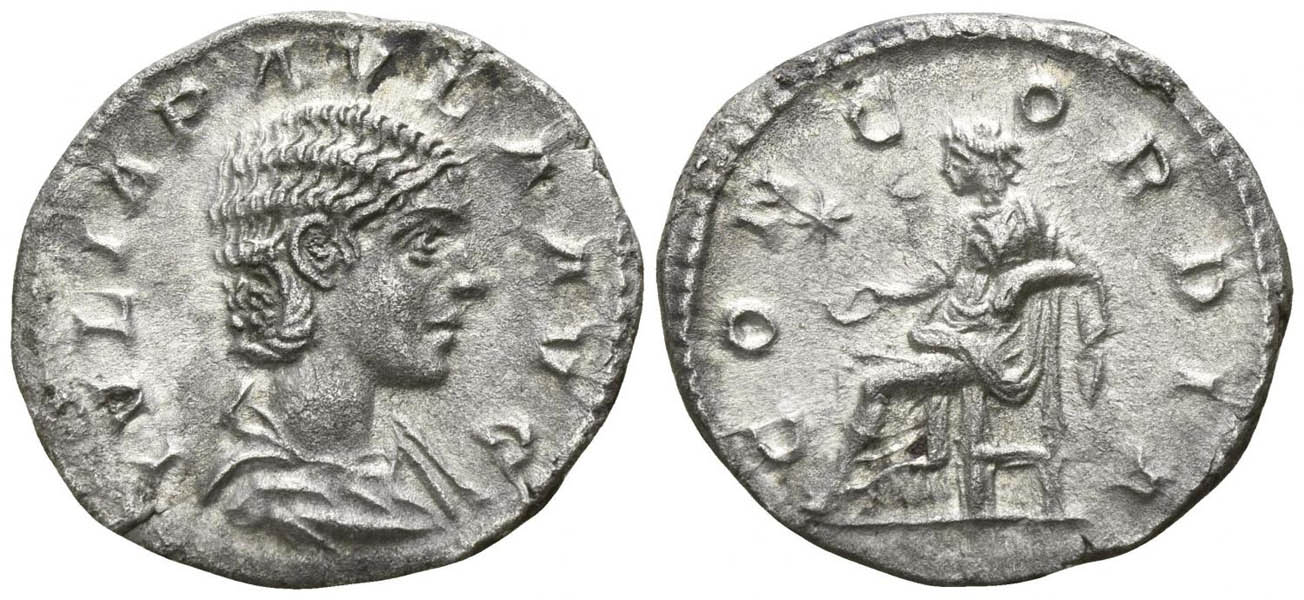
Here are two from my collection from Rome. The second was just acquired and I have to use the seller's photo for now.


In the first case the obverse image conforms exactly to the catalog description in BMCRE; i.e. hair in two waves.
However, the hair at the back forms a small bun, not a queue. (BMCRE 173 for Elagabalus)

Women-Of-Rome-–-Julia-Paula,-First-Wife-Of-Elagabalus


In this second case, same coin as above, I count at least three waves, four with the top.
Again, the hair at the back forms a small bun, not a queue (BMCRE 174 for Elagabalus)

Women-Of-Rome-–-Julia-Paula,-First-Wife-Of-Elagabalus

In both cases the reverse has a star "high" in the left field. The main difference between "high" and others is that the star touches or nearly touches the lettering of the inscription. Even when the lettering is low and leaves little space to the knee, the star is "high" if it touches the lettering.

Other reverse types from Rome depict Juno, Pudicitia, Venus, and Vesta, four goddesses of particular importance to the personal and social function of women.

Now let us compare these to what we see

AT ANTIOCH:

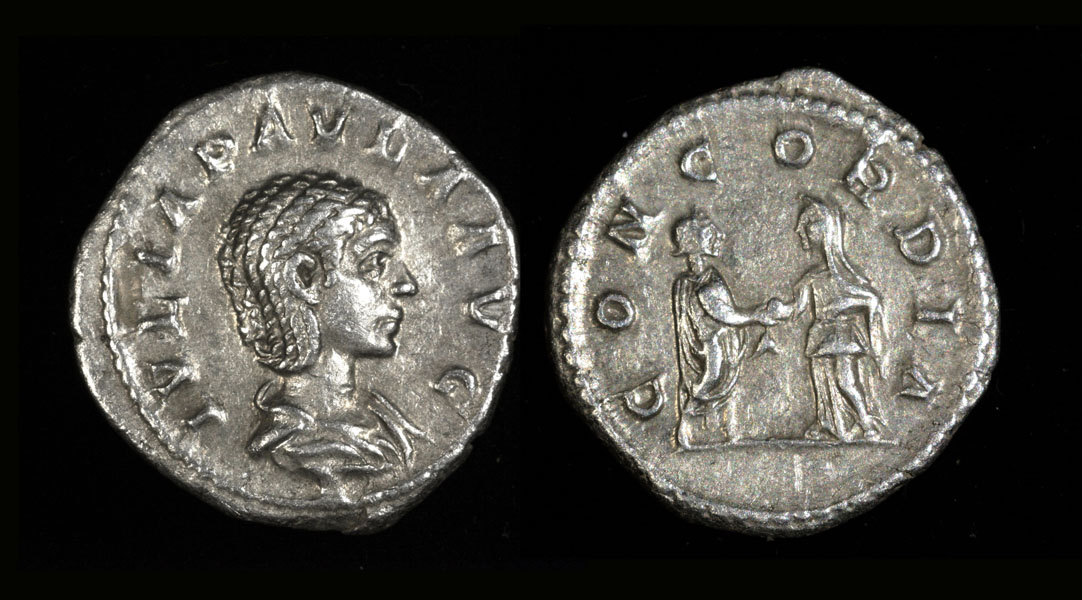
Here things really get interesting, for we find more diversity of types and treatment of types than at Rome. But our first attention is drawn to the treatment of the obverse portrait. In the catalog, BMCRE the written description is very much like that for Rome, differing by the larger number of ridges in the count. Here is what you see - -

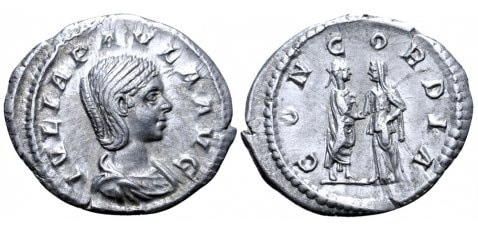
In my first example, the hair is styled rather like what we see at Rome, but with no horizontal "ridges" as above. Instead the "ridges" now run vertically, and these correspond in number to the catalog description, in this case I count six (BMCRE 318 for Elagabalus)

Women-Of-Rome-–-Julia-Paula,-First-Wife-Of-Elagabalus

The reverse is also CONCORDIA, but now with the emperor and empress in the pose of clasping their right hands (handshake). For Paula this type is specific to Antioch.

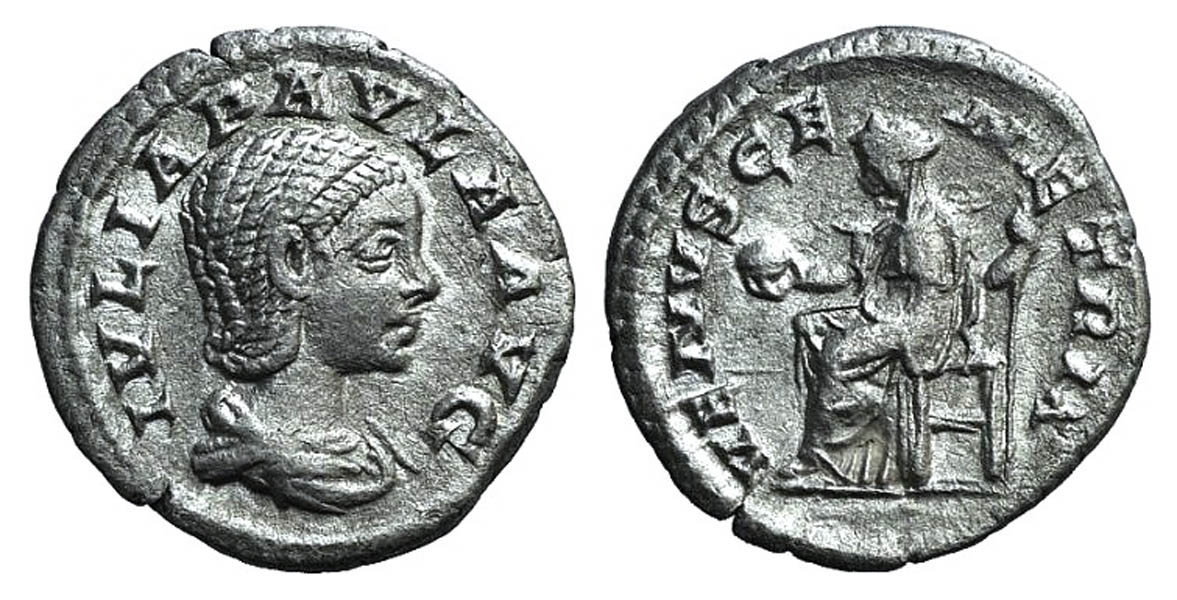
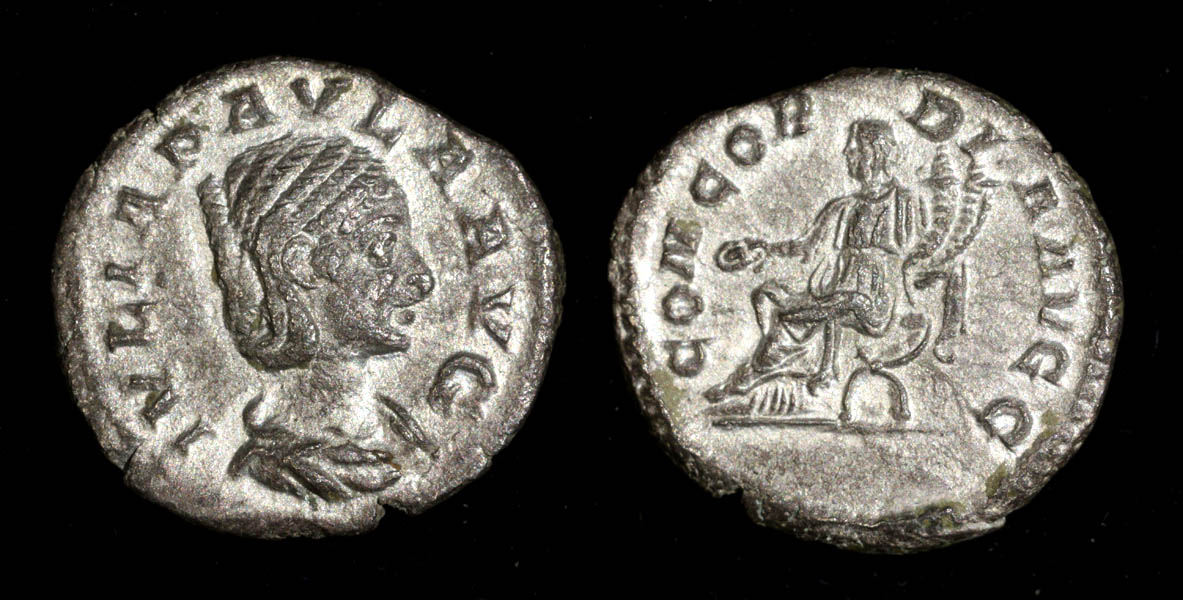
For my next example the execution of the bust is positively ghastly, but it shows with great prominence the formation of the queue in the back of the hair along with five "ridges"
Women-Of-Rome-–-Julia-Paula,-First-Wife-Of-Elagabalus


The reverse may look similar to what we saw from Rome, but is different in several ways. The inscription now reads CONCOR DI AAVGG and the type features Concordia seated l. on a (backless) curule chair instead of a throne holding a patera forward in r hand, but cradling a double cornucopia on her left. This coin corresponds most closely to BMCRE 321 for Elagabalus, differing only in the break pattern of the reverse inscription.

++++++++++++++++++++++++++++++++++++++++++++++++++++++++++++++++++++++++++++++++++++++++++++++++++++++++++++

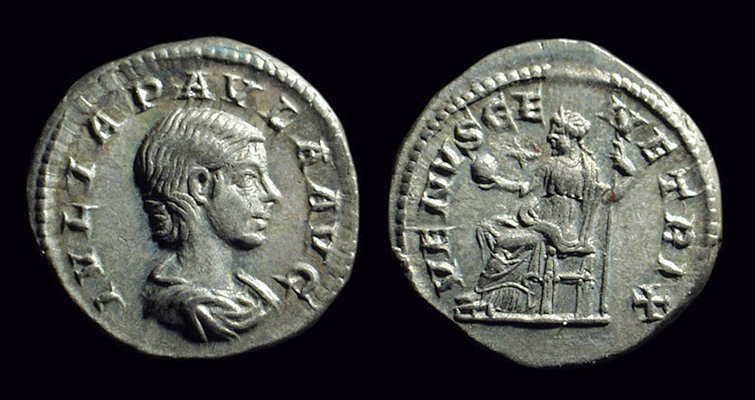
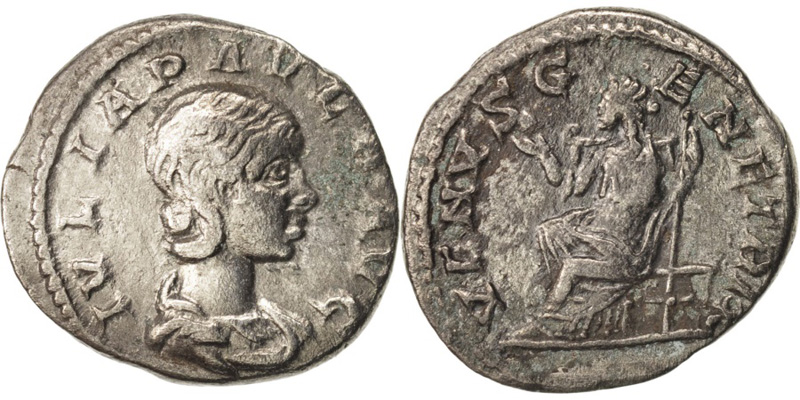
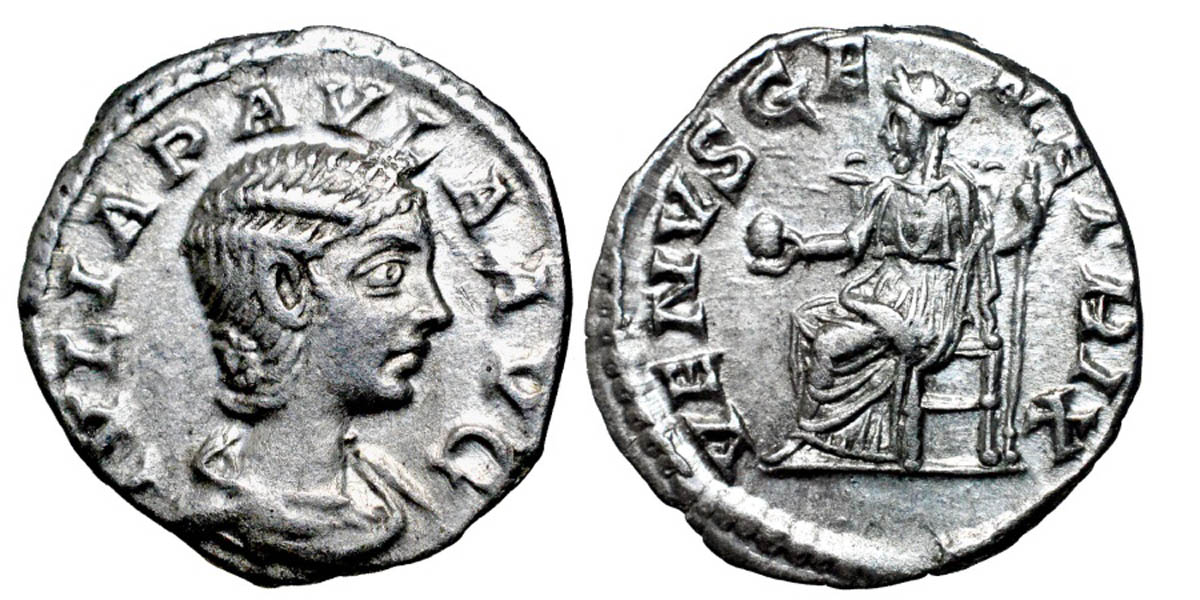
I am now going to break a rule of this series and use a pair of imported images in order to emphasize a point I tried to make above. The next two images are from sellers at V-coins and show examples of the same reverse type and inscription, but one is from Rome and one is from Antioch. From what I have been saying, please tell us which is which, and the clues that told you.

With VENVS GENETRIX they feature a type I do not yet own:

Coin A
Women-Of-Rome-–-Julia-Paula,-First-Wife-Of-Elagabalus

Coin B
Women-Of-Rome-–-Julia-Paula,-First-Wife-Of-Elagabalus


Which is Rome? Which is Antioch?

How do you know?

Edited by lrbguy
04/27/2017 09:38 am
Moderator
Learn More...
Spence's Avatar
United States
34401 Posts
 Posted 04/26/2017  3:21 pm  Show Profile   Bookmark this reply Add Spence to your friends list Get a Link to this Reply
Great post! If I read things corectly, bust "A" is Rome and "B" is Antioch due to the hair wave direction.
"If you climb a good tree, you get a push."
-----Ghanaian proverb

"The danger we all now face is distinguishing between what is authentic and what is performed."
-----King Adz
Moderator
Learn More...
echizento's Avatar
United States
23731 Posts
 Posted 04/26/2017  5:44 pm  Show Profile   Bookmark this reply Add echizento to your friends list Get a Link to this Reply
Excellent information and super coins.
Pillar of the Community
Justinokay's Avatar
United States
564 Posts
 Posted 04/26/2017  5:54 pm  Show Profile   Bookmark this reply Add Justinokay to your friends list Get a Link to this Reply
Love how you always have a story to tell for each coin
Pillar of the Community
Learn More...
Palouche's Avatar
Spain
2752 Posts
 Posted 04/27/2017  04:17 am  Show Profile   Bookmark this reply Add Palouche to your friends list Get a Link to this Reply
Hi lrb,excellent historical write up and a sϊper
explanation on mint differences,thanks for sharing

with spence (Rome - A).......(Antioch - B)
hairstyles.

Saludos Paul.

Pillar of the Community
EFLargeCents's Avatar
United States
1304 Posts
 Posted 04/27/2017  10:13 am  Show Profile   Bookmark this reply Add EFLargeCents to your friends list Get a Link to this Reply
Wonderful write up Irbguy! I need to add one of her yet to my collection, or maybe two!
Pillar of the Community
lrbguy's Avatar
United States
949 Posts
 Posted 04/27/2017  11:44 am  Show Profile   Bookmark this reply Add lrbguy to your friends list Get a Link to this Reply
Thanks for the responses folks., Its good to know at least a few people are interacting with this stuff, and hopefully are getting into it with some sense of intrigue.

Yes, Paul and Spence, you both got it the way the sellers listed them and the way I see it. But hold on...

I actually have a hidden agenda, of sorts, and I hope to take you with me. Let me explain. The mint differentiation I shared with you follows the work of Harold Mattingly in the British Museum catalog (BMCRE) in 1950 (and again 1975). He meticulously describes points of difference in the coins and maps the distribution as I gave it to you. However, for many RIC remains the definitive guide to these issues, even in modern online boards, and in RIC things look differently.

The coins of Julia Paula are covered in the middle segment of RIC IV, edited by Humphrey Sutherland under the general editorship of Mattingly and Edward Sydenham in 1938. I mention who did this work because of what happened. RIC blends all the coins of Julia Paula into a single listing (vol IV, part II, pp. 45-47). They explain this decision as follows: "Of the royal ladies, Julia Paula, Aquilia Severa, Soemias and Maesa, certain issues were probably struck in Syria. But the difficulty of distinguishing them from the Roman issues, except in a few individual cases(emphasis mine), precludes a separate classification of them in the Corpus." The exceptional items referred to are flagged by footnotes for numbers 217, 218, and 220 as "Probably of the mint at Antioch." However, for #222 with the VENVS GENETRIX reverse (see examples above) the footnote reads, "Also of the mint at Antioch." So that is attributed to both mints.

Now, to me as a numismatist, the place were a coin is minted is a rather important bit of knowledge not be be disregarded. Sutherland, et al in 1938 cannot make the distinctions to separate Rome from Antioch. However Mattingly, who was part of the original team, subsequently took up the matter and gave us some points of differentiation in BMCRE. Seaby's Roman Silver Coins (III), uses a modified Cohen numbering sustem to bring the two together, noting where BMC makes attributions to Antioch. To be honest, we really should be following the more recent scholarship, and moving it along, because the job is not quite done. Let me show you.


IN THE MARKETPLACE

The coins of Julia Paula are not great rarities, but they aren't cheap either. When you put down $200-$400 for a coin you like to be sure of what you are getting. But here is what we face. Consider the following from V-coins (and now that you have the principles down, what do you make of these?):


vc3 - seller says Rome.

Women-Of-Rome-–-Julia-Paula,-First-Wife-Of-Elagabalus


vc4 - seller says Rome.

Women-Of-Rome-–-Julia-Paula,-First-Wife-Of-Elagabalus

vc5 - seller says Rome.

Women-Of-Rome-–-Julia-Paula,-First-Wife-Of-Elagabalus

Do you agree with these? (Hint: BMCRE would say "no") You could hide behind RIC and say "sure." Is that the more authentic solution?


Now consider these two:

vc6 - $500 seller says Rome with a special note, "Rare with early hair style."

Women-Of-Rome-–-Julia-Paula,-First-Wife-Of-Elagabalus

vc7 - $400 seller says Rome without comment.

Women-Of-Rome-–-Julia-Paula,-First-Wife-Of-Elagabalus


What do you think?

Here's the big question: is there a definitive hair style and combination of reverses for Rome (or for Antioch)?

I'd like to talk about the problems of these coins with you.
Could we have some discussion on this from our Eastern mint experts?
Pillar of the Community
Learn More...
Palouche's Avatar
Spain
2752 Posts
 Posted 04/28/2017  06:33 am  Show Profile   Bookmark this reply Add Palouche to your friends list Get a Link to this Reply


OK,

Coin vc3 Rome I think its Antioch

The hair ridges run vertically not horizontally and are brought together at the the back in a queue not a small bun.

Concordia is sitting on a backless curule chair not a throne.

Reverse legend reads CONCOR DI AAVGG

Coin vc4 I agree Rome
Coin vc5 I agree Rome,but not that sure as the style seems different,there is no star,and it has a different reverse legend break.

Although worn there are horizontal ridges in the hair and a small bun at the back.
Both Venus are sitting on a throne.
vc4 has a star in the field.

vc6 and vc7

The obverse should be Antioch,but the reverse should be Rome....


I hope someone comes up with some answers?

Saludos Paul
Pillar of the Community
lrbguy's Avatar
United States
949 Posts
 Posted 04/28/2017  10:54 am  Show Profile   Bookmark this reply Add lrbguy to your friends list Get a Link to this Reply
We came out the same Paul, right down the line.

Coin #3 should have been a gimme, since it screamed "Antioch" from both sides, as you well pointed out.

On coin #5 you were able to see the horizontal ridges which are very faint. That's great! However, in your thinking on the reverse you started to mix the characteristics of the Concordia type and the Venus. The Venus reverse does not make use of a star (not on coin 4 either) and the curule chair, which Rome did not use, is for the Concordia type, not with Venus. So #5 is consistent with Rome all the way, reverse break pattern notwithstanding. It's tricky because this reverse type was used at both mints. The hair arrangement tips the balance, and you caught that.

For numbers 6&7 I want to hear more about this "early style" someone at Harlan Berk's place came up with. I am going to take these up with Curtis Clay since he is local and the most likely person over there to have made that determination. I'll let you know what he says.

However, for attribution, pride of place belongs to the Concordia reverse which was not used in this form in the East. It has to be Rome, which motivates the "early style" idea. That proposal makes sense if we assume that Antioch followed Rome on that initial style early on, and that Rome split off with the horizontal ridges approach to differentiate the obverses. But for a single issue in a single year, what do we mean by "early?" The bigger question is, was/is there hoard evidence or something to settle the matter? Otherwise it is but a convenient hypothesis (and that may well be the whole of it). We shall see.

Anyway, good job!
Valued Member
coffeyce's Avatar
Hong Kong
54 Posts
 Posted 09/01/2018  12:20 am  Show Profile   Bookmark this reply Add coffeyce to your friends list Get a Link to this Reply
this is my example

Julia Paula (wife of Elagabalus) AR Denarius. Rome, AD 219-220. IVLIA PAVLA AVG, draped bust right / CONCORDIA, Elagabalus and Julia Paula standing facing each other, clasping hands. RIC 214 (Elagabalus); BMCRE 318 (same); RSC 12. 2.69g, 21mm, 12h.

Women-Of-Rome-–-Julia-Paula,-First-Wife-Of-Elagabalus
  Previous TopicReplies: 9 / Views: 4,760Next Topic  

To participate in the forum you must log in or register.


Disclaimer: While a tremendous amount of effort goes into ensuring the accuracy of the information contained in this site, Coin Community assumes no liability for errors. Copyright 2005 - 2026 Coin Community Family- all rights reserved worldwide. Use of any images or content on this website without prior written permission of Coin Community or the original lender is strictly prohibited.
Contact Us  |  Advertise Here  |  Privacy Policy / Terms of Use

Coin Community Forum © 2005 - 2026 Coin Community Forums
It took 0.33 seconds to rattle this change. Forums