While visiting the local coin shop I noticed an unusual banknote among the usual things on display. I asked what it was. A local issue from Lodz, I was informed. As I haven't encountered one before, I asked to see a catalog entry for it. Searching the basic Polish catalog produced no results - it's not even listed there.
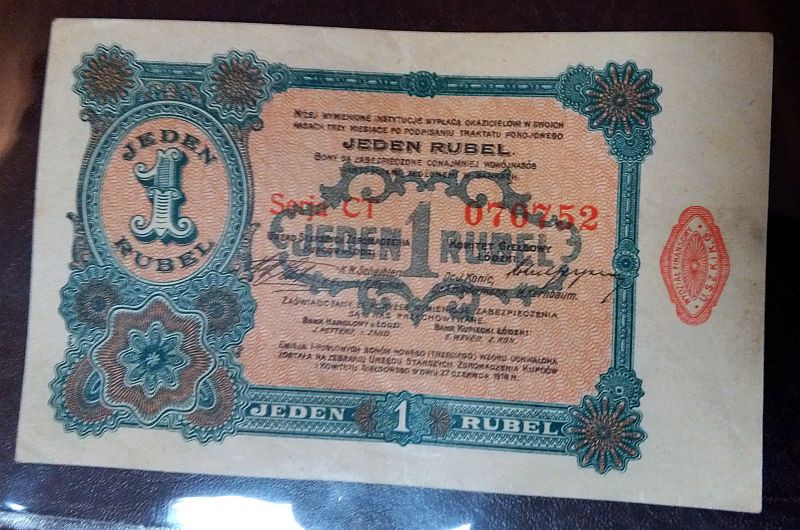
The said note, dated 1916. The photo taken with the coin shop's permission.
Some research was clearly needed. Turned out there is much more to this note than I expected.
Note: as I do not own any of the banknotes in question, I added links to the WCN auctions archive for high-resolution images.
- - -Local issues from Lodz (Poland)1914-1916Germany declared war on Russia on August 1, 1914. The tsarist administration and the Russian army were evacuated. The industrialists took control of the city and created a temporary civilian authority called the Main Civic Committee (which I will be referring to as the MCC). The German army entered Lodz on August 20 but withdrew a week later. They returned on October 8 and withdrew for the second time after three weeks. A three-week battle for Lodz followed (November/December 1914). The Russians were defeated and the Germans took control of the city for the third time on December 6. This time they stayed there for four years.
The Lodz division of the Russian State Bank ceased its operations during the first days of the war as the probability of losing the territory by the Russians was deemed to be high. Local industrialists initiated the issuance of the notes in order to counter the lack of legal tender following the closure of the Russian bank and the removal of the funds which were deposited there.
On August 7, it was decided that a sum of one million roubles was to be issued in three denominations: 20 kopeks, 50 kopeks, and 1 rouble, in order to meet the needs of industry and trade. The public were informed of the nature and purpose of the issue and requested to accept these notes instead of the legal tender as the locally issued notes were properly backed.
All notes had the same wording. The inscriptions read:
The institutions mentioned below shall pay the bearer at their counters three months after the peace treaty is signed
ONE ROUBLE.
The notes are back at least twice by the assets held by the banks.
We hereby certify that the aforementioned assets are held by us.
Commercial bank in Lodz (signature)
Traders' Bank in Lodz (signature)Another paragraph stating when and by whom the issue of the notes was approved was added to the subsequent issues. The other side had the same text written in Russian.
A set of the first issue notes - WCN archive lotBy December, as the initial issue of one million roubles has run out and applications for new loans were still arriving, it was decided to issue another million roubles in these notes. At first, it was expected that the issuing activity would cease after reaching the sum of 1-2 million roubles. The reality, however, proved to be different. In the first half of 1915, the monetary situation in Lodz did not improve - in fact it worsened. Lodz was cut off not only from Russia but also from Warsaw. The debtors did not pay they dues as they were uncapable of doing so, their obligations were also temporarily suspended. The sales of goods was limited due to the restriction of the market to parts of the Piotrkow and Kalisz Governorate and communication difficulties. At the same time, the factories had to meet considerable expenses due to paying out allowances for the workers and keeping order in the factories - hence the increasing number of loan applications. Pledged assets included various public securities and bills of exchange. The said loans were interest-free.
But factory owners weren't the only ones who benefited from this issue. The cash-strapped Main Civic Committee which controlled the city economy from the beginning of the war until August 1915 took out loans as well. Initially, the MCC made an agreement with the Russian government which was to lend it 2 million roubles. However, the MCC received only two installments of this sum - the rest could not arrive due to the communication link with Warsaw (and Russia) being broken. On top of that, taxing the population was difficult to manage due to the constantly changing wartime situation. The MCC received a 1.3 million rouble loan in the local notes. By March 1915, these funds were close to running out and in May another loan to the MCC in these notes was approved and paid out (3.0971 million roubles).
Considering all these needs, it comes as no surprise that authorization to issue further notes was given in January, February (1 million roubles each), March, April, May, and July (2 million roubles each). The 1914/15 issue totalled 12 million roubles. Considering the volume of the loans, issuing twenty-kopek notes was deemed impractical. A five-rouble note was authorized in 1915. These notes featured signature facsimiles. They weren't just a security measure: the signatures of the most well-known of the local industrialists added to the credibility of the local notes.
As the design of the first series of these notes was simple, contemporary counterfeits (mostly of the 1 rouble note) appeared. This was the reason for the change of the format, design, and background of the 50 kopeks and 1 rouble notes. The 50 kopeks and 1 rouble notes of the first series were exchanged for new ones from June to October 1915. The counterfeiting is reported to have subsided after that.
A set of the second issue notes - WCN archive lotThe policy of the issuing body was to loan money only up to 50% of the value of the securities pledged by the loan taker (30% for bills of exchange), and the MCC wasn't exempt from that rule. Loans in these notes were also provided for the military hospital in Lodz and to organizations paying out benefits to families whose male members were serving in the Russian army.
People who had a Russian savings account - who weren't able to withdraw the money they deposited, as the Russian institutions were gone - could receive 48% of the deposited sum in these notes: in 1915, the body which issued the notes decided to act as an intermediary between the account holders and the Russian government. The bankbooks were deposited and were to be held until the Russian government returned the money. On a similar basis, payouts for pensioners were arranged.
The MCC ceased to operate on June 30, 1915. All its functions were taken over by the occupiers. In mid-August, the Praesidium of the Police demanded limiting the lending to specific public purposes only - no more loans were to be given to private companies or persons. The Financial Division replied that the sum of 12 million roubles in issued notes was sufficient and new notes would be printed only to exchange the old 50 kopeks and 1 rouble notes for new ones.
Third issue note - WCN archive lotHowever, within a month, the Praesidium changed its mind and ordered 2 million roubles in notes to be printed. The Financial Division did not comply fearing that additional issues may cause the value of the notes to fall. Following long negotiations, a loan to the Magistrate was granted in February 1916.
Later in 1916, the Germans, under the pretence of 'restoring the Kingdom of Poland', began to undertake actions leading to the creation of an issuing bank for the Polish territories which would give them more influence over the economy of the occupied territories. An institution called Polska Krajowa Kasa Pozyczkowa (Polish National Loan Bank, PNLB) was set up and began to issue the Polish mark banknotes dated December 9, 1916 (1917). The Polish mark notes appeared in circulation in the first half of 1917.
On April 14, 1917 the occupiers issued a regulation which declared the PNLB banknotes are the sole legal tender within the area of the so-called 'Kingdom of Poland'. The exchange rate was set by the German authorities at 1 rouble=2.16 mark, while the actual rate stood at 1 rouble=2.50 mark in mid-April.
Unusually, when the roubles started to be exchanged for marks, Russian notes were assessed based on their condition. The more damaged the note, the fewer marks one received. People who possessed rouble notes were aware of the fact that the assessment of the banknotes' grade was nonsense - they were issued by the same central bank and had the same backing regardless of what they looked like - but as the German banks were the main, if not the only institutions who would exchange the rouble and everyone had to comply with these weird rules. The German authorities made significant gains.
On April 20, 1917, it has been decided that the Lodz rouble notes would be handstamped with a new value (at a rate of 1 rouble=2.20 mark) and that stamped notes could circulate along with the PNLB Polish mark. Few people turned their local notes in for stamping as the exchange rate was low at the time. Supplementing the April 14 regulation, the Germans issued another regulation on June 5 specifically stating the Lodz local rouble notes could not have been circulating after April 25. The population still didn't turn them in as the exchange rate fluctuated around 1 rouble=2.50 mark.
Second and third issue notes were stamped. The handstamp on the second issue 50 kopeks notes read:
Maximum circulation value 1 M. 10 f. No guarantee of repayment and authenticity of this note.The value was 2.20 mark and 11 mark for the stamped 1 and 5 rouble notes respectively.
Various stamped and holed notes - WCN archive lotThe aforementioned regulations have been widely publicized by the German authorities to convince the population to stamp their notes. This action achieved its goal, at least to a certain extent: some people turned them in thinking that - a one-rouble local note has a '2.20 Mk.' handstamp and the regular exchange rate is 1 rouble=2.50 mark (40 kopeks for 1 mark) - that means a one-rouble local note is actually worth only 88 kopeks. The wealthy and the speculators held on to their local notes - but the actual value of the notes did rapidly fall below face - down to ca. 80% by July 1917.
In order to prevent a further fall of the local notes' value, the issuing entity asked people to hold on to them, publicizing information regarding the backing of the notes, the goals of the issue, and figures detailing the loans granted and securities pledged. It wasn't particularly effective, as the value of the local notes fluctuated at around 15% below face until the end of 1917. By the end of the year the notes almost disappeared from circulation and were rarely seen in commercial transactions.
As the war was drawing to a close, the question of redeeming the local notes arose. A peace treaty between the Central Powers and Russia was signed in March 1918. However, as the war went on between Germany and other countries, the redemption of the notes was postponed. The armistice came into effect on November 11, 1918. The Treaty of Versailles was singed on June 28, 1919 and ratified by the Polish Parliament on July 31, 1919. However, the redemption was postponed again as the treaty had not been ratified by the Allies yet.
Finally, as the Treaty of Versailles was ratified in Paris on January 10, 1920, it was decided that the loans received by various companies and institutions were to be repaid by March 10 and the local notes began to be redeemed for roubles from April 10, 1920.
As time passed, smaller and smaller amounts of the local notes were handed in for redemption and by 1923, notes for a total of 1,342,045 had not been redeemed. But even at that point, the remaining notes had their backing deposited at the Commercial Bank in Lodz.
Of course, nobody could have predicted that three months after signing the peace treaty - and that's when the notes were to be redeemed - the rouble would be an 'inflationary fiction'.
Summary of the 1914-1916 issues:
- 1st series - undated (second half of 1914): 20 kopeks, 50 kopeks, 1 rouble.
- 2nd series - March 13, 1915: 50 kopeks, 1 rouble, 5 roubles.
- 3rd series - June 27, 1916: 1 rouble.
The notes circulated on par with the official Russian rouble (and later alongside the Polish mark) not only in the city of Lodz but also in outlying towns such as Pabianice, Zgierz, or even Tomaszow Mazowiecki from the beginning of the war until the end of 1917.
- - -25 years later history repeats itself.
1939The German Army crossed the Polish border on September 1, 1939. From the beginning of the war, Lodz was a target for the German airforce. During the night of September 4/5 the evacuation of Polish authorities and institutions began. On September 5 the Lodz Army, created earlier that year and tasked with preventing German attacks in the city's direction, suffered a major defeat. By September 6, the Polish military, the central and local authorities, and the police left the city. Many citizens, who also fled Lodz heading in the direction of Warsaw, were the target of the German airforce.
On September 6, the first meeting of the Lodz Civic Committee was held. It's aim was to take control over the city from which the authorities have been evacuated. It consisted of 6 sections - among them one to deal with finances. One of the first decisions of the Committee was to issue local notes, which were to be used instead of the legal tender which disappeared from circulation.
The inscriptions on the front read:
The notes of the Commission shall be exchanged for banknotes without any restrictions and fees within six months from the day on which the peace treaty is signed.
The notes are backed by assets deposited on behalf of the Commission. On the back:
Forgery of the notes will be penalized in accordance with the provisions of the criminal code.On September 9, the German army entered the city. At first, the Germans told the Committee to go on with its activities but as the situation of the Germans in the city stabilized, the Committee's scope of activities became more and more restricted. In the end it could only perform charity work.
A set of the 1939 issue notes - WCN archive lotLodz became part of the newly created Generalgouvernement on October 26 but that situation didn't last long. As a result of the efforts of the local Nazi groups, the city of Lodz was incorporated into the German Reich on November 9. The same day the head of the Committee was arrested which meant the end of its activities, even though it has never been formally dissolved.
Summary of the 1939 issue:
The local notes were issued in four denominations: 50 groszy, 1 zloty, 2 zlote, 5 zlotych. All are dated 1939. The two top values have a six-digit serial number, while the smaller ones have none.
Specimens with handwritten annotations exist.
- - - Sources:
Wikipedia and the Lodz State Archive website for the historical data, WCN auction archives for the linked images, Leksykon Numizmatyczny (WN PWN Warszawa-Lodz, 1994) for verification of the issued denominations, M. Hertz Lodz w Czasie Wielkiej Wojny (Lodz, 1933) for the story behind the 1914-1916 issue.







 Posted 04/29/2017 3:28 pm


