| Author |
 Replies: 14 / Views: 3,157 Replies: 14 / Views: 3,157 |
|
|
Pillar of the Community
United States
4883 Posts |
Valerius Licinius Licinianus was a successful military commander, but never served as Caesar. Nevertheless, he was capriciously appointed Augustus by Galerius, and adopted by Diocletian, who although retired was clearly endorsing this alteration to the order of succession within the tetrarchy he'd founded. All this in reality didn't render Lucinius' position less precarious, so he prudently allied himself with Constantine by becoming engaged to the latter's sister Constantia. When Galerius died, the scramble for real power commenced. Licinius solidified his relationship with Constantine by marrying Constantia and at least superficially embracing Christianity. He then defeated his rival Maximimus II in battle, leaving Licinius in firm control of the eastern portion of the empire, with Constantine holding the western part. However, Constantine presumed to encroach on Licinius' dominions, and soon the two were at odds. Things went Constantine's way, and not only did Licinius lose the Balkans, but in the aftermath Valens, his handpicked usurper of Constantine, was summarily killed. A shaky peace ensued, but after several years hostilties again broke out between the two emperors. This time Licinius was utterly vanquished, Even his wife couldn't save him from being hanged, and his son Licinius the Younger ultimately was also executed. 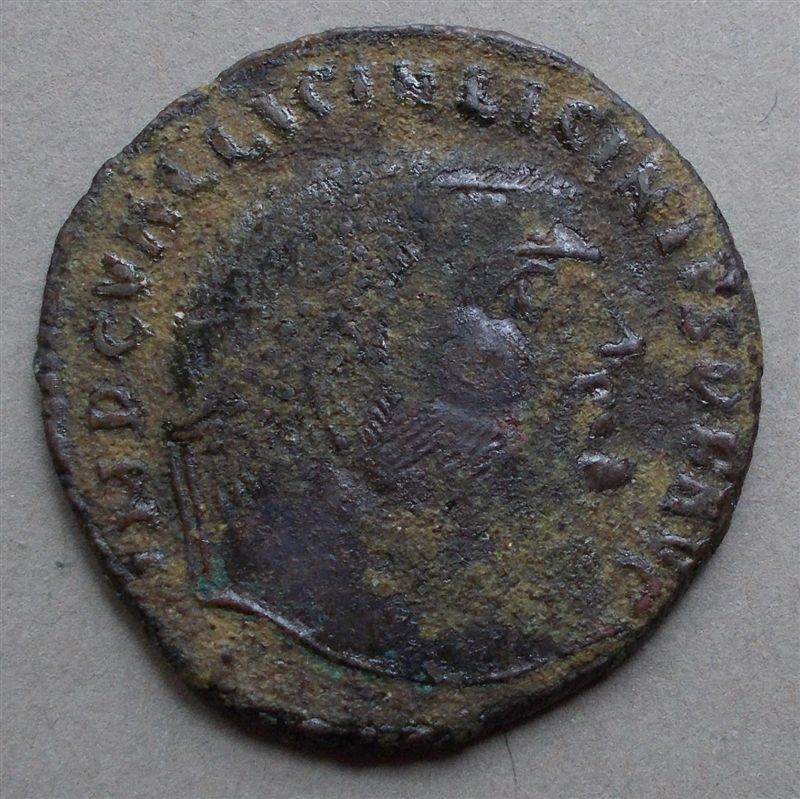 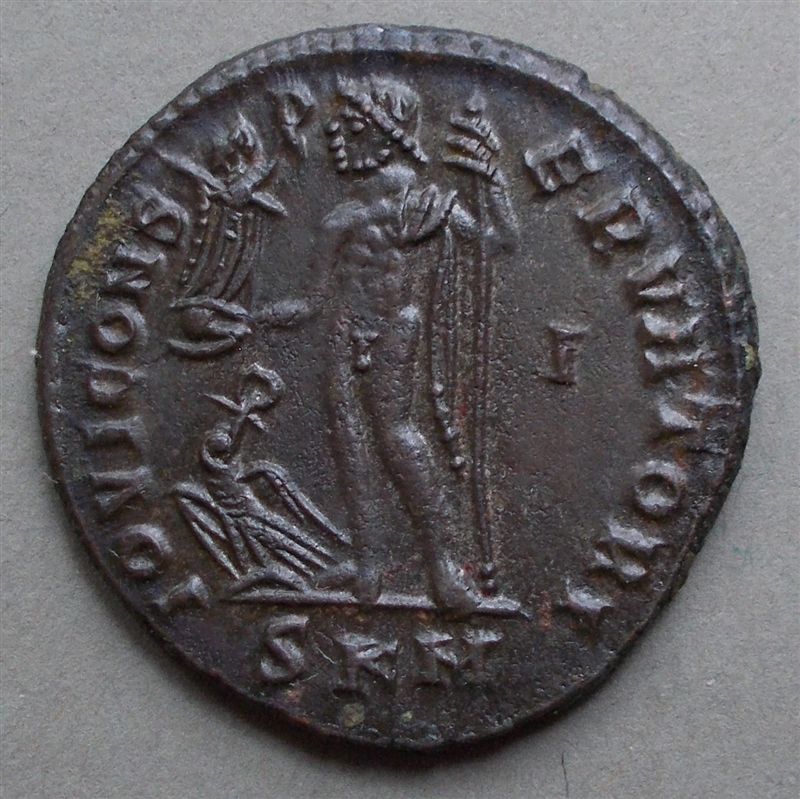 This specimen certainly has unsightly deposits on the obverse, but what appealed to me was the extremely well preserved reverse. I'm somewhat confounded in trying to correctly identifiy it, though. It strongly resembles RIC VII Cyzicus 4 (Sear 15218) but there's a discrepancy in that the mint mark is clearly "SKM" instead of "SMK". Colligo ergo sum
Edited by Lucky Cuss
04/29/2017 6:37 pm
|
|
|
|
Pillar of the Community
United States
7067 Posts |
You know I don't know Romans, but any chance this may be a mule with a Licinius obverse (IMP C VAL LICIN LICINIVS P F AVG) and a Valens reverse (like the following Valens)? 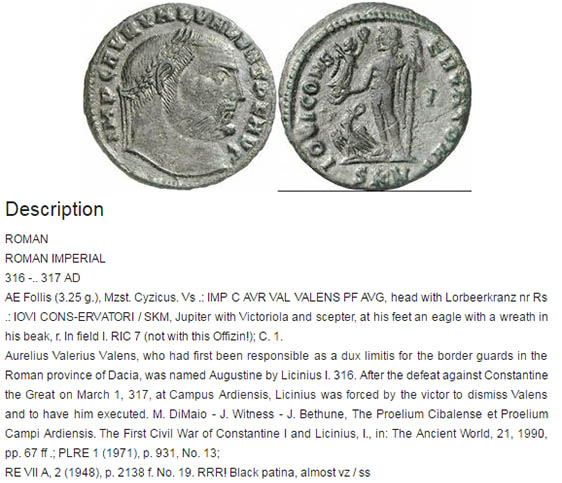 I suspect there's a simpler explanation...I'm out of my element here! Having said that, I really hope I'm right considering the prices I see attached to Valens' issues with this reverse! The top coin below, which according to the description has an "SKM" mintmark and, of course, "I" in the right field "sold at a CNG auction in the early 90's for $45,000 before closing fees." (ERIC) 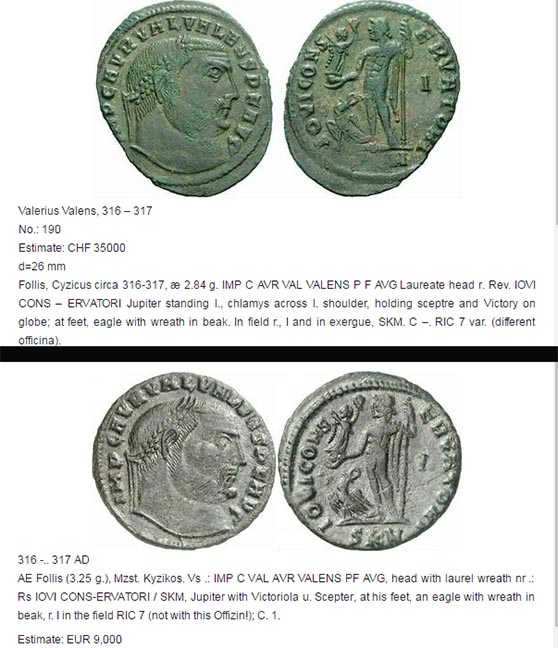 Edited by Kamnaskires
04/28/2017 11:54 pm
|
|
Pillar of the Community
United States
1046 Posts |
Dane's pages list this as RIC 6, Sear 15219
|
|
Pillar of the Community
United States
949 Posts |
Quote:
Dane's pages list this as RIC 6, Sear 15219 That depends upon how you read the mark in the right field. Is it a Roman numeral I (for officina 1) or is it a Greek gamma for officina 3? If it's a gamma, the Licinius coin is RIC VII 4 for Cyzicus. If it's a I, the Licinius coin is RIC VII 6 for Cyzicus. Either way, the coin of Valens Bob wants to compare is RIC VII 7 for Cyzicus (that's from the book version of 1966) Personally, I read it as a gamma => RIC VII 4 from the first group that used Greek numerals in the fields not Roman numerals. As for the metathesis of the M and K, celator gaffs like that could occur any time. Since the coins of Valens are so rare it is possible the mixup helps to determine if a coin belongs to him, but it doesn't work that way in reverse. The same die may have been used for Licinius as a normal order of things. That would only be a mule if the reverse type were not intended for Licinius at all. Edited by lrbguy
04/29/2017 10:59 am
|
|
Pillar of the Community
 United States
4883 Posts |
Quote:
That depends upon how you read the mark in the right field...Personally, I read it as a gamma.... Although not perfectly formed, I also had been proceeding on the presumption it was gamma. Colligo ergo sum
|
|
Pillar of the Community
United States
4883 Posts |
Quote:
As for the metathesis of the M and K, celator gaffs like that could occur any time. This seems to pose another question. If it's in fact a mere transposition (for there certainly doesn't seem to be a mint designated by the sequence "SKM"), then for Roman coinage would it more proper to categorize such as an "error" or an "uncatalogued variation"? Colligo ergo sum
|
|
Moderator
 United States
23731 Posts |
Looking a the mark in the field I believe it's an F.
|
|
Pillar of the Community
United States
949 Posts |
Appearance is one thing, Ron, but it would have to be part of a series. Was there a series at Cyzicus that used an F in the right field and no other field marks?
|
|
Moderator
United States
23731 Posts |
Ellarby, Now that I had the time to check RIC. For that mint mark of SKM there was no field mark F. It sure doesn't look like an I to me. If not and F it resembles the special character MU which is not listed either. It might be a coin that did not make it in to RIC. 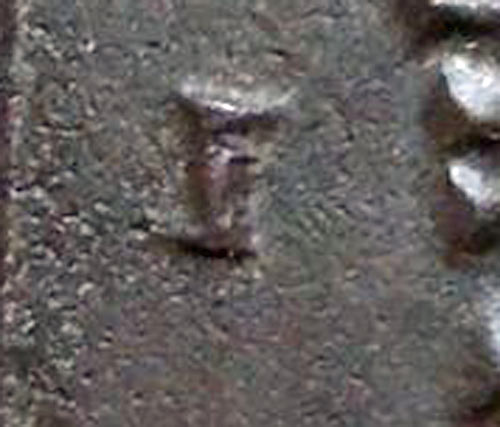 |
|
Pillar of the Community
United States
949 Posts |
Thanks for the closeup. In that pic it looks more like an "I" than a gamma, against my original impression. If by "MU" you are referring to the Greek letter mu, I don't see the resemblance. Greek MU in upper case looks like a letter "M", and in lower case is much more curvilinear than the field mark. Otherwise I don't know what a "special character MU" is or what it looks like. Anyway, call it as you see it.
|
|
Moderator
United States
23731 Posts |
If you look on Dane's page in notes you will see the character I'm referring to.
|
|
Pillar of the Community
United States
4883 Posts |
Quote:
For that mint mark of SKM there was no field mark F. Now I'm confused. Was "SKM" then a legitimate mint mark as opposed to merely a slip-up in rendering the well documented "SMK" mark? Or was this such a common blunder that there're numerous "SKM" types catalogued? Colligo ergo sum
|
|
Moderator
United States
23731 Posts |
The mint mark of SKM was used on this type on RIC VII Cyzicus 5-7. I don't know if it was a mistake or not. The more I look at the enlarged image of the field mark, Ellarby is correct it is an I, it's just an odd looking one.  |
|
Pillar of the Community
United States
4883 Posts |
Here's another I happened to pick up today. 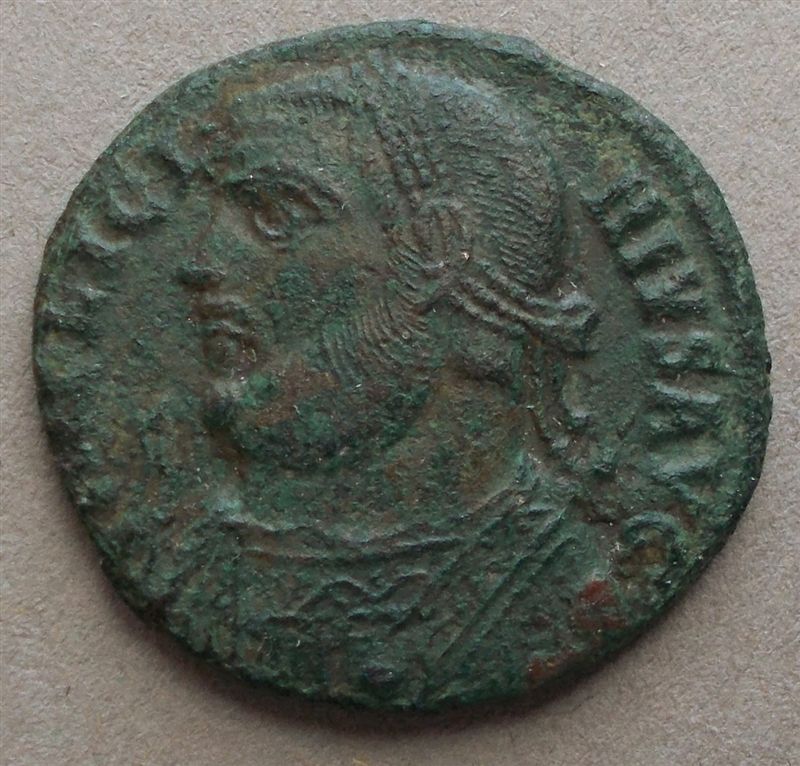 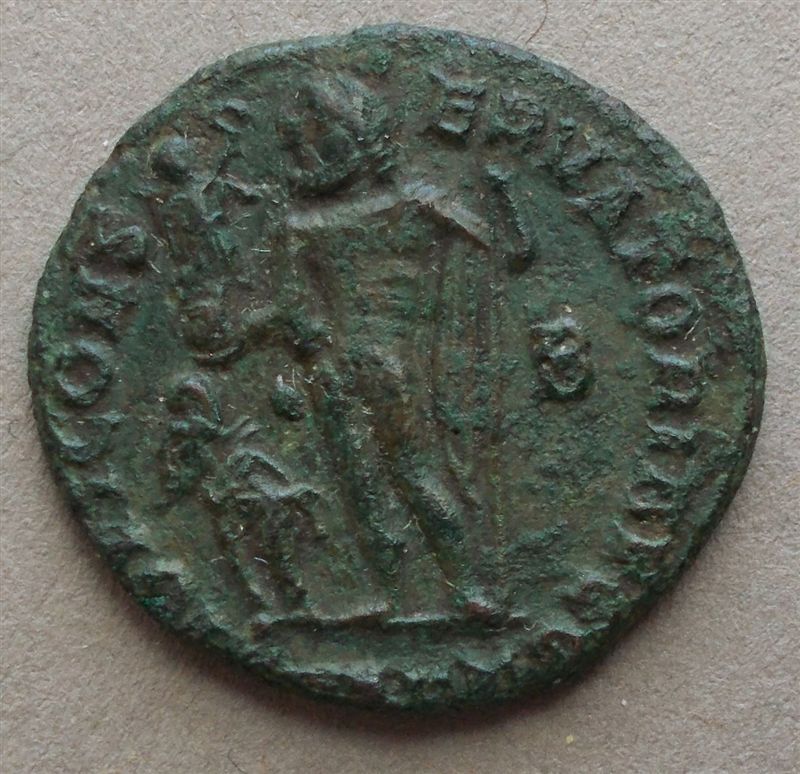 What interested me about this one was the left facing portrait, which, generally speaking, is atypical. If I were a bit more certain regarding the mint mark, my confidence in calling it as RIC VII Antioch 27 (Sear 15239) would be greater. Colligo ergo sum
Edited by Lucky Cuss
05/04/2017 1:19 pm
|
|
Pillar of the Community
United States
949 Posts |
Quote:
The mint mark of SKM was used on this type on RIC VII Cyzicus 5-7. Ron is quite correct about this, and I stand corrected. Bruns does list this series for Licinius and for Constantine and Valens with the SKM mark, and does so without comment. There are not a lot of examples, but enough to suggest that the mark was intentional for use with the Roman numerals in the right field. Normal (Greek) officina letters were not used with this style of mark. |
| |
Replies: 14 / Views: 3,157 |
|







 Posted 04/29/2017 01:00 am





