| Author |
 Replies: 13 / Views: 2,648 Replies: 13 / Views: 2,648 |
|
|
Pillar of the Community
United States
4883 Posts |
Flavius Julius Constantius was perhaps the most ruthless of the sons of Constantine the Great. He came out of the various intriques involving his brothers and cousins as sole emperor (not to mention sole survivor as well). His reign consisted of almost constant campaigns against usurpers and foreign enemies alike until on one such he suddenly took ill and died. 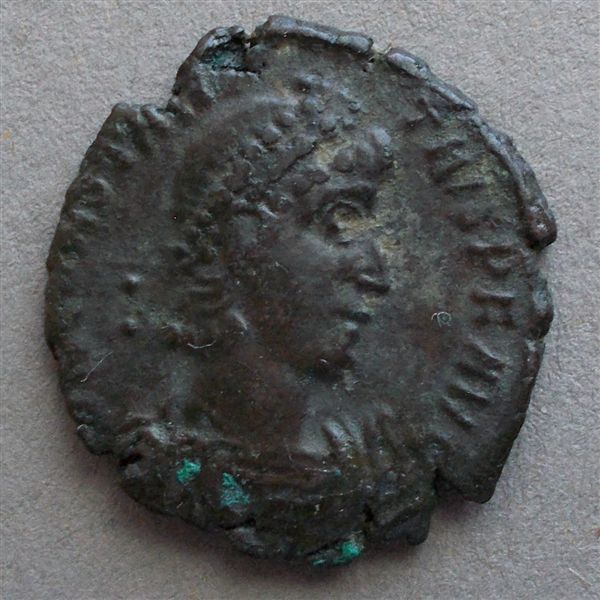 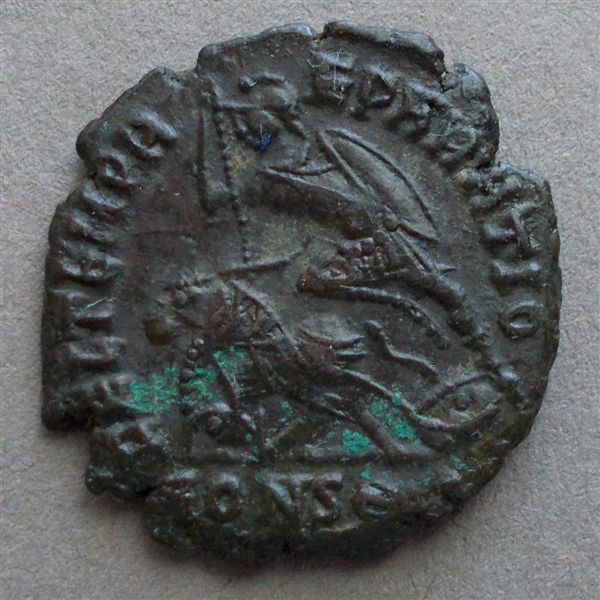 I was attracted to this by the dynamism of the reverse. But I can't quite nail down exactly which one of the type it is. There'a a whole series of these catalogued in RIC VIII, and your choice'd depend on whether you take the last letter of the mint mark to be a "B" or an "E", and also on details like whether the fallen horseman is bearded or helmeted or not, which is awfully hard to tell one way or another. Plus there's supposed to be a gamma in the left field on many of the likely candidates, which I'm not seeing. Colligo ergo sum
|
|
|
|
Pillar of the Community
United States
949 Posts |
The reverse type is FH3 which has the falling horseman turned back (not falling forward) He is still mounted, hence not yet fallen.
It has the R-E reverse inscription break pattern. As I read it, the officina letter is a rather clear "theta." There MAY be a dot (or possibly star-like mark) at the right edge of the exergue.
The key is the diameter of the coin. If it is 17-18mm with a dot it is RIC VIII Constantinople 135.
|
|
Pillar of the Community
 United States
2843 Posts |
picked up one of these yesterday. Looks about the same design (condition is another story, mine is worse off) and I was going to post for IDing thanks for helping me.
|
|
Pillar of the Community
 United States
4883 Posts |
Quote:
The key is the diameter of the coin. If it is 17-18mm with a dot it is RIC VIII Constantinople 135. Well, to me it's certainly not clear to me whether there was ever a dot present. This specimen is obviuosly somewhat irregular in shape. Its diameter varies from 17.0 to 17.7 mm. Colligo ergo sum
|
|
Pillar of the Community
United States
4883 Posts |
Here's a similar bronze that was struck on an undersized flan, so the legends are very incomplete. I think it's another Constantius II although I wouldn't be shocked if it turned out to be an issue of Constans. I haven't yet really pinned this one down, even though you'd think that "S" in the reverse's left field would make identifying it pretty easy. The fallen (falling?) horseman looks to me to be bareheaded, bearded, and reaching back. My main problem is that I'm not finding a good mint mark match, perhaps because I'm misreading it. I think it may be SMHBI, although I'm hard pressed to see how the "SM" portion of that could've been squeezed in, but if that's so, the closest variety I can come up with is RIC VIII Heraclea 88. 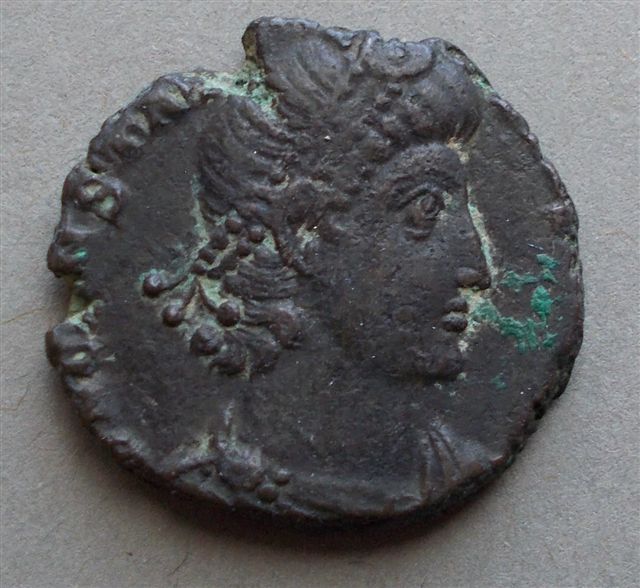 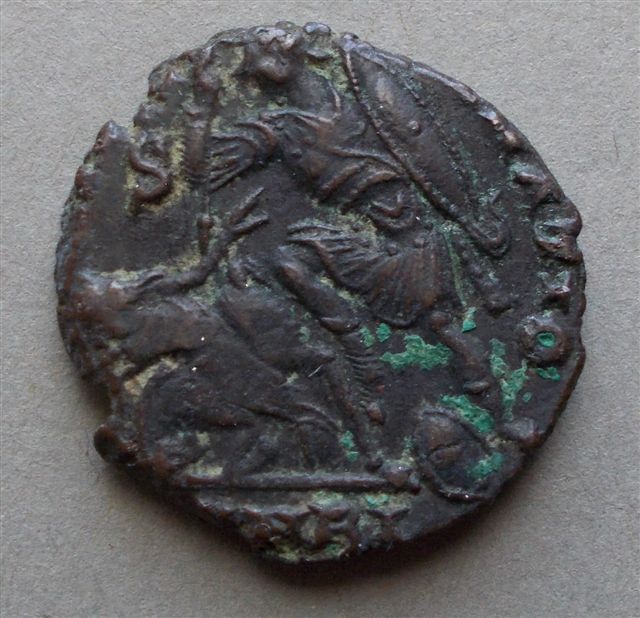 Colligo ergo sum
Edited by Lucky Cuss
05/17/2017 10:36 am
|
|
Pillar of the Community
United States
1046 Posts |
Imho, Constantius II - Antioch RIC 148
Mint mark: ANBI
|
|
Pillar of the Community
United States
4883 Posts |
RIC VIII Antioch 148 is supposed to bear the mint mark ANH, so while I'd have to concede that that's also within the realm of possibility, and probably more likely than my conjecture that it's from Heraclea, I still don't see that it's a definitive mint mark match.
An aside on the coin's design - I do find it an interesting insight into the Roman way of looking at things that you have a reverse legend that essentially translates to, "Happy days are here again!" and that this sentiment is represented by the act of slaying an enemy in battle.
Colligo ergo sum
|
|
Pillar of the Community
United States
1046 Posts |
RIC 148 includes all of the officinae Here's the full list from Dane's pages 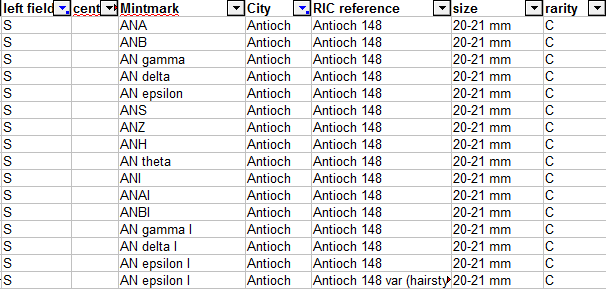 |
|
Pillar of the Community
United States
4883 Posts |
Size remains a concern - this latest specimen also just barely makes 18mm at its widest, overall very similar in size to the first. But I can't argue the point that ANBI does seem to be the most probable mint mark.
Colligo ergo sum
|
|
Pillar of the Community
United Kingdom
2121 Posts |
Given the amount of the coin that is off flan one can assume that the die that was used would be about 21mm in size. The fact that this was struck on a small flan is a manufacturing issue rather than anything else.
|
|
Pillar of the Community
United States
4883 Posts |
Here's yet another within this theme, not dissimilsr in design to the first specimen, and again struck on what seems to be a very undersized flan that measures about 17 mm across. I believe the mint mark to be CONST (Constantinople). The horseman appears to be helmeted and clutching his steed's neck. Again, there'sa whole series of these listed for Constantius II that vary only in the most minor of details. The problem I'm having identifying this one is again the lack of any letter in the field on the reverse. 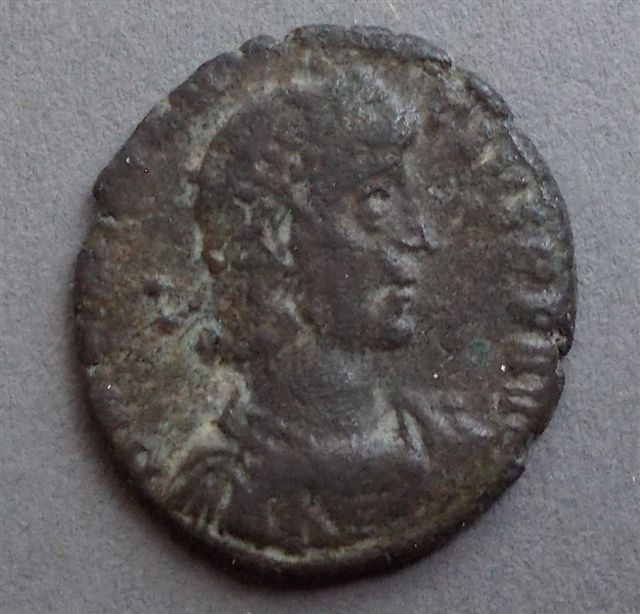 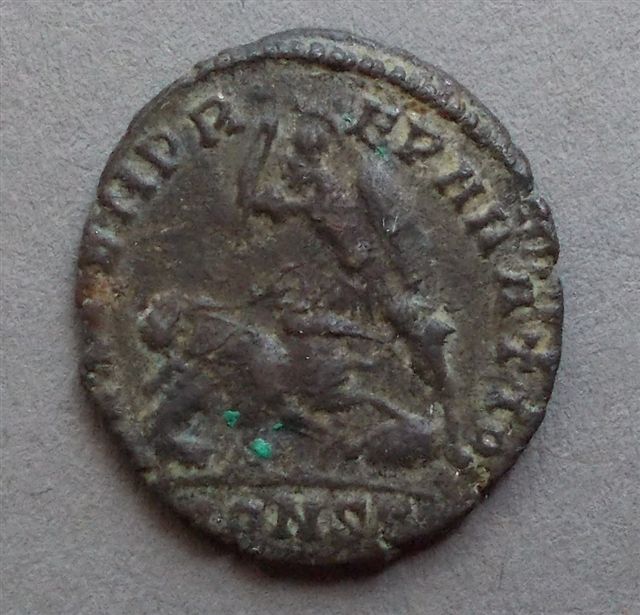 Colligo ergo sum
Edited by Lucky Cuss
05/26/2017 7:26 pm
|
|
Pillar of the Community
United States
1046 Posts |
There is no such mint mark CONST for this series.
Imho, the mint mark is CONSS or CONSSdot. Having no field marks precludes the mint mark from being CONSSstar
That leaves 3 possibilities based on whether the horseman is reaching or clutching
1) RIC 78 = CONSS and clutching
2) RIC 118 = CONSS and reaching
3) RIC 135 = CONSSdot and reaching
To me it looks like the horseman's arm is reaching back
Edited by Biancasdad
05/26/2017 10:41 pm
|
|
Pillar of the Community
United States
4883 Posts |
Quote:
Imho, the mint mark is CONSS or CONSSdot. Quote:
To me it looks like the horseman's arm is reaching back I've given this some extra scrutiny this evening under high magnification and using the best lamp I have, and I've come to the conclusion that you're right on both counts. I don't see a dot, but such could've been just off the flan in this instance. Colligo ergo sum
|
|
Pillar of the Community
United States
1046 Posts |
Sounds good LC
With so many varieties it's hard to find other examples for comparison. If I find any I'll post them.
|
| |
Replies: 13 / Views: 2,648 |
|






 Posted 05/04/2017 11:41 am





