










 Posted 05/14/2017 3:49 pm


Perhaps those are indeed American price ranges but they are by far inflated. I've got a bunch of these and although the are old and have a neat centre hole, they are still quite common in junk lots - and that's kind of what they are.
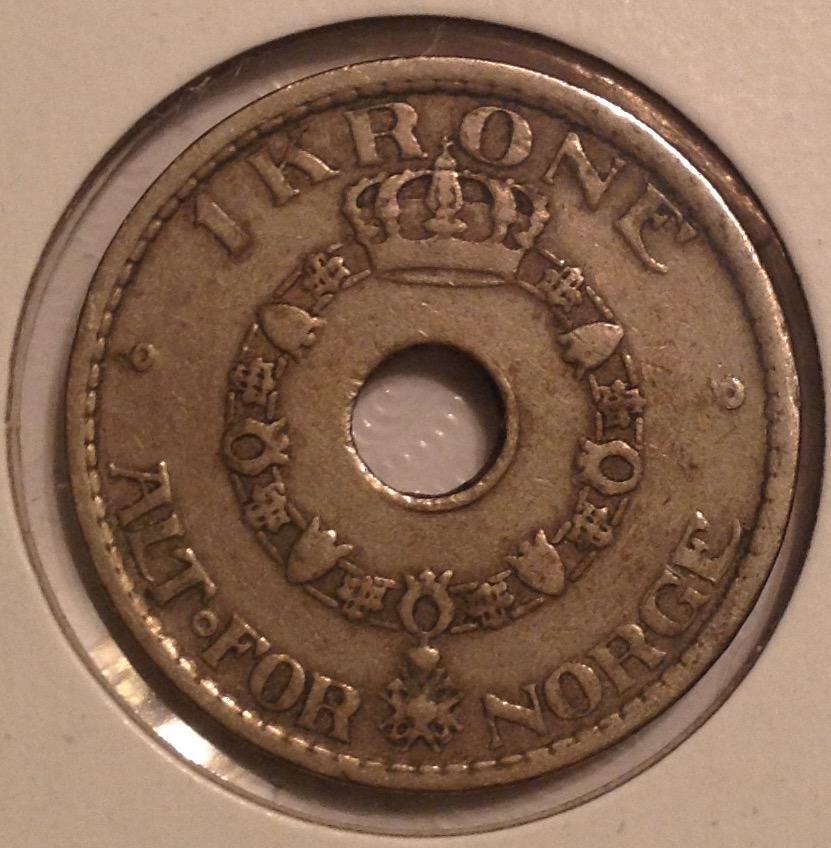
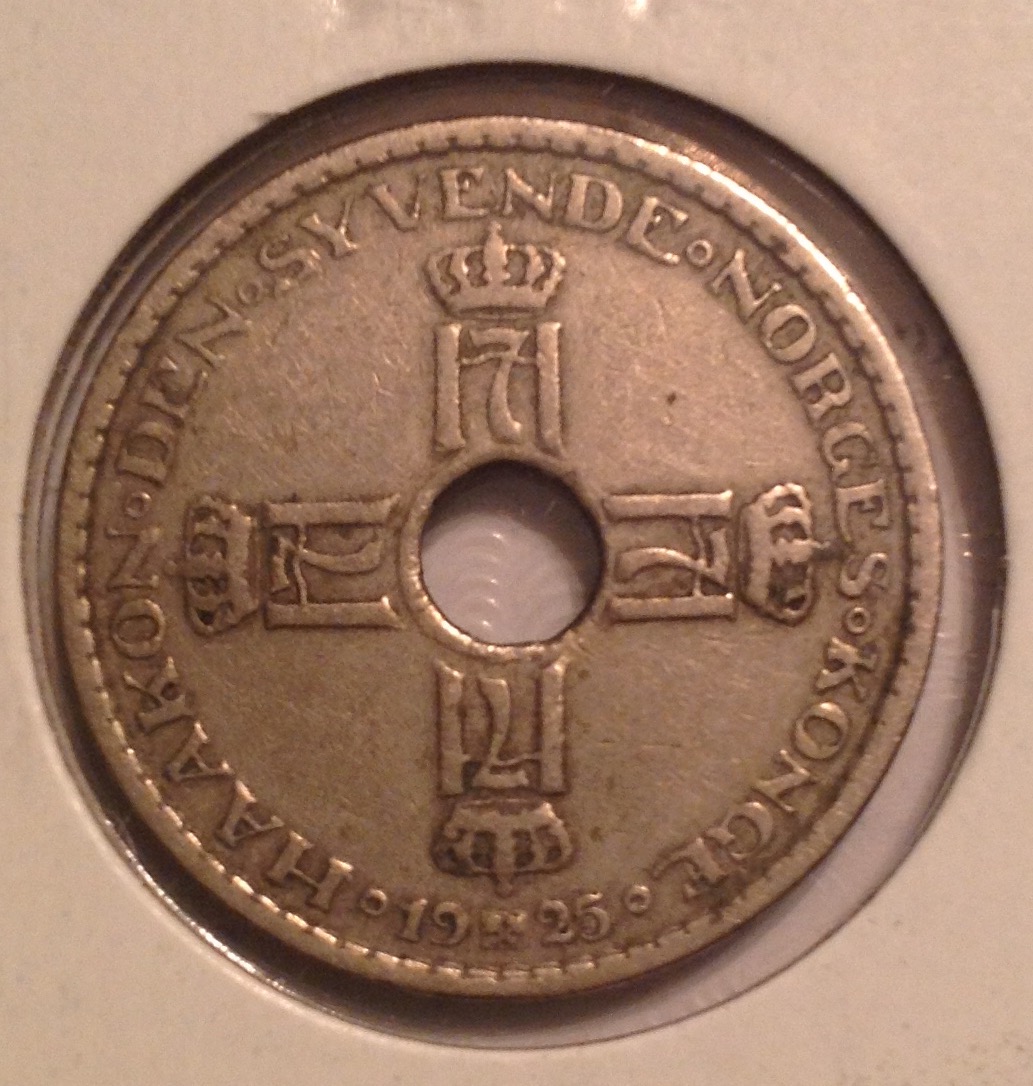
Norway was very early on to abolish silver around 1920 as a result of the first world war which greatly affected silver prices and made many countries use less or no silver at all. Like many countries starting in the 19th century bu carrying on into the early 20th century, centre holes were used to signalize that the coin was not silver despite having the same colour. Norway did just this to their 10-, 25- and 50-Øre coins, along with the 1-Krone coin. Since they suddenly did not have any precious metals, they were more cheap to make and not only wore less, but they lasted longer in circulation. This coin series was minted now and then up until the 1950's, when a non-holed version of this coin entered circulation. I'm not entirely sure if this coin lasted that long, but this size of 1-Krone coins were phased out in the late 1990's, and I think these were legal tender up until then. I'll probably stand corrected on that point.
I'd like to compare these coins to Swiss 5-, 10-, and 20-Rappen coins, in the fact that the same design can easily get old and exciting when looking through coin lots with these, but they have to get very old to be worth something noteworthy, i.e. 1870's and 1880', and still remain in decent condition. Although this coin type does not reach that far back, the principle is the same, unless it's in very good condition (lustre would be appreciated), then it would probably be worth a tad more than common junk bin item. Age doesn't play any significant money factor in lower conditions.
When it get to Norwegian coinage it gets sort of tricky - here in Sweden, this series doesn't see much of a premium (commonly circulated condition) when being sold, but the earlier copper-nickel and silver coin series get a lot more attention, somehow. A good rule of thumb I have when looking online for Norwegian coins is that anything from 1923 or back and face value is 10 Øre or more, then it's not common junk bin items, and a single coin, despite their tiny sizes, can easily fetch the equivalent of $6 or more in common, circulated condition. The older they get from there, the more money want for them. But sadly, most coins from 1924 and onwards are still very common and not very sought after.
Hope this helps or was interesting to read!
Norway was very early on to abolish silver around 1920 as a result of the first world war which greatly affected silver prices and made many countries use less or no silver at all. Like many countries starting in the 19th century bu carrying on into the early 20th century, centre holes were used to signalize that the coin was not silver despite having the same colour. Norway did just this to their 10-, 25- and 50-Øre coins, along with the 1-Krone coin. Since they suddenly did not have any precious metals, they were more cheap to make and not only wore less, but they lasted longer in circulation. This coin series was minted now and then up until the 1950's, when a non-holed version of this coin entered circulation. I'm not entirely sure if this coin lasted that long, but this size of 1-Krone coins were phased out in the late 1990's, and I think these were legal tender up until then. I'll probably stand corrected on that point.
I'd like to compare these coins to Swiss 5-, 10-, and 20-Rappen coins, in the fact that the same design can easily get old and exciting when looking through coin lots with these, but they have to get very old to be worth something noteworthy, i.e. 1870's and 1880', and still remain in decent condition. Although this coin type does not reach that far back, the principle is the same, unless it's in very good condition (lustre would be appreciated), then it would probably be worth a tad more than common junk bin item. Age doesn't play any significant money factor in lower conditions.
When it get to Norwegian coinage it gets sort of tricky - here in Sweden, this series doesn't see much of a premium (commonly circulated condition) when being sold, but the earlier copper-nickel and silver coin series get a lot more attention, somehow. A good rule of thumb I have when looking online for Norwegian coins is that anything from 1923 or back and face value is 10 Øre or more, then it's not common junk bin items, and a single coin, despite their tiny sizes, can easily fetch the equivalent of $6 or more in common, circulated condition. The older they get from there, the more money want for them. But sadly, most coins from 1924 and onwards are still very common and not very sought after.
Hope this helps or was interesting to read!


