| Author |
 Replies: 10 / Views: 2,126 Replies: 10 / Views: 2,126 |
|
|
Valued Member
United States
297 Posts |
|
|
|
|
Pillar of the Community
United States
7737 Posts |
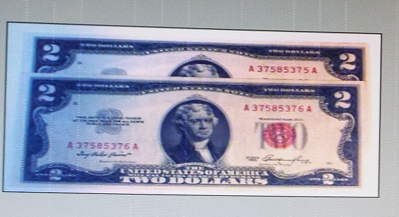
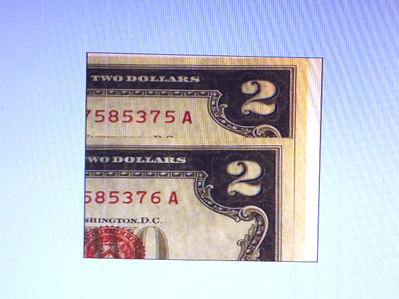
Size difference is most likely due to differences in environmental storage conditions. Light, humidity and temperature can affect paper.
|
|
Bedrock of the Community
United States
94367 Posts |
 This is quite an extraordinary comparison for sure. |
|
Valued Member
 United States
297 Posts |
While I agree storage conditions, paper, humidity, etc. , can affect paper, I remember that these have always been kept together, and again are consecutive. Thanks again for the help, though.
|
|
Pillar of the Community
United States
7737 Posts |
Even though they are consecutive and they were stored together, one of the notes was exposed to a greater degree to the elements than the other note.
When they came off the printing press I can assure you that they were of the same dimensions.
|
|
Pillar of the Community
United States
1610 Posts |
How do the two compare with another denomination, or several denominations? Which is the "true" size?
The only parts that need to be the same size are the printed (engraved) fields. If you have them laid out like that, trying to get one edge continuous with the other, make sure that the same amount of ink is showing above. It looks like the bottom bill lines are not exactly perpendicular/parallel. Measure with a mm rule.
Edited by Biedercoins
05/17/2017 07:05 am
|
|
Pillar of the Community
United States
747 Posts |
Your notes are Series 1953, not Series 1963.
The reason for the different sizes is paper shrinkage. This Series was printed using the wet printing process. The sheets were dampened prior to printing. The drying process results in paper shrinkage. Differences in the amount of water used, drying time, drying heat, etc. lead to different rates of paper shrinkage.
The change to dry printing began with Series 1963. The BEP printed dry and wet printed notes at the same time with wet printed notes keeping the old series (1953C for $2.00 US Notes) and dry printed notes getting the new series (1963). This is why the signatures are the same on these different series.
|
|
Valued Member
United States
297 Posts |
At first I thought it must be shrinkage, too, but having just found the bills, I took a careful look. They are part of a run of 13 consecutive bills, from A37585367 to A37585380. The oddball is the #375 number. It is longer than all the other bills, even though it is in the middle of the pack. In each of other packs of 1953, 1953-A, 1953 B, and 1953-C I found at least one bill that is longer than all the others. One is even longer than the one you see. I was going to post more pictures, but the rules prohibit editing after one day. It looks like it will remain a mystery. Thanks for trying to help.
|
|
Valued Member
United States
297 Posts |
By the way, a measure of the serial number of each bill with a mm scale produced a difference of one centimeter, with the larger bill having the longer size serial number.
|
|
Pillar of the Community
United States
747 Posts |
Are the position letter and number the same for the larger ones?
|
|
Valued Member
United States
297 Posts |
Everything is the same, with the exception of a slightly longer serial number. If you like I can start a new topic and show you pictures .
|
| |
Replies: 10 / Views: 2,126 |
|






 Posted 05/16/2017 8:22 pm





