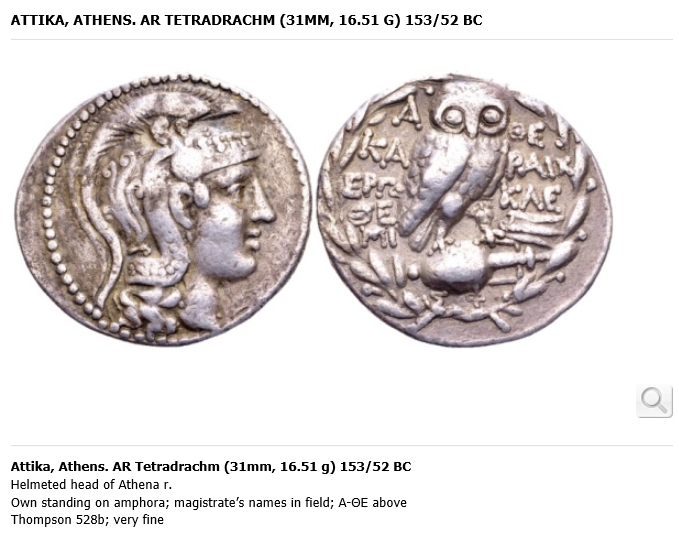
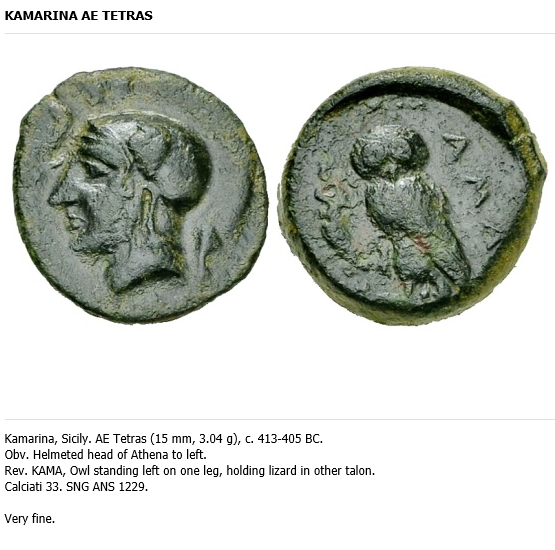
I am down to my last two owls in my collection as I trim it back bit by bit.
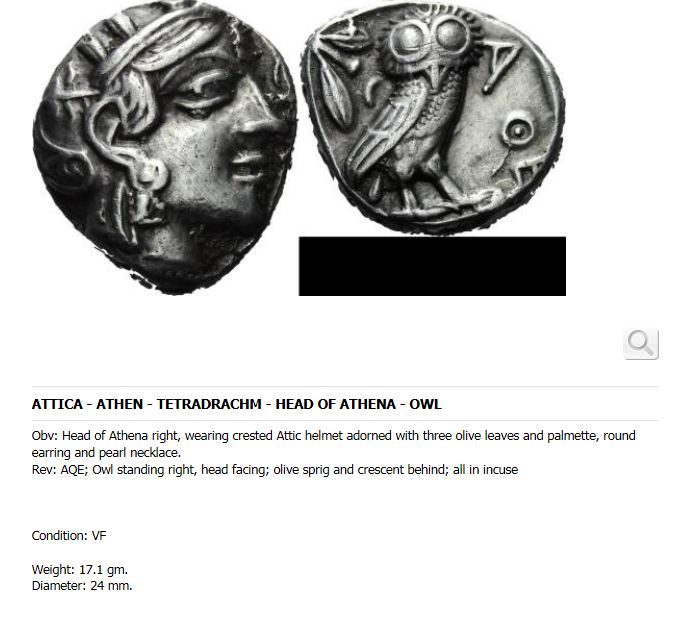
Athens, AR Tetradrachm, ca 393 - 370 BC
Obv:- Head of Athena right with eye seen in true profile, wearing crested helmet ornamented with three olive leaves and floral scroll
Rev:- owl standing right, head facing, to right ATE in large lettering, to left olive sprig and crescent
Minted in Athens c. B.C. 393 - 370.
Reference:- Flamen p. 126, 1 (Pi I); Svoronos Athens plate 19, 17; SNG Cop -
Ex-Forum Ancient Coins
16.699g, 24.31mm, 270o
The following information was provide by the dealer with the coin:-
"Transitional style tetradrachms include all of the wide spectrum of variants with the eye in profile issued after the classic "old style" almond eye tetradrachms but before the broad thinner flan "new style" tetradrachms. Recent research has classified variations of the transitional style - Pi Type, Quadridigite Style, Heterogeneous Style and sub-groups of the styles, and proposed chronologies for the different styles and groups.
This coin is the earliest transitional type, the first Pi style type, essentially identical to the "old style" with the exception of the eye in profile. The "Pi" designation is based on the P shape of the floral spiral and palmette ornamentation on the helmet bowl. The coin can be classified as Pi style, group 1. The floral ornament on examples this early do not yet resemble Pi."

Egypt, Athens Imitative, Silver tetradrachm
Obv:- Head of Athena right, droopy eye, crested helmet with olive leaves and bent-back palmette, wire necklace, round earring, hair in parallel curves.
Rev:- Alpha;Theta;Epsilon;, right, owl standing right, head facing, erect in posture, olive sprig and crescent left, all within incuse square;
Minted in Egypt from . B.C. 420 - 380.
Reference:- cf. SNG Cop 31 ff., SGCV I 2526 (Athens),
Ex- Forum Ancient Coins where they graded it VF. The metal did not fill the die completely on the obverse resulting in the rough flat high area near Athena's temple. A test cut on the reverse was filled with pitch in antiquity.
The silver is quite bright making it relatively tricky to photograph.
From the Harald Ulrik Sverdrup Collection. Ex CNG. From a small hoard of 5 Athenian and 4 Athenian imitative issues.
Comment provided by dealer -
"Athenian tetradrachms with this droopy eye and bent back palmette have been identified as Egyptian imitative issues because they are most frequently found in Egypt and rarely in Greece.
Early in his reign the Egyptian Pharaoh Hakor, who ruled from 393 to 380 B.C., revolted against his overlord, the Persian King Artaxerxes. In 390 B.C. Hakor joined a tripartite alliance with Athens and King Evagoras of Cyprus. Persian attacks on Egypt in 385 and 383 were repulsed by Egyptian soldiers and Greek mercenaries under the command of the Athenian general Chabrias. Perhaps these coins were struck to pay the general and his Greek mercenaries."
17.157g, 25.3mm, 270o





 First Page


 Posted 05/20/2017 2:53 pm