|
This page may contain links that result in small commissions to keep this free site up and running.

Welcome Guest! Registering and/or logging in will remove the anchor (bottom) ads. It's Free!
To participate in the forum you must log in or register. | Author |
 Replies: 9 / Views: 3,484 Replies: 9 / Views: 3,484 |
|
|
Pillar of the Community
United States
949 Posts |
Because of the extreme paucity of Imperial silver in the name of Tranquillina I can only give you a link for an antoninianus that sold within the last two weeks prior to this writing: https://www.sixbid.com/browse.html?...&lot=2918227 br / However, by means of Provincial coinage I can here provide her portrait in silver with a drachm from Caesaria in Cappadocia: Draped bust right; CABINV TRANKVLLIANE (read SABINU TRANQUILLIANE)
Mt. Argaeus; pellet to upper right, MHTRO KAIC B N ? // ET E; (date = Regnal Year 5) in exergue.
(E=epsilon) 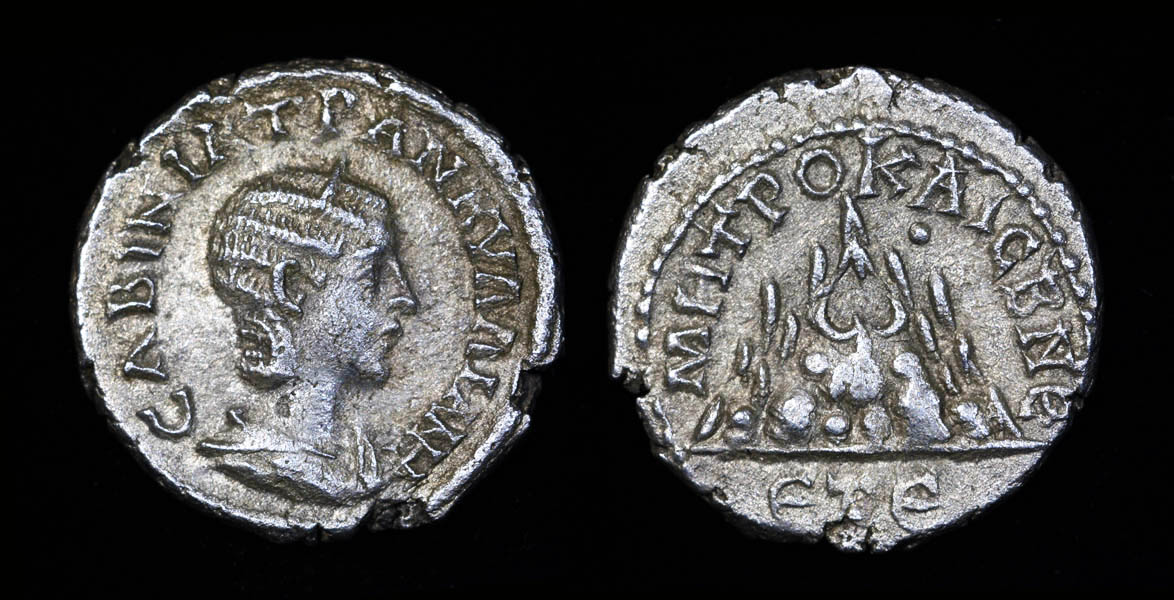 Furia Sabinia Tranquillina (c. 225 - aft. 244) was the Empress of Rome and wife of Emperor Gordian III. She was the young daughter of the Praetorian Prefect Gaius Furius Sabinius Aquila Timesitheus, the man who was appointed the head of the Praetorian Guard by the Roman Emperor Gordian III in 241. In May that year, Tranquillina had married Gordian. She became a Roman Empress and received the honorific title of Augusta. Her marriage to Gordian was an acknowledgement by the young emperor of Tranquillina's suitability as an empress as well as Timesitheus' political indispensability. To have arranged his own high appointment and the marriage of his daughter to the emperor, we may be sure Timesitheus held sway over the timid boy-emperor. Celebrations were probably brief as Gordian, Timesitheus and Tranquillina soon marched east at the head of an army to answer the invasion of Roman Syria by the Persian king Shapur. Under the guidance of Timesitheus the Persians were contained and the lands they had pillaged restored. Had this able captain not fallen ill and died in the winter of 243, Gordian would have fared very well in the Imperial order. However, the gap in military leadership was filled by the elevation of Philip the Arab, deputy to Timesitheus, who had ambitions that did not leave room for an Imperial regent on the throne. In February of 244 Gordian III, and his third wife, Tranquillina, met their ends. Although coins for this issuer were putatively issued from 241 until 244, the Imperial coins of Tranquillina are inexplicably rare. They include the full range of denominations then being struck for her husband in silver and bronze, lacking only gold coins or medallions. Though Tranquillinas series shows every sign of being the first output of a substantial coinage, it must have ceased after the initial issue. It remains a mystery why Tranquillinas coinage ended as soon as it began, for Timesitheus remained praetorian prefect until his death two years later, and Gordian remained married to Tranquillina for the remaining three years of his own life. Fortunately the Roman Provincial coinage that includes her image, particularly in combination with Gordian III, is quite plentiful and therefore readily accessible to the collector of modest means. I have a little over 25 examples in my collection alone, so you know they are cheap. Here are a couple of nice Provincial bronzes to round out the picture: AE28 Markianopolis Pentassarion
Gordian III and Tranquillina face to face; AVTKMANT GORDIANOC AVG E(t) TRANKVA/LLINA
Athena in Athenian(?) helmet, stg l holding spear vertically in left hand, and with right hand holds her shield at feet .
VP TERTVLLIANON MARKIA[NAPOLI]TWN
E in left field (denomination)
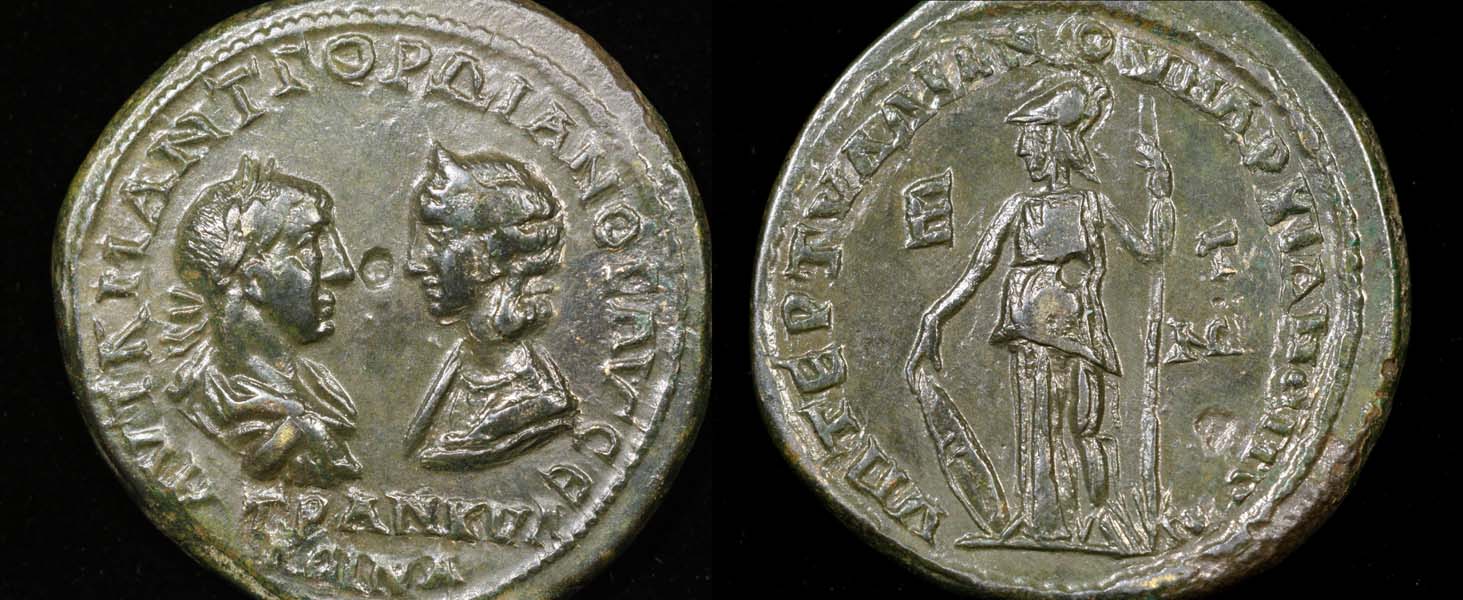 The figure in the obverse inscription of her cognomen (at the end of its first line) is probably not intended to be an "A" but it looks like one to me. More likely it is an uncial "I." AE25 Anchialos
Gordian III and Tranquillina face to face, [...]ANT GORDIANO KAI CEB TRANKVL/ LINA
Diana with bow in l hand and patera in outstreched r hand. Stag l at feet.
OVLPIANWN AGXIALEIN (=Anchialos)
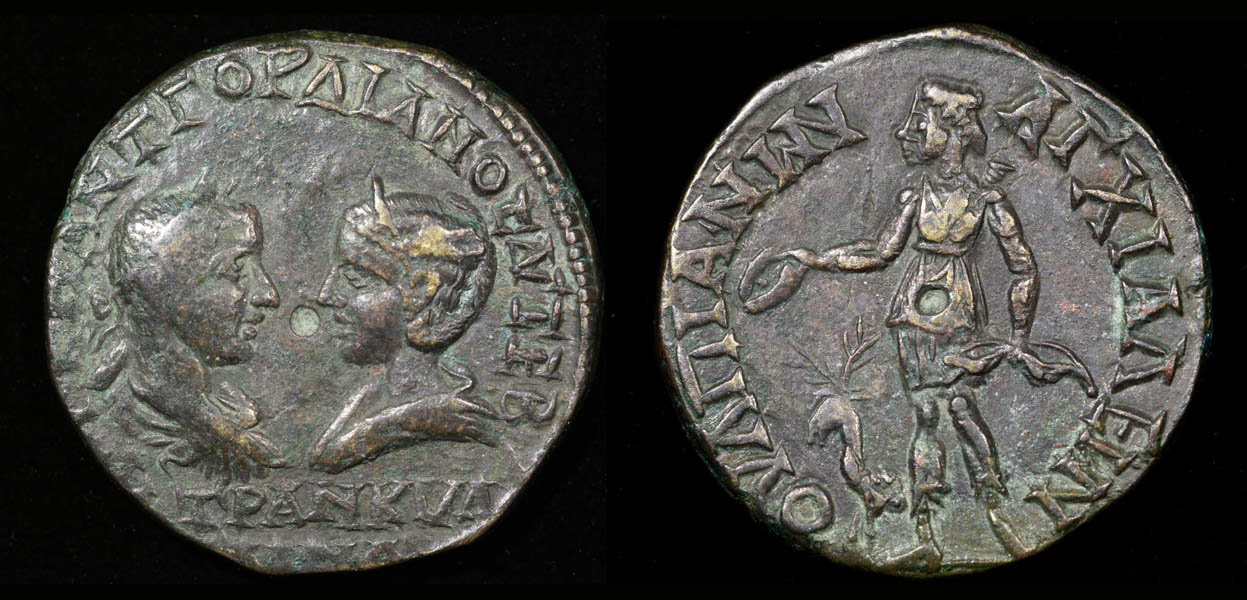 I'm not sure about the denomination for this coin, but it is not as large as the typical Pentassarion. It could be a Tetrassarion. Edited by lrbguy
06/06/2017 2:10 pm
|
|
|
|
Pillar of the Community
United States
7067 Posts |
Excellent coins, information, and photography. Well done. Thanks for sharing! Remarkable reverse on that last one...great detail.
|
|
Moderator
 United States
34542 Posts |
@irbguy, thanks for sharing--that was excellent! With regard to that potentially uncial letter I, could it just be an engraving error? The other letter Is in the inscription don't have the extra stroke on them. Just a thought...
"If you climb a good tree, you get a push."
-----Ghanaian proverb
"The danger we all now face is distinguishing between what is authentic and what is performed."
-----King Adz
|
|
Pillar of the Community
 United States
949 Posts |
Not many interested in this empress, I guess. Gordian III wasn't very high profile.
Thanks for looking, guys.
|
|
Pillar of the Community
United States
616 Posts |
Um, Caesaria is in Israel. Is there another one in Cappodocia?
|
|
Pillar of the Community
 Spain
2752 Posts |
Well I'm interested.  Super write up and lovely coins lrb. It amazes me how the celators managed to get that much detail on the heads of the emperor and empress.  What signifigance is the pellet? As I've noticed the same pellet on Gordian III coins aswell. Thanks for sharing, Saludos Paul Quote:
Um, Caesaria is in Israel. Is there another one in Cappodocia? Caesarea, originally Mazaca, the capital of Cappadocia; renamed Eusebeia from ca 150 BC to 17 AD; modern Kayseri in central Turkey. |
|
Pillar of the Community
United States
616 Posts |
Quote:
Caesarea, originally Mazaca, the capital of Cappadocia; renamed Eusebeia from ca 150 BC to 17 AD I learned something this morning.  Thanks! |
|
Pillar of the Community
United States
949 Posts |
Quote:
What signifigance is the pellet? Good catch, Paul. I don't think the pellet has any significance as far as the scene is concerned, but whether or not it appears, and where, can vary. For these drachms, when the mint mark is ET Delta, the pellet appears on the left side of the mountain as we look at the scene. But it may not appear at all for either delta or epsilon. Based on later parallels, I think we may say that the pellet appears to act as a series mark (on/off) and as a graphic connection to the officinae (left/right) at the mint where coins like this were produced (here in Caesarea). I have not looked at it enough to see what is done for other officinae, if they minted these drachms at all. We know that the Imperial mint system made increasingly frequent use of mint letters and marks from just after the time of Gordian climaxing with the House of Valentinian in the 4th century. They served various purposes, all, I think, having to do with mint recognition and accountability of one kind or other. But these markers are important to watch over the long haul. |
|
Valued Member
Hong Kong
54 Posts |
Here is an example I just got Mesembria, Gordian III and Tranquillina, Demeter reverse Æ 27mm/12.9gm Con/ VF+; glossy dark green patina, strike crack @ 7 o'clock Obv/ AYT K M ANT ΓOPΔIANOC AYΓ CEB / TPANKYΛ[ΛINA]; Laureate, draped and cuirassed bust of Gordian III, on the left, facing draped bust of Tranquillina, on the right. Rev/ MECAMBPIANΩN; Demeter standing front, head to left, holding grain ear in her right hand and scepter with her left hand. Ref/ Varbanov 4188 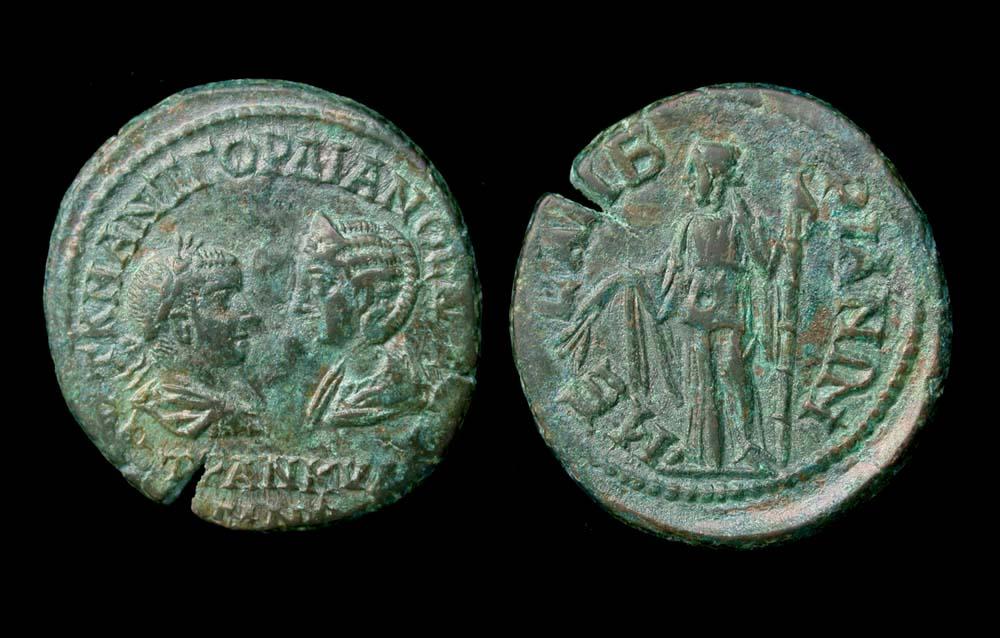 |
|
Pillar of the Community
Spain
2752 Posts |
Super coin! Lovely green patina...and a great representation of the two portraits, especially Gordian..
The centralising dot (if thats the correct expression?) is very well hidden on the obverse, as quite often I´ve seen it destroy one or other of the portraits, and on the reverse gives Demeter a discreet belly button...Very nice!
Thanks for sharing Paul
Edited by Palouche
09/02/2018 10:45 am
|
| |
Replies: 9 / Views: 3,484 |
|
To participate in the forum you must log in or register.
Disclaimer: While a tremendous amount of effort goes into ensuring the accuracy of the information contained in this site, Coin Community assumes no liability for errors. Copyright 2005 - 2026 Coin Community Family- all rights reserved worldwide. Use of any images or content on this website without prior written permission of Coin Community or the original lender is strictly prohibited.
Contact Us | Advertise Here | Privacy Policy / Terms of Use
|
| Coin Community Forum |
© 2005 - 2026 Coin Community Forums |
| It took 0.37 seconds to rattle this change. |
 |
|
| |
| |







 Posted 06/06/2017 8:51 pm


