Marcia Otacilia Severa or Otacilia Severa was the Empress of Rome and wife of Emperor Marcus Julius Philippus, "Philip the Arab," who reigned over the Roman Empire from 244 to 249. She was a member of the ancient gens Otacilia, of consular and senatorial rank. Her mother was related to the gens Marcia. Her father was Otacilius Severus (Severianus), who served for a time as Roman Governor of Moesia and Pannoneia.

In 234, Severa married Marcus Julius Philippus, a member of the Praetorian guard under Severus Alexander who became deputy to the Prefect Timesitheus under Gordian III and succeeded him. She bore him three children from 237-247, the eldest of which was Marcus Iulius Severus Philippus (Philippus II). Upon the death of Timesitheus in winter 243, the affections of the military leadership shifted to Philip who was championed as successor to the man who had been chief counselor to Gordian III. With a son of his own, Philip was not inclined to support a regency for Gordian, and in February of 244 the emperor Gordianus perished in Mesopotamia in uncertain circumstances.
Ancient sources suspected that he was murdered, implicating Severa in the conspiracy, but nothing substantive has come of that speculation. Philip became the new emperor and immediately arranged a fitting funeral for his predecessor, after which his ashes were returned to Rome for burial. Thus exonerated in the eyes of the Senate, they unhesitatingly affirmed his claims to the purple. Once affirmed, Philip gave Severa the honorific title of Augusta and had their son made heir to the throne as Ceasar.
The Constantinian panegyrist, Eusebius, claimed that Philip and Severa must have been the first imperial Christian household, inasmuch as they had provided safeguards and assistance for various Bishops of their time. However, inasmuch as fair treatment in contrast to persecution might seem like communion in an environment of widespread prejudice, there is no evidence that Philip acted any more preferentially toward Christian complainants than did his predecessors. The actions of Philip's successor, Trajan Decius, mandating Christian persecution, no doubt seemed like normalcy to Christians not long after the Edict of Toleration. In that context, Philip might well seem more than sympathetic to the causes of Christians when he did not hold them accountable for actions which were later held liable for punishment. Be all that as it may, without more determinative evidence of Christian practice and preference, the matter cannot be resolved and the claim cannot be sustained for any member of the royal household.
In the year 248 Philip and his wife led the empire in the celebration of the 1000th anniversary of the founding of Rome, lavishing a multitude of benevolences and benefices upon the people, and extolling the hope that the imperial family would be long standing. However, late in 248 certain instabilities in parts of the imperial military guard began to manifest themselves with the rise of alternate claimants to the imperial throne. In the space of a few months, three usurpers Silbannicus, Iotapian and Pacatian, arose from different parts of the military ranks, and challenged the rule of Philip. While the suppression of these insurgents was achieved, the strength of his reign was compromised. Were it not for the interventions of the city prefect of Rome, Trajan Decius, Philip would surely have retreated into a cocoon of self pity. Even at that, his military campaign at Verona cost him his life and that of his son. Philip died in battle near Verona and Decius became the sole emperor. Severa was in Rome at that time and when the news of her husband's death arrived, their son was murdered by the Praetorian Guard still in her arms. The historians leave us no notes as to whether Philip's wife was also lost or merely widowed, but thereafter Otacilia Severa does not appear in the pages of history.
COINSAs antoniniani the silver coinage for Otacilia Severa is plentiful, but it is very rare as denarii or quinarii, these latter appearing with only 3 reverses from Rome and one from Antioch.
One of the principal series editors for the
RIC, Edward Sydenham, died only a matter of a few months prior to the publication of volume IV in 1949. As a result a third editor was brought in for the final stage. The Introduction has the almost unmistakable hand of Harold Mattingly on it, but the final stages of the catalog listings were handled by Humphrey Sutherland or Robert Carson (or both) who tend to arrange things differently.
In particular, the introduction divides the coins of Philip I into eight issues from 244-248 A.D., the last being just at the time of the death of Philip, father and son. However, the catalog listings follow a different paradigm, first listing coins which are dated. Then the coins are grouped by the three types of obverse legend, followed by the listings of the reverse types and their style variations. In the catalog listing the RIC numbers are assigned according to the latter arrangement, but the coins do not all follow one another chronologically.
For this display we will follow the development of the coins chronologically by issue, but provide the RIC numbers as identifiers of each variation shown. First we will identify the number and date of each of the eight issues, following the gradual sequence of obverse inscriptions, and then for each issue we will show the reverse types with which they were identified. All the coins shown are in my collection although the most recent acquisitions use seller photos since the coins have not yet arrived.
Issue 1 - 244 A.D.
.........none for Otacilia Severa
Issue 2 - 245 A.D. (Long obverse legend:
MARCIA OTACIL SEVERA AVG)
.........
PVDICITIA AVG RIC 123c
.........This was the definitive type for this issue.
.........

.........
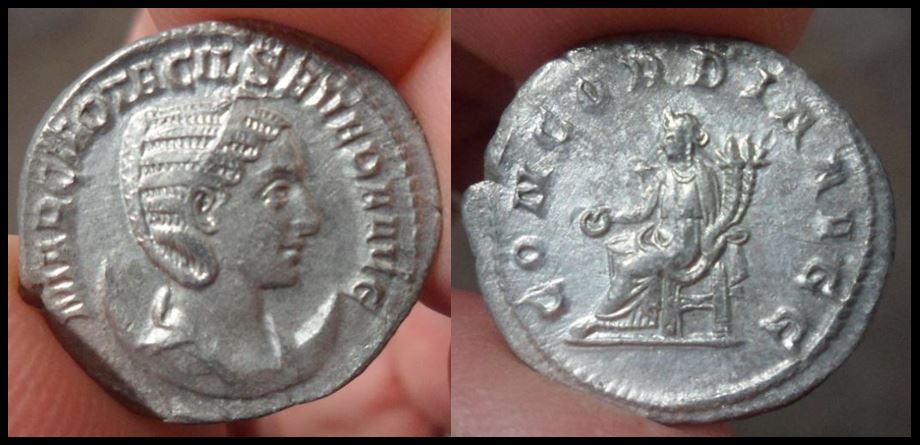
CONCORDIA AVGG (double cornucopia - two horns as one)
RIC 119b
.........(no photo, but see next)
..................This type is common for the full run of issues, but is rarely encountered with the first obverse legend.
Issue 3 - 245-247 A.D. (2nd obverse legend:
M. OTACIL SEVERA AVG) (actually used 246-248)
.........
CONCORDIA AVGG (double cornucopia - two horns as one)
RIC 125c
..................same type treatment as above but with second obverse legend.
.........

.........
CONCORDIA AVGG (altar left, single cornucopia)
RIC 126
..................The "altar" appears as an extension of the throne beyond the knee of the seated figure.
.........

.........
IVNO CONSERVAT RIC 127*
..................In the
RIC Introduction (Mattingly) this type is attributed as the first issue for her from the mint at Antioch. However, the main catalog (Sutherland/Carson) lists it for both Rome and Antioch on the ground that some doubt exists(which means editors disagree). So let us take note as follows:
.........

.........Here I show two examples (above and below this text) in which the hair style of the first has more in common with the other examples from Rome than does that of the second. The overall manner of execution of the second (hair, crescent, expression, reverse figure) is not typical of Rome, but the jury is still out until more examples can be compared.
.........

Issue 4 - 247 (short obverse legend:
OTACIL SEVERA AVG)
.........
CONCORDIA AVGG (altar, and single cornucopia)
RIC129
..................(continues issue 3 second type reverse, but uses a shorter obverse legend)

Issue 5 - 248A.D.
.........
SAECVLARES AVGG RIC 116b
..................(hippopotamus // IIII)
..................The Saeculares were the decennial (=Secular) games which were ever a stimulus to public solidarity and commerce. However, for this year the games were understood to mark the 1000th anniversary of Rome itself, so the series was particularly extensive for the coinage of Philip, featuring animal themes (from the menagerie assembled by Gordian III). The hippo was used for the coins of Otacilia Severa only.
.........

..................This is a sorry wreck of an example but it will show what we need here. The hippo has any of three postures on these. This one with head up, one for head down, and one for head on level with the back.
The exergual marks are counters for the number of the officina producing a coin type. The coins of issue 5 for Severa were all produced at officina 4, and bear the Roman numeral IIII.
Issue 6 - 248A.D.
.........
PIETAS AVGG -
delta (Greek mint mark)
..................Pietas stg left raising r. hand, holding box of perfume in left. To her left, an altar.
.........This was a smaller issue also in year 248. These too are numbered for officina, but in Greek numerals. The coins of Severa in this issue all bear a field mark Greek numeral on the reverse left side. The coins of issue 6 for Severa were all produced at officina 4, and bear the Greek numeral
delta.
.........

..................The reverse type is Pietas stg left raising r. hand and holding box of perfume in the left. To her left stands an altar. In the upper example the altar is unlit, but in the next example there is a flame on the altar.
.........

Issue 7 & 8 - 248 (perhaps to 249)
.........
PIETAS AVGVSTAE ..................Extolling the piety of the entire imperial household seems to be a fitting end to their coinage.
.........





 Posted 06/19/2017 5:56 pm





 .
.

 . I've got the same Sesterius of hers


