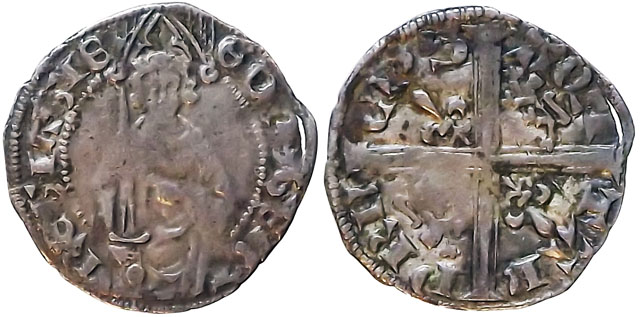
Just bought this scarce coin of Edward the Black Prince of Wales for my historical figures collection.
It fits in with the Shakespeare theme I am working on. The king of France in Henry V refers to "that black name, Edward, Black Prince of Wales"
Below is an excerpt from wikipedia on the reason for the word 'black' is his title.
"Although Edward is often referred to as the "Black Prince", there is no record of this name being used during his lifetime, nor for more than 150 years after his death. He was instead known as Edward of Woodstock (after his place of birth), or by one of his titles. The "Black Prince" sobriquet is first found in writing in two manuscript notes made by the antiquary John Leland in the 1530s or early 1540s: in one, Leland refers in English to "the blake prince"; in the other, he refers in Latin to "Edwardi Principis cog: Nigri" (i.e., "Edward the Prince, cognomen: The Black").[17] The name's earliest known appearance in print is in Richard Grafton's Chronicle at Large (1569): Grafton uses it on three occasions, saying that "some writers name him the black prince", and (elsewhere) that he was "commonly called the black Prince".[18] It is used by Shakespeare, in his plays Richard II (written c.1595) and Henry V (c.1599). It later appears prominently in the title of Joshua Barnes's The History of that Most Victorious Monarch, Edward IIId, King of England and France, and Lord of Ireland, and First Founder of the Most Noble Order of the Garter: Being a Full and Exact Account Of the Life and Death of the said King: Together with That of his Most Renowned Son, Edward, Prince of Wales and of Aquitain, Sirnamed the Black-Prince (1688).
The origins of the name are uncertain, though many theories have been proposed. These fall under two main heads:
that it is derived from Edward's black shield, and/or his black armour.
that it is derived from Edward's brutal reputation, particularly towards the French in Aquitaine.
The black field of his "shield for peace" is well documented (see Arms above). However, there is no sound evidence that Edward ever wore black armour, although John Harvey (without citing a source) refers to "some rather shadowy evidence that he was described in French as clad at the battle of Crecy ' en armure noire en fer bruni ' - in black armour of burnished steel".[19] Richard Barber suggests that the name's origins may have lain in pageantry, in that a tradition may have grown up in the 15th century of representing the prince in black armour. He points out that several chronicles refer to him as Edward the Fourth (the title he would have taken as King had he outlived his father): this name would obviously have become confusing when the actual Edward IV succeeded in 1461, and this may have been the period when an alternative had to be found.[20]
Edward's brutality in France is also well documented, and this may be where the title had its origins. The French soldier Philippe de Mezières refers to Edward as the greatest of the "black boars" - those aggressors who had done so much to disrupt relations within Christendom.[21] Other French writers made similar associations, and Peter Hoskins reports that an oral tradition of L'Homme Noir, who had passed by with an army, survived in southern France until recent years.[22]In Shakespeare's Henry V, a reference by the King of France to "that black name, Edward, Black Prince of Wales" suggests that the playwright may have interpreted the name in this way. There remains, however, considerable doubt over how the name might have crossed from France to England. In 1642, Thomas Fuller commented that the Black Prince was "so called from his dreaded acts and not from his complexion".[23]
Recently however, his name being associated to any misdeeds or brutality have been in doubt by several historians. The greatest stain on Edward's dark reputation was the 1370 sack of Limoges, in which chronicler Jean Froissart describes "It was a most melancholy business - for all ranks, ages and sexes cast themselves on their knees before the prince, begging for mercy; but he was so inflamed with passion and revenge that he listened to none, but all were put to the sword. Upwards of 3,000 men, women and children were put to death that day."[9] However a more contemporary document written by Edward himself was recently discovered in a Spanish archive. The letter was written to the Count of Foix and describes how, during the invasion of Limoges, the Black Prince took "200 knights and men-at-arms prisoner". A local contemporary source from an abbey at Limoges documented "300 fatalities total in the city." There is no mention of a massacre of 3,000 people or more.[9] It is possible Froissart greatly exaggerated the events that gave the Black Prince his name, but also possible that Edward did not produce a truthful account of the campaign.
In France Edward is seen as a villainous invader who ruled the occupied territories with an iron fist. The 1963-66 French television series theirry la Frondedramatized the era, following the exploits of a young disenfranchised lord who fights gallantly against the Black Prince and English occupation.["
Anglo-Gallic. Aquitaine: Edward the Black Prince. 1362-72.
Hardi d'argent of Poiters
(.96g).
Half-length figure of the Prince/Long cross divides legend. Elias 205b. aVF, natural split on reverse.
Ex S. George Tucker, sold by Owl (the late John Barton) 10/81, #154$150+
Ex: William Rosenblum Coins Auction 47A - June 29, 2017 Lot 105







 Posted 07/16/2017 8:14 pm





