Hello All!
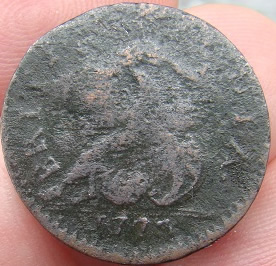
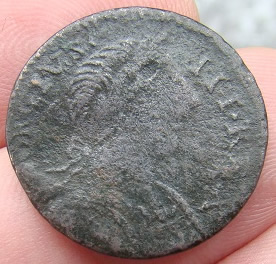
I was coming across the auction website cng coins and I stumbled on a coin that was a farthing from UK but imitative used in colonial uk. It was a very rare piece. Afterwards I looked at my coin and I saw it was not an normal UK farthing. The head looked different aswell as the reverse. I know there are lokal imitations known of this type but I was wondering if this one could be used in the USA?
Here copied paste the iformation on cNGCoins website:
UNITED STATES, Colonial & Related. New York issues. CU Halfpenny (26mm, 92.0 grains/5.96 g, 5h). Mould-Atlee "Tory Copper". Uncertain mint, possibly in America. Dated 1777. GEORGIV[S ·] III · REX ·, laureate and armored bust of George III right / [B]RITA[N] NIA ·, Britannia seated left on globe, holding laurel branch and transverse scepter; Union shield to right; 1777 below double exergual line. Breen 1009 (same dies) = Vlack 10-77A = B. K. Weston, "Evasion Hybrids: The Missing Link," in The Colonial Newsletter, August 1999, p. 1952, fig. 7; Stack's (15 January 2008), lot 5758 (same dies); Whitman W-8125 corr. (incorrect photo). VF for issue, gray-brown surfaces, some roughness. Extremely rare. The best of only five known examples.
A series popular and well studied within the realm of United States numismatics, the 'evasion' issues from America's colonial period provide an interesting glimpse into a fledgling nation's early history. At this time, certain areas in the colonies experienced a shortage in the supply of coppers, which provided manufacturers such as those in Birmingham with a profitable business enterprise. However, in an attempt to quell this spurious activity, an anti-counterfeiting law was passed in Great Britain which severely punished this practice. Not to be hindered by this act, the 'smashers' of these coppers discovered and exploited a loophole, whereby small coinage of the current British types (Halfpennies and Farthings) were produced with imitative non-regal legends, such as 'GEORGIUS III ROX' for 'GEORGIUS III REX' on the obverse, and 'BONNY GIRL' for 'BRITANNIA' on the reverse. Alternatively, as halfpennies and farthings were not produced each year at this time, counterfeits could be issued bearing a date not used by the regal series. In either event, these issues could not technically be considered counterfeits, as they weren't imitating actual coins, but were in fact fantasy issues that appeared as equivalents to the regal issues, without any concern or regard over their status.
These pieces, however, are not entirely of British origin, as some were produced in the colonies by strikers such as James F. Atlee, Walter Mould, Ephraim Brasher, and John Bailey, and struck at such clandestine American mints in New York City and Machin's Mills, near Newburgh. The above type has been the subject of much debate regarding its true origin and manufacture, as Robert A. Vlack's photographic plates of Colonial coins, "18th Century Counterfeit Halfpence Made In America," include it as 10-77A, and Walter Breen listed that, despite its uncertain provenance, it is generally '.conceded to be American.' However, more recent research by Byron K. Weston in numerous articles and commentary in 'The Colonial Newsletter,' suggests that this type may not in fact be of American origin after all, as the style cannot be clearly linked to colonial manufacturers. In any event, its status as an icon within the colonial series has long-since been established, as was evident in Stack's Americana sale in 2008, the last time this type was sold at auction. The condition of that specimen, well-worn and fair, holed, and struck with a die shift on the obverse, brought a winning of over $2,700, including the buyer's fee. The present example, however, presents a unique opportunity for the specialist to acquire what is undoubtedly the most attractive and well-preserved specimen available.







 Posted 07/24/2017 09:29 am





