Here's a last minute entry from my collection!
You might expect criminals to try to pull one over on you, but what about your country's official mint?
Roman Empire
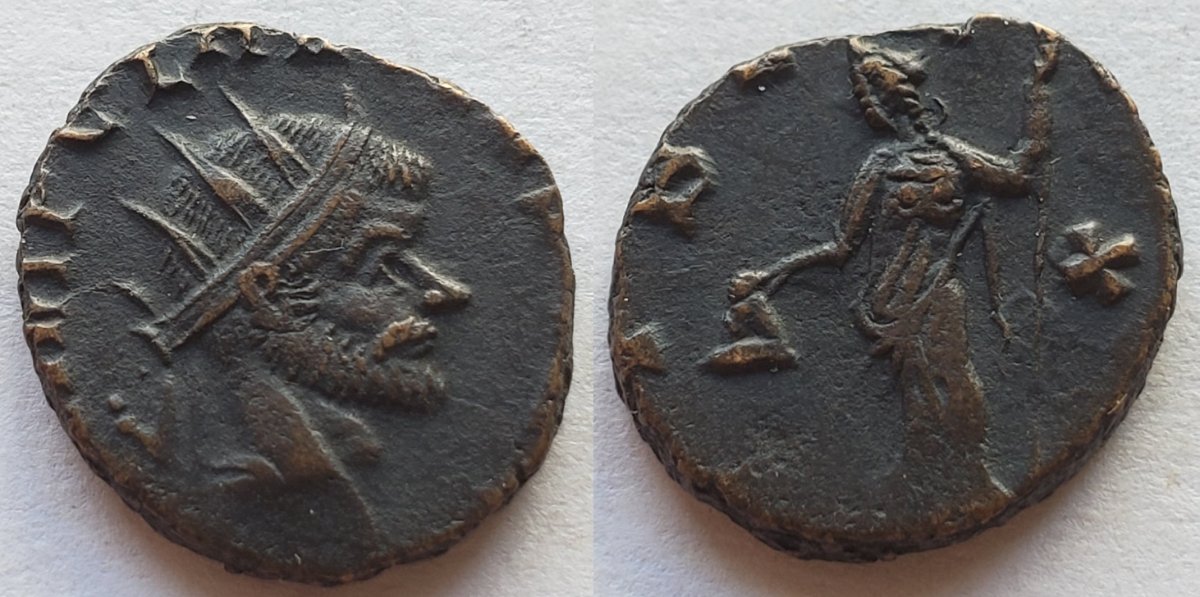
Claudius II Gothicus, 268-270 AD
"Billon" double denarius
Struck during or after the "mint worker's revolt", ca. 270-271
Obv: Radiate head of Claudius II right, legend mostly off flan (probably IMP C CLAVDIVS AVG)
Rev: LIBERT AVG. Liberty standing left holding freedman's cap
Rome mint, 10th officina
The double denarius, or Antoninianus, was first introduced in 215 AD by emperor Caracalla, (Marcus Aurelius Antoninus Pius Augustus, hence "Antoninianus") with the specific intent of inflating the currency supply - the new coins were larger and more impressive than the dime sized denarius, but did not have twice the silver content. These were not popular coins, and were infrequently issued until about 240 AD when they suddenly overtook denarius production, and runaway inflation made every smaller denomination obsolete. By 260, the antoninianus was the only circulating coin, and had been reduced from about a 6g coin of ~50% fineness to a 3g coin of less than 5% fineness.
Despite the abysmal shape of Rome's economy, she was still consuming many tons of silver to provide that scant semblance of "silver" (the coins were soaked in acid prior to striking, giving them the appearance of silver when first issued).
During the reigns of Claudius II and Aurelian, the mint was managed by a man named Felicissimus, who either ordered, encouraged, or allowed the mint workers to steal silver and produce inferior coins which would still circulate under the "full faith and credit" of the Roman Empire's economy. Claudius II did not have time to address the issue as he turned the tide of the wars against the barbarian hordes, but died of plague during his campaign. Aurelian, known for his blunt personality and no-nonsense attitude, turned his full wrath toward the situation in late 270 or early 271. Felicissimus led a desperate rebellion, using his stolen finances to scramble an army of soldiers whose loyalty he could buy, gladiators, and probably armed private citizens. The "mint revolt" saw Felicissimus executed for his crimes, and the rebellion was brutally put down - more than 7,000 or Aurelian's professional soldiers were killed in the fighting, and probably many more of the rebels. As punishment, the mint at Rome was shut down for about two years, then never allowed to dominate Roman coin production ever again.
It has been postulated that some of the survivors of the rebellion fled from Rome and put their skills to make an illegal mint to continue to churn out their inferior coins for profit.
Back to this coin - the portrait immediately reveals that it was not engraved by the portrait engraver of the Rome mint (It has been postulated that the most skilled artisans engraved the portraits for the dies, and those of lesser skill engraved the legends and reverse figures). But, unlike the cartoonish "barbarous radiate" antoninianii made in blacksmiths' shops across the empire, the figure on the reverse is almost indistinguishable from the official Rome mint coins at the time. The X officina behind Libertas also identifies it as a product of the Rome mint. Therefore, this coin was either the product of a Rome mint employee making illegal coins from pilfered metal, but without access to the official Claudius II bust (which would have been locked when not under supervised use), or else it was engraved by a runaway former Rome mint employee in his illegal workshop.
For comparison, an official Rome mint coin of the type:
http://www.wildwinds.com/coins/ric/...RIC_0062.jpg(Sorry, hotlinking not allowed from Wildwinds)





 First Page
 Previous Page


 Posted 10/15/2019 8:34 pm