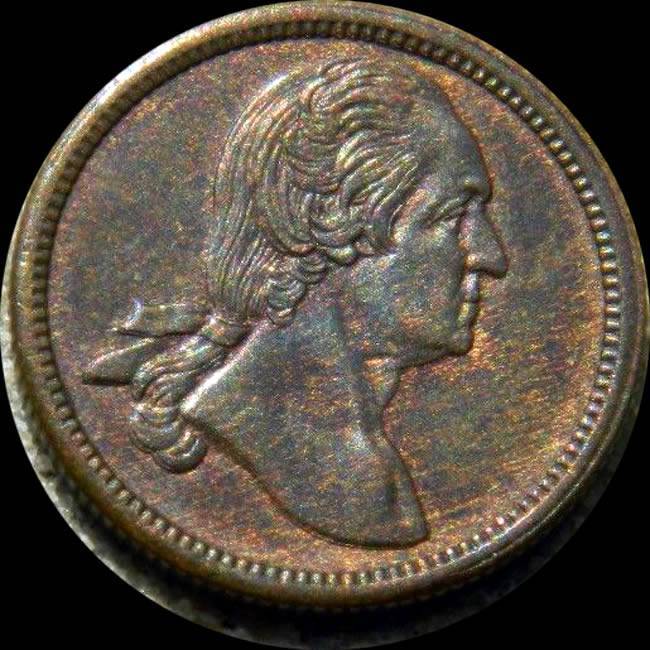
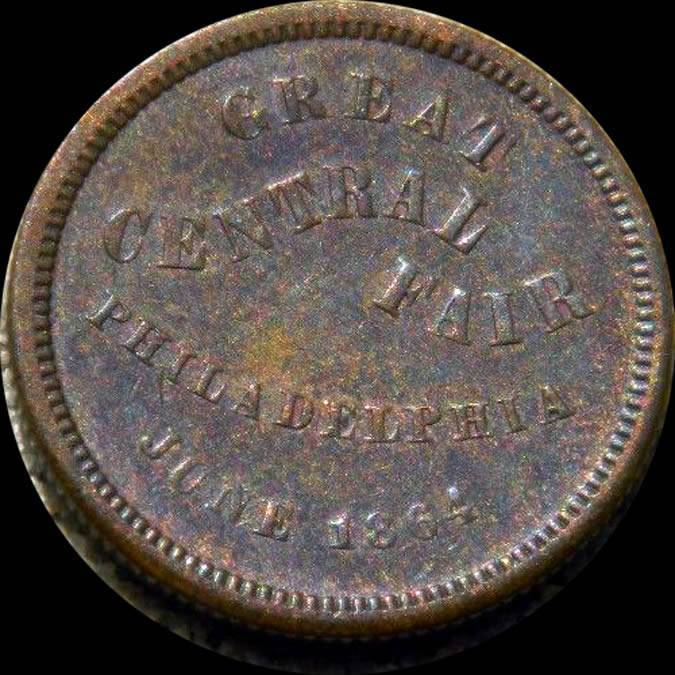
Going to throw this one out here that I picked up last night and hope it's okay to do so, although I understand if it has to be moved. This token looks Unc to me and I love the obverse appearance especially!
This is a token struck in June, 1864 for the Philadelphia Sanitary Fair, or the "Great Central Fair", held in Logan Square. There are lots of interesting articles about this fair, and the numismatic aspects, available with a quick Google search.
To summarize, the Philadelphia Mint brought in a coin press, along with blank bronze planchets that would have been destined for the new bronze 1864
Indian Head cents, and silver planchets as well to strike silver tokens.
The Sanitary Fair itself provided opportunities for wounded and sick Union soldiers to receive medical care from civilian volunteers, and also raised funds to help relieve the burden on the Sanitary Commission.
The dies, featuring a bust of George Washington on the obverse, and the fair's name on the reverse, were engraved by Anthony Paquet (yes, the one from the "small eagle" pattern
Flying Eagle cent and the much more famous 1861-S $20 Double Eagle.)
Two features served to distinguish the bronze strikes from regular 1864 bronze
Indian Head cents: first, and foremost, the edge was reeded; second, the diameter was reduced to 18mm, about the size of a dime. These two changes apparently helped ensure that the coins would not easily pass into circulation as cents.
According to an article written by the ANS, these tokens sold for 10 cents (bronze) and 50 cents (silver.) Paquet also engraved a full-size medallic issue using different dies.
Using the 2017 Bureau of Labor Statistics data, a 10 cent purchase in 1864 would now cost you around $1.49; the 50 cent silver token would be a "steeper" $7.45.
Considering the profit that would be realized, then and now, the Sanitary Commission probably made out pretty nicely on the deal.
Here is the token. It is listed by Fuld as PA 750L-1a, a common R-1. The silver issue (Fuld PA 750L-1f) is rated an R-5; and Fuld also lists a gold-plated or gilt issue (PA 750L-1k) as an R-8, which probably explains why I've never seen one. However, even the R-5 silver issues are available without too much searching.
Thanks for taking the time to look at this interesting piece of American history. Your comments, and thoughts on a grade, are appreciated.







 Posted 10/01/2017 12:22 am





