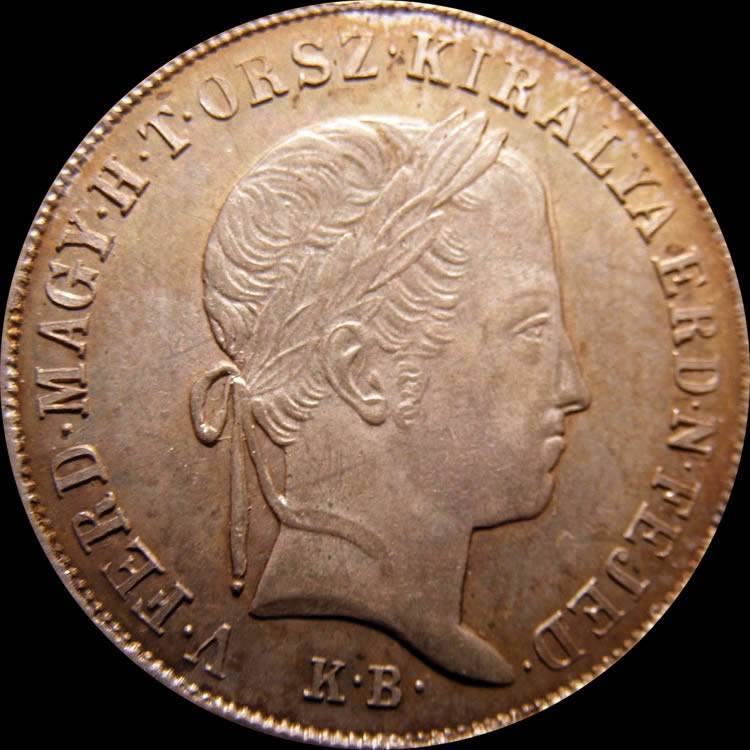
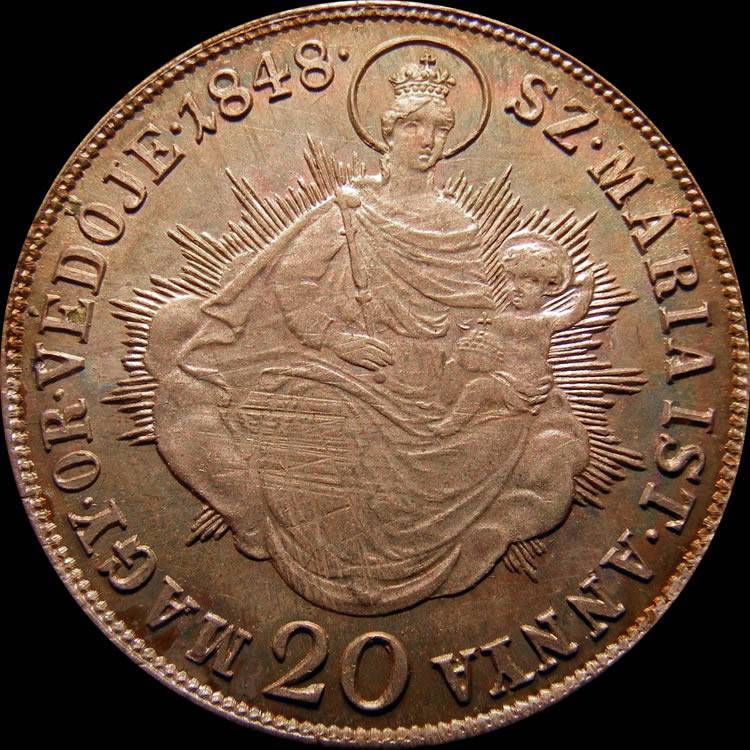
This is a very neat silver 20 Krajczár (Kreuzer) coin minted in Körmöcbánya (Kremnitz/Kremnica) with a lot of history attached to it. It has very heavy gold toning with some iridescence on the reverse, and looks AU to me. The reverse test marks are present as usual, but they do not affect the grade. Passing at 3 to the gulden, it is about 26.5mm in diameter, sized between a US quarter & a US half dollar.
Ferdinand V (Emperor Ferdinand I of Austria) is on the obverse; the reverse features the Madonna and child motif, shared with other Hungarian issues, along with some Bavarian issues such as the 20 Kreuzer & "Madonna" Thaler. The reverse legend on this coin is different from the pre-war 20 kreuzer/krajczar issues, and the obverse on the pre-war coins names the regent as Ferdinand I instead of Ferdinand V as seen on this example.
Some of these coins were actually hollowed out and used as "spy coins" to carry small paper dispatches and messages during the war, similar to box dollars.
The story behind the coin:
In 1848 Hungary declared its independence from Austria and the Habsburg Dynasty; a relatively short (1.5 year) but violent and bloody revolutionary war soon followed.
In the early stages of the conflict, Austria was suffering a series of defeats; a few months in, the situation was looking somewhat dire for the Austrians. A change in the fortunes of war resulted in Austria regaining some of its lost initiative, but the telling blow to Hungarian dreams of independence came when Czar Nicholas I of Russia pledged 30,000 men to the Austrian cause, which already numbered 60,000 in strength. In addition, the Slovaks, Serbs, and others (who rightly felt that Hungary was attempting to impose its culture upon them) joined up with the Austrians, looking to win favor and greater autonomy after the foreseen Austrian victory. Only the Poles ultimately sided with the Hungarians, and they were unable/unwilling to contribute enough militarily to swing the odds back into Hungary's favor.
Forced to fight a war on two fronts, outnumbered, the Hungarians negotiated a surrender with the Russian Army in 1849, expecting that the Russians would show leniency. None was granted; the Russian Army commander (a German fighting for the Russians, von Rüdiger) instead turned the remaining revolutionary soldiers over to the Austrian forces.
Retribution was swift and brutal, with thousands of Hungarian men, women, and soldiers killed in mass executions ordered by the Austrian General von Haynau. Hungarians suspected of participating in or supporting "insurrection" were subject to torture and deprivation, if not immediate execution, and their lands and property were forfeit. Able-bodied Hungarian soldiers that escaped execution were impressed (forcibly drafted) into the Austrian Army; many of them later deserted at the first opportunity and fled the country or went into hiding. The Revolutionary Prime Minister of Hungary, Batthyány, was executed by firing squad in public.
Some of the more fortunate upper class citizens, political leaders and military commanders (such as the Hungarian general Kossuth) were able to escape to the United States and to other European countries which were more sympathetic to the Hungarian cause (or which also rightly feared the further economic and military weight and influence of the Habsburgs in the affairs of Europe.)
Austria eventually granted Hungary status as a "co-monarchy", granting its sovereignty and establishing a monarchical-parliamentary government, and many of the goals sought by the revolutionaries were finally achieved in whole or in part.
However, disastrous continued Habsburg meddling in European affairs both political and ethnocultural -- along with the Hungarian upper class's continued mistreatment and marginalization of ethnic Slovenes, Serbs, Croats and Romanians -- would lead to the eventual loss of over 3/4 of the antebellum Hungarian territory by way of treaty following the Allied Powers' victory in WWI. Hungary would not finally become a free and independent republic until 1990, some 250 years after this coin was struck.










 Posted 10/09/2017 02:14 am


