Coin Community Family of Web Sites Join Thousands of Coin, Bullion, & Money Collectors
300,000 items to help build your collection! Vancouvers #1 Coin and Paper Money Dealer Royal Estate Auctions - $1 Coin AuctionsJoin Thousands of Coin, Bullion, & Money Collectors Specializing in Modern Numismatics Coin, Banknote and Medal Collectors's Online Mall Royal Canadian Mint products, Canadian, Polish, American, and world coins and banknotes.


Username:
Password:
Save Password
Forgot your Password?


This page may contain links that result in small commissions to keep this free site up and running.

Welcome Guest! Registering and/or logging in will remove the anchor (bottom) ads. It's Free!

1808 Carolus Llll 8R, Authentic?

To participate in the forum you must log in or register.
Author Previous TopicReplies: 22 / Views: 4,741Next Topic
Page: of 2
Pillar of the Community
Cross-eyed's Avatar
United States
849 Posts
 Posted 10/19/2017  08:05 am Show Profile   Bookmark this topic Add Cross-eyed to your friends list Get a Link to this Message Number of Subscribers
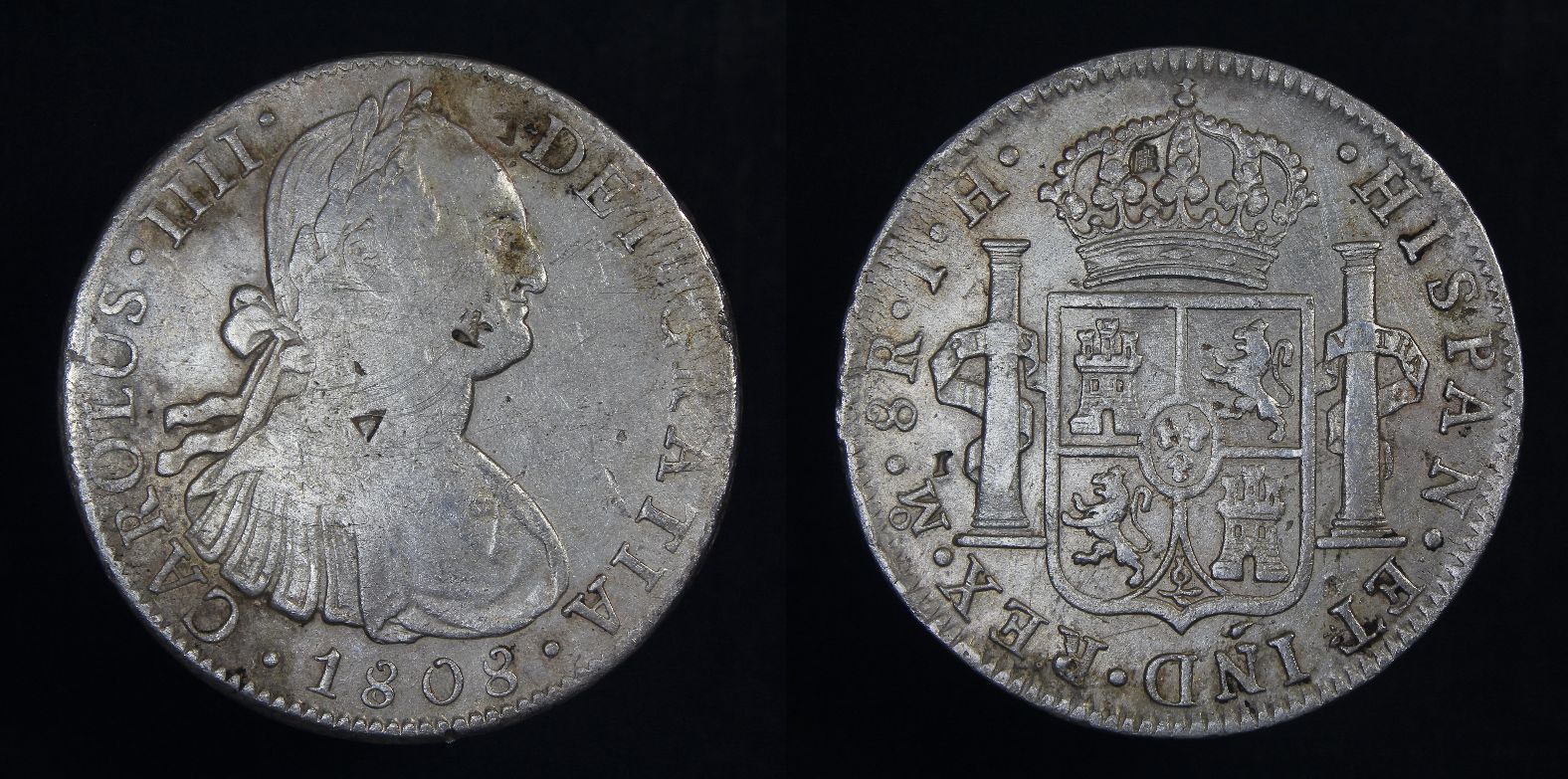
I picked this one up at the local coin store the other day.Mainly,because I didn't have one,and I like having a coin on hand when I go to research it.
I've read through some of the threads here and I think it may be a "Boston" type.?But,I'll let you decide.
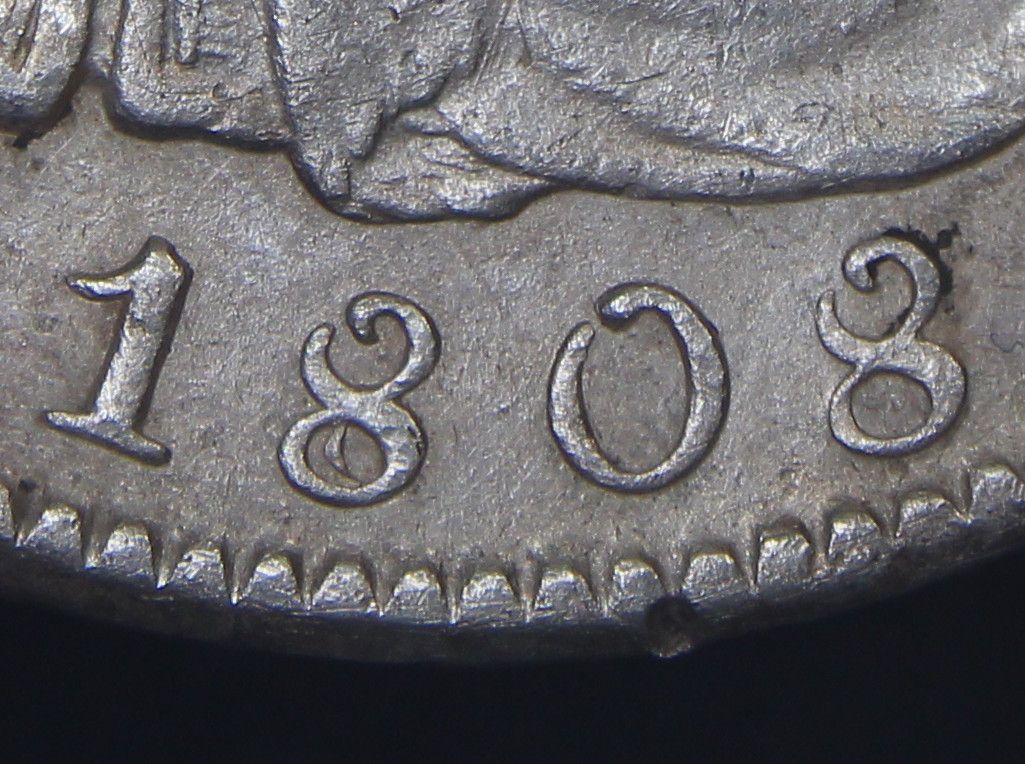
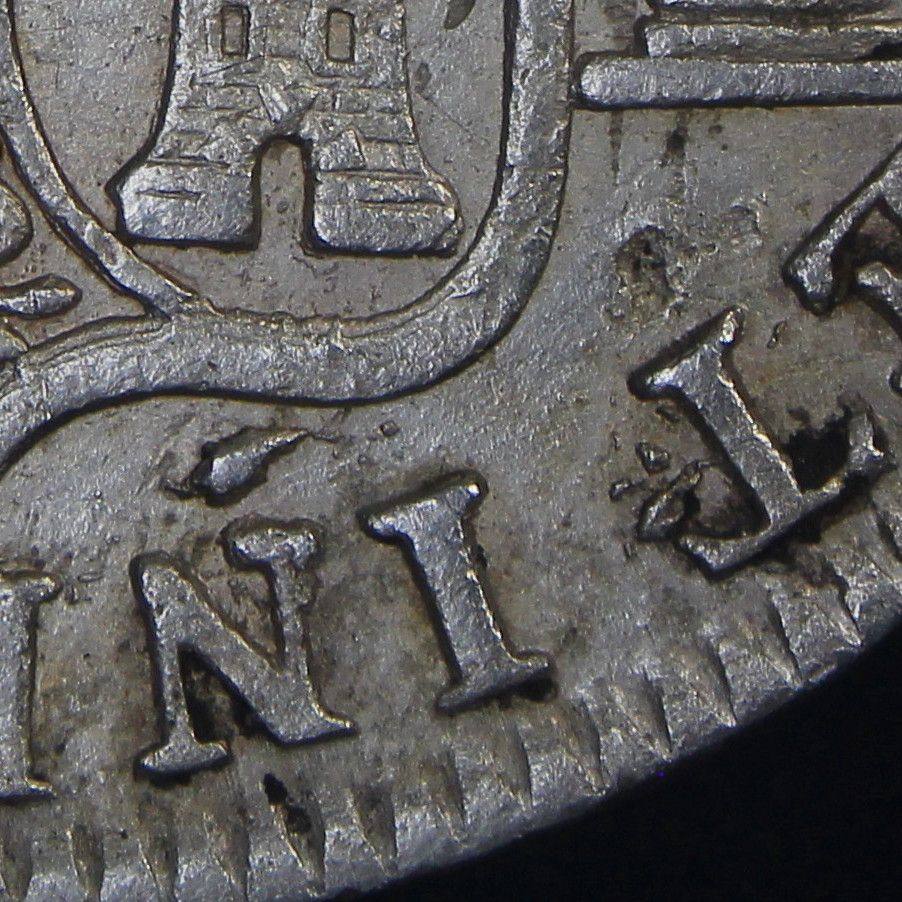
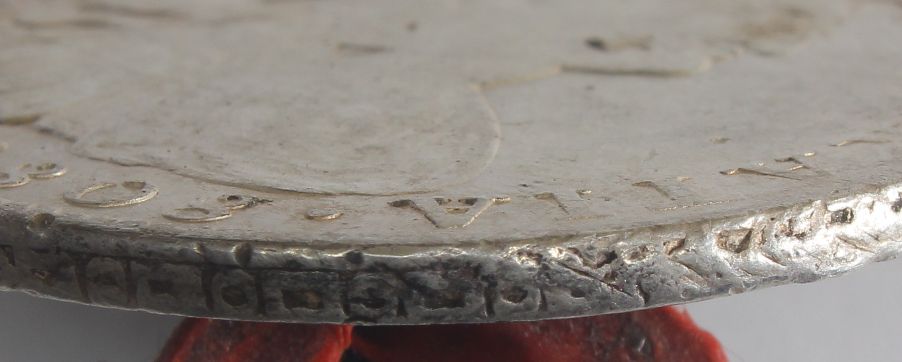
It looks like it has a RPD,die chips,and some cool chop marks.Which is another reason I bought it.
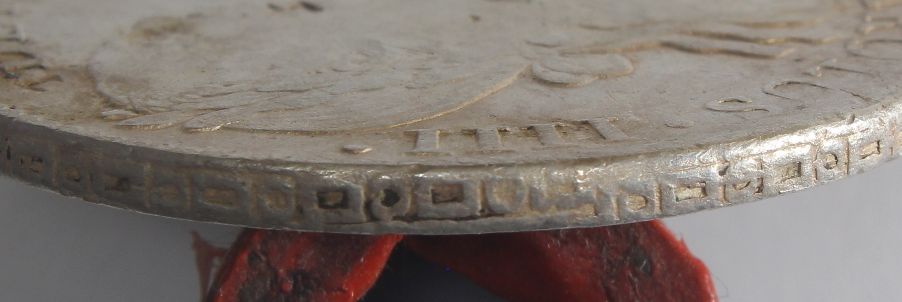
If you need different/better pictures of the rims just let Me know.Hopefully,they are to your satisfaction.

1808-Carolus-Llll-8R,-Authentic?
Bedrock of the Community
Dorado's Avatar
Canada
24885 Posts
 Posted 10/19/2017  08:20 am  Show Profile   Bookmark this reply Add Dorado to your friends list Get a Link to this Reply
Pillar of the Community
jgenn's Avatar
United States
1156 Posts
 Posted 10/19/2017  2:30 pm  Show Profile   Bookmark this reply Add jgenn to your friends list Get a Link to this Reply
At first glance it looks like the edge overlap, shown in the top photo, near the IIII is very short so not a match in length for the very long overlap on the opposite. However, I think I see evidence of a longer overlap in the top photo that may extend several segments more to the right. The key point is that the parallel die milling machine used on genuine 8 reales always creates overlaps of equal length on opposite sides of the edge.

A Class II counterfeit should generally have correct weight and specific gravity but often does not show the correct application of the edge design. So I reserve my judgement because I can't really tell how long the overlaps are from these photos.
Pillar of the Community
Cross-eyed's Avatar
United States
849 Posts
 Posted 10/20/2017  07:47 am  Show Profile   Bookmark this reply Add Cross-eyed to your friends list Get a Link to this Reply
Thanks for the link Dorado.
I spent some time last night trying to see if I could tell where the overlaps are on the coin.And as messed-up as the rim in that area is,I just can't make a judgement call on the exact location,of the over lap,for picture #2.
The weight of the coin is 26.67g.I'll have to look up and try My hand at a S.G.test.
So with out the edge over lap information,I'm assuming,that I won't be able to determine its authenticity.That's OK.I have gained the knowledge that I need for any future purchases.
Thank You for Your time spent.
Bedrock of the Community
Dorado's Avatar
Canada
24885 Posts
 Posted 10/20/2017  4:04 pm  Show Profile   Bookmark this reply Add Dorado to your friends list Get a Link to this Reply
@ Cross-eyed

Please watch this video :
6DuDDOlQC8M
Pillar of the Community
Cross-eyed's Avatar
United States
849 Posts
 Posted 10/21/2017  07:35 am  Show Profile   Bookmark this reply Add Cross-eyed to your friends list Get a Link to this Reply
So...are You leaning toward it being fake...or that I should use it to launch some fireworks?
Watching the video,it looks like the fake one was larger in diameter.So I dug out My calipers from the garage(not an easy task I might add).This one is 40mm north and south,and 39.1 east and west.A little oblong.
I've read through the SG test,but I haven't rounded up any of the equipment yet.One of these days I'll get too it.
Edited by Cross-eyed
10/21/2017 07:37 am
Pillar of the Community
jgenn's Avatar
United States
1156 Posts
 Posted 10/21/2017  11:21 am  Show Profile   Bookmark this reply Add jgenn to your friends list Get a Link to this Reply
This reply from swamperbob, for calculating the specific gravity by estimating the volume, uses "dry" measurements and may be of help.
Pillar of the Community
Cross-eyed's Avatar
United States
849 Posts
 Posted 10/21/2017  1:29 pm  Show Profile   Bookmark this reply Add Cross-eyed to your friends list Get a Link to this Reply
Thanks,I may try that,but numbers aren't exactly My strong point.So it may take Me a while.

Would it be easier to take it too the LCS and have Him do a XRF test in order find out the silver content?
Pillar of the Community
jgenn's Avatar
United States
1156 Posts
 Posted 10/22/2017  6:52 pm  Show Profile   Bookmark this reply Add jgenn to your friends list Get a Link to this Reply
The type of XRF used at coin shops is good enough to indicate the silver and copper content. I don't believe it would be powerful enough to detect the trace amount of gold that should be present in the silver processed in Mexico at the time your coin would have been minted if it was genuine. Silver ores extracted from the main mines in Mexico contained gold and the technique to separate out the gold was not greatly improved until the late 1800's (the MacArthur-Forrest cyanide leaching process was developed in 1887). swamperbob gave the figure of roughly 0.3 to 0.4% gold detected in genuine 8 reales using laboratory quality XRF. If at all possible, have your LCS attempt to detect gold in your coin.
Edited by jgenn
10/22/2017 6:53 pm
Pillar of the Community
Cross-eyed's Avatar
United States
849 Posts
 Posted 10/23/2017  07:00 am  Show Profile   Bookmark this reply Add Cross-eyed to your friends list Get a Link to this Reply
Look for .3-.4% gold.O.K. Not a problem.Knowing Him,He'll be just as curious as I am.But I don't know how good His machine is.I know he uses it for percentages of gold in jewelry.So it might go down that far. I guess we'll find out.
Pillar of the Community
Cross-eyed's Avatar
United States
849 Posts
 Posted 11/08/2017  6:47 pm  Show Profile   Bookmark this reply Add Cross-eyed to your friends list Get a Link to this Reply
Well,I stopped by the LCS and He wasn't too busy today,so I had Him shoot the coin.Here are the results of His machine.
AG 96.7738
AU 0.0758
CU 2.9006
ZN.1975
Ni 0.0298
Pb 0.0225
Pillar of the Community
jgenn's Avatar
United States
1156 Posts
 Posted 11/08/2017  9:29 pm  Show Profile   Bookmark this reply Add jgenn to your friends list Get a Link to this Reply
Interesting!

@swamperbob, please comment on this.

I think swamperbob described getting at least three XRF readings from different spots on the coin and averaging them -- but based on what you have listed, this is likely to be a class II counterfeit with a silver content that high. At the time class IIs were being make, the US had a glut of silver that drove prices down so the extra high silver percentage would still be profitable when traded to China.

Is your LCS anywhere near Washington, DC? I would love to test some of my 8 reales with an XRF machine that gives out that much detail.
Edited by jgenn
11/08/2017 11:00 pm
Pillar of the Community
swamperbob's Avatar
United States
5362 Posts
 Posted 11/08/2017  11:02 pm  Show Profile   Bookmark this reply Add swamperbob to your friends list Get a Link to this Reply
I was asked to comment so here goes.

Visually the coin has many of the ear marks listed in my book which I use to isolate probable (likely) silver counterfeits of the type that were made in and around Boston between 1870 and 1930. These are late Class 2 made after the Comstock discovery in Nevada. The dies show repunched elements, soft surface lumps, poor surface finishing, the planchet shows surface cracking from cold or cool drawing and/or lamination, dentil issues (are probable - hard to be sure from these pictures), The edge dies show squared circles in the edge design, variable segment shape and spacing and the presence of diagonal straia on part (half) of the edge. The laps appear to be opposed (roughly) but the length is obscured by the deepest diagonal straia as is typical.

So likely Counterfeit - one of the millions made for use in China to take advantage of the premium.

I would next do a Specific Gravity test to confirm a density of about 10.3. A density of over 10.25 is typical of Class 2 UK and US origin coins. Chinese Contemporary circulating Counterfeits in silver are said to be about 10.20 but I have yet to scientifically confirm one of those. The Chinese density is as stated in a Royal Mint test of Chinese counterfeits found in circulation in Canton in 1835 that were tested in London at 800 fine or lower. It is my current opinion that the UK used primarily 850 fine silver to strike 8Rs before 1835 and variable contents up to 925 thereafter. Whereas the US used 900 fine silver which was the US mint standard.

Coins under 800 fine can be easily detected by SG tests accurate to ONE decimal which can be done using a scale accurate to 1/100th of a gram. Accuracy of the scale is what is critical NOT WHAT the scale reads. Many cheap scales (particularly digital scales using Chinese chips) will read to 2, 3 or even 4 decimals when there is a 0.2% stated accuracy in the fine print. That means any reading taken should be expressed to 1 decimal when weighing an object that weighs 27 grams. So if you get a reading of 10.2 instead of 10.3 (round off all places after 1) you have a counterfeit in the 800 fine range not 900 fine.

After doin SG, weight and ring tests the next step is XRF. You do need to know how to read the results. There are beginner errors that abound. I was guilty of some before I read more extensively on museum testing of silver art works.

The first criteria is the power of the X-ray signal. The more powerful the deeper a reflected signal will be detected by the reader. Hand held guns like those in jewelry shops, coin shops and junk yards are low power and read mostly surface returns. Half to one quarter of the thickness of a human hair is typical for gold.

A laboratory unit is far stronger in terms of X-ray beam strength. This results in a DEEPER reading. You also need to be aware that the more dense the target metal the more likely there will be a strong reflected signal. That returning signal must escape the metal surface to be read by the unit. Typical lab units penetrate 2-4 times deeper than hand held units.

The surface of a coin unlike a museum piece can not be cleaned BEFORE testing. So steps must be taken to modify the results. The surface of an uncleaned coin has surface debris - corrosion products especially Iron in the form of rust is typical. Read Iron with skepticism.

Also screw press struck planchets were typically annealed (softened) by heating them BEFORE they were struck. Each time a coin is heated some copper in the surface is lost. After the strike the completed coins were usually soaked (washed) in heated acid to remove scale and toning. This had an added effect of enriching the silver surface. The combined effect seen on both genuine and contemporary counterfeits is an apparent increase in silver and a corresponding loss of copper content the closer to the surface you are.


Based on the results of the XRF test and presuming it was done on a typical handheld gun - the coin is a Class 2 Silver Contemporary Circulating Counterfeit almost beyond any possible dispute. The tests done in fully detailed (showing all figures not just orders of magnitude) scientific reports gives rough limit of 0.4% to be certain that an artifact or coin was made in Colonial Mexico (pre-1820).

The silver versus copper ratio using a handheld gun will always read too high in silver and too low in copper. That is exactly what I see here 96.8 Ag and 2.9% Cu. Copper is not very dense and produces the weakest return signal of the primary critical components. Silver is denser and returns a signal from up to two times deeper. Silver surface enrichment is also normal so I believe they started as raw 90-10 nominal alloy planchets.

Since the gold content even of a hand held gun will be accurate to 0.1%, the handheld gun is completely acceptable to screen out Class 2 silver counterfeits made AFTER 1880.

Here the gold result is expressed as 0.0758. This is a figure that is expressed to 4 decimals when there is no scientific accuracy to any greater than 1 decimal. However, one decimal is all we need. Therefore I would say with a high level of confidence that the silver used to make this coin was definitely NOT mined or refined in Mexico in 1808 or any date before that time.

This coin as a Class 2 coin is for the present as valuable as any comparable genuine coin. The reason is that testing (correct scientifically valid testing is not done). Having seen over 300 tests so far, I believe that the number of Class 2 coins is almost equal to the actual number of genuine survivors. About 1 in 2 coins tested will confirm as counterfeit.

I hope that helps. Remember even the contemporary counterfeits are valuable, the only fakes that should be destroyed as shown in the clip are Numismatic Forgeries - the ones made solely to defraud collectors.

Pillar of the Community
jgenn's Avatar
United States
1156 Posts
 Posted 11/08/2017  11:26 pm  Show Profile   Bookmark this reply Add jgenn to your friends list Get a Link to this Reply
Thanks swamperbob for the detailed explanation, especially regarding XRF!


Quote:
Since the gold content even of a hand held gun will be accurate to 0.1%, the handheld gun is completely acceptable to screen out Class 2 silver counterfeits made AFTER 1880


I don't believe you have been so specific here in the forum regarding the accuracy of handheld XRF -- this is very useful to know.
Pillar of the Community
Cross-eyed's Avatar
United States
849 Posts
 Posted 11/08/2017  11:56 pm  Show Profile   Bookmark this reply Add Cross-eyed to your friends list Get a Link to this Reply

Quote:
Thanks swamperbob for the detailed explanation, especially regarding XRF!

Thanks!Some really good information there for sure.
The machine He uses is box about 18" square,hooked up to a computer,not one of the hand held ones.If that makes a difference.
Pillar of the Community
swamperbob's Avatar
United States
5362 Posts
 Posted 11/09/2017  12:04 am  Show Profile   Bookmark this reply Add swamperbob to your friends list Get a Link to this Reply
I have been fearful that saying handheld guns are OK for one element will be misunderstood. They are ONLY good enough for gold testing. They can only prove a coin is NOT genuine - no test with a handheld gun can PROVE a coin is genuine.

The correct way of thinking about the result would be:

Ag reading 96.8% likely 90.6%
Cu reading 2.9% likely 8.7%
Zn reading 0.2% likely 0.6%
Au reading 0.1% likely 0.1%

Zinc and copper readings would likely triple. I would ignore readings under 0.05% entirely as unlikely to be significant. Hold the gold reading as accurate to 0.1%. Adjust silver downward by forcing a balance to 100%.
  Previous TopicReplies: 22 / Views: 4,741Next Topic
Page: of 2

To participate in the forum you must log in or register.


Disclaimer: While a tremendous amount of effort goes into ensuring the accuracy of the information contained in this site, Coin Community assumes no liability for errors. Copyright 2005 - 2026 Coin Community Family- all rights reserved worldwide. Use of any images or content on this website without prior written permission of Coin Community or the original lender is strictly prohibited.
Contact Us  |  Advertise Here  |  Privacy Policy / Terms of Use

Coin Community Forum © 2005 - 2026 Coin Community Forums
It took 0.39 seconds to rattle this change. Forums