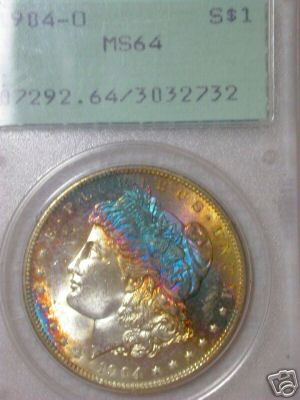
Quote:
The toning you see is the product of what, in most cases, is called "corrosion." In numismatics, when it has a pleasing appearance, it is called "toning" instead of "corrosion" and fans pay exorbitant prices for it.
Technically speaking, toning results from corrosion, but saying that toning and corrosion are one and the same is deceptive, since corrosion has a negative connotation, and suggests an ongoing degradation of the metal. Toned coins on the other hand, can be stable with little change for dozens of years, perhaps centuries.
Let me give you the PCGS definition of corrosion.....
Quote:
PCGS defintition.
corrosion
Damage that results when reactive chemicals act upon metal. When toning ceases to be a "protective" coating and instead begins to damage a coin, corrosion is the cause. Usually confined to copper, nickel and silver regular issues, although patterns in aluminum, white metal, tin, etc., also are subject to this harmful process.
So toning can actually have a protective effect on a coins surfaces.
Quote:
When you do this artificially - and it's relatively easy if you're willing to be exact about your work and patient - you become a pariah, someone we publicly identify and disparage, because the only "acceptable" toning is that which came about by natural processes, without deliberate human help.
Yet, when done right, there is no physical way to determine whether the toning has been created artificially or naturally.
I have yet to see an artificially (or intentionally) toned Morgan that has all the criteria that would pass it off as naturally toned. The pull-away effect, textile patterns, elevation chromatics and color progression at least for now I have never seen duplicated. If they could be reproduced, there would be thousands of them.
Anyone have one to show?
I have seen a handful of questionable pieces, usually album toned, where there is just something not right about them and I can't always say why. You look at enough of them and you just get a feel.
As with all collecting niches, knowledge is the key. As was mentioned above, take a good look at Brandon's article on the Jhonecash site......well worth it.
Interesting to note that Eliasburg, Pogue, Clapp and many other major collections contained a significant amount of toned coins.....and they have remained unchanged to this day.
Let me finish this with, in my humble opinion, is a fairly nice example of how beautiful and unique naturally toned Morgans can come.

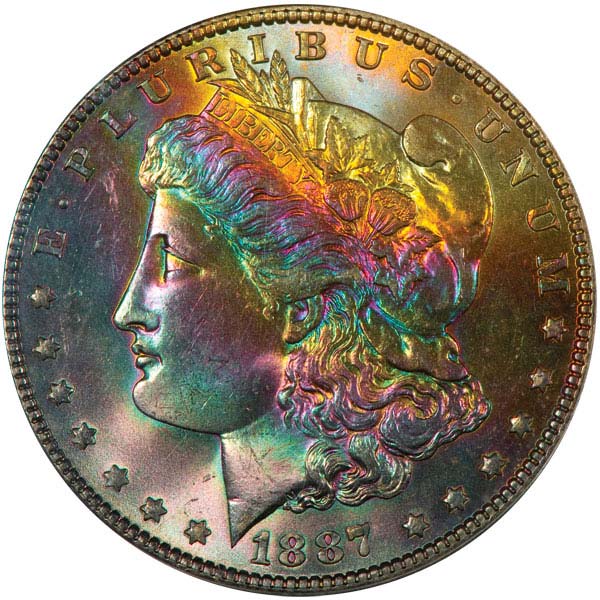
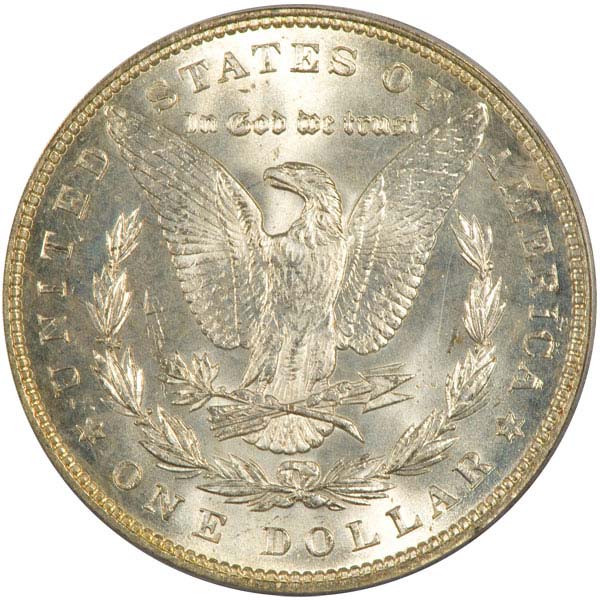
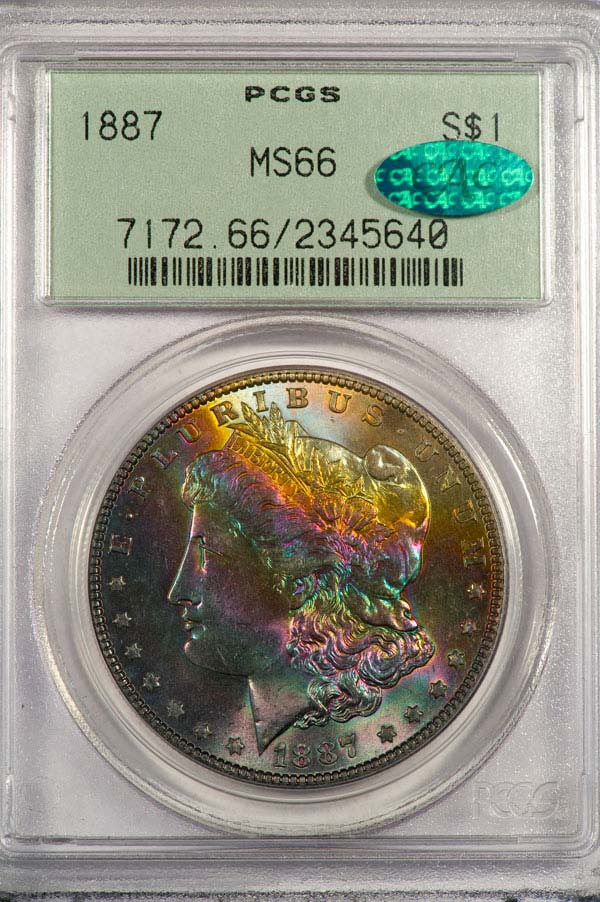






 First Page


 Posted 11/12/2017 1:06 pm