In the early Middle Ages, Friesland was a vast area that ranged from large parts of present-day North Holland to northern Germany. In this Frisian area, valuable coins have been struck. The hard core of the coinage lies in the area nowadays the province of Friesland. The earliest coins struck here were imitations of Merovingian coins in Dorestad. Also well-known are the Frisian sceatta's and the imitations of the Carolingian silver denari of the CRISTIANA RELIGIO type.
In the 11th century, the Frisian counts of the genus Brunswijk, the so-called Bruonen, minted a huge amount of silver penny's in their name. Not much of them have been found in Friesland, because they have been traveling massively towards the Baltic Sea through trade. At the end of the 11th century, this coinage collapsed. During the following period, until the end of the 12th century, silver pennies were struck by the bishops of Utrecht. These are mostly the so-called anonymous light Frisian pennies of about 0.2 grams with an image of a bishop or saint, but without readable legend.
After the end of the 12th century we see no coinage in Friesland for quite a while, but in the middle of the 15th century a period of urban coinage flourished. The cities of Leeuwarden, Bolsward, Sneek, Workum, Franeker and Dokkum minted on their own behalf. The only city officially entitled to this was Leeuwarden by an envoy of Emperor Sigismund from 1417. However, this period of urban coinage has been short-lived and small. After 1493, only Leeuwarden struck some change in the name of the city between 1580 and 1600. These coins were mostly of bad silver. In 1498, Maximilian of Austria gave the Frisian areas a loan to Albrecht of Saxony who was succeeded by his son George von Saxen after his death in 1500.
A power struggle with Charles of Gelre over the management of Friesland would cost George of Saxony so much money that he had to sell his rights in Friesland to Karel V for 15,000 gold guldens in 1515. It took until 1522 before Charles of Gelre dropped his claims on Friesland and until 1524 before Friesland was completely incorporated into the Burgundian empire of Charles the V.
From 1527 until 1530 a Burgundian minthouse was located in Leeuwarden which on the corner Eewal and Slotemakerstraat. The coin master was Frank van Papevelt and die cutter Jacob Ysbrandsz. The coins issued here were for a very long period thought to be issued in Luxembourg because of the coin sign lion. The coinage from the period from 1498 to about 1530, in the name of the various rulers, is referred to as the country coinage.
The provincial currency, founded in 1580 in Leeuwarden, has never really been a great success. This is partly due to the fact that the coin offices competed with each other for the supply of precious metals. The center of trade had moved to the seaside provinces of Holland, West Friesland and Zeeland at the end of the 16th century. The supply of (precious) metals and their prices were much more favorable to the more inland provinces.
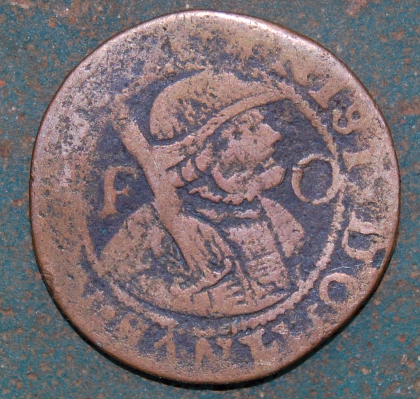
The early coins were issued after Saxon example, including the bust of a Saxon nobleman. Also referred to a the Frisian farmer. This portrait is found in many variations. The Legend on these coins was: NISI DOMINUS NOBISCUM, unless the Lord is with us. Later, Friesland followed more the mint policy of the other provinces by striking leeuwendaalders, ducatons, 3-gulden pieces, etc. In the eighteenth century, however, the Frisian coinage quickly decayed, the last copper types of the new type were issued in 1724. The last silver coins were issued in 1738, until 1752, when the Frisian mint was officially closed.
Obv: Frisian nobleman (to Saxon example) to the right with sword over the shoulder. To the left of the chest, the letter F and to right the letter O. This abbreviation is interpreted as Frisia Ordines (Frisian state) but also as a Frisian oord.
Legend: NISI. DOMINVS. NOBISCVM. (or variant). This means: unless the Lord is with us.
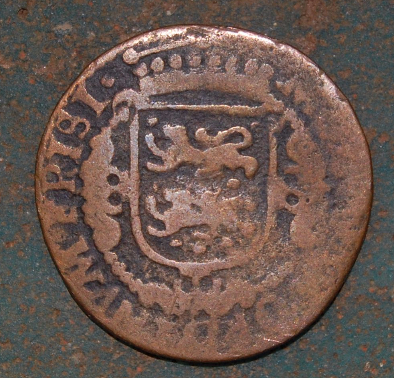
Rev: Frisian coat of arms with a pearl crown. In it two glaring lions above each other looking straight ahead. Below and next to the weapon there are curly decorations.
Legend: MONE x NOVA x ORDINVM x FRI (year) (or variant). The text is full: moneta nova ordinum Frisiae, and means: new currency of the state of Friesland.
Diameter: 24mm
Mass: 3,46 gram





 Posted 10/27/2017 08:14 am





