The city of Utrecht originates in Roman times. The present Domplein was the Roman center of the city. An army camp was located around the city. After the Romans left, this place was inhabited on a small scale until it flourished in the Middle Ages and expanded into the diocese of Utrecht. During excavations at the Domplein a leather purse was found containing 50 aurei. Among the specimens was a whole series (36 pieces) of Emperor Nero, showing his portrait of young boy to man. The coins can now be viewed at the central museum in Utrecht. Utrecht also owns the highest dome tower in the Netherlands (112 meters). This tower, completed in 1382, has also served as a shelter and defensive place for the bishop of Utrecht in turbulent times. The tower has seven bells that weigh 25 tons together. Furthermore, the city is known for the signing of the Union of Utrecht in 1579. This signing took place in the Utrecht Town Hall. In 1713, the peace of Utrecht was also drawn in this town hall.
The coin house
Very little to nothing is known about the location of the very early minting. It is only known for the later periods. From these data it appears that the Utrecht mint house has had various locations in the city. A house on the Korte Nieuwstraat (then Sint Pauwelsgang) has housed the mint of the bishops in the 14th / 15th century. This was located in the area of #8203;#8203;Saint Paul close to the bishop's palace. In 1363 someone called Sijbe was employed as a co-master.
The Royal Mint moved from the city of Hasselt in 1567 to Utrecht at the end of the Munt or Sacksteeg. This mint has also housed the provincial mint until about 1647. For unknown reasons, the mint was moved to some buildings of the Saint Cecilia Monastery around 1647. Most likely, the need for a broader building was the main reason. Already in 1644, it was considered whether the building was suitable for housing the mint. The Cecilia Monastery was located between Neude and Nieuwe Gracht. It was a very large complex that proved large enough for the housing of the mint and for housing the coin master. This building has long served as a mansion. The coins of King Louis Napoleon were issued here and until 1911 the coins of the Kingdom of Holland. When the old mint became too small, it was moved to a new and larger building on the Leiden road in 1911. Our coins are still issued in this mint building in Utrecht.
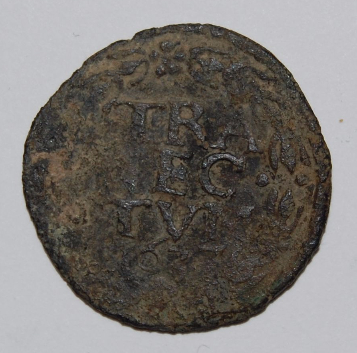
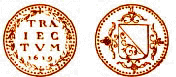
Obv: A tulip wreath containing the text TRA IEC TVM in 3 lines and below the year 1637
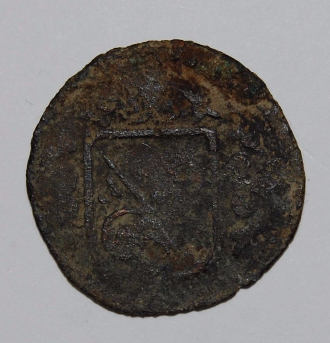
Rev: Utrecht's city weapon adorned with lily shapes. In the quarter left a flame decoration.
Diameter: 20mm
Mass: 1,81 gram










 Posted 10/27/2017 08:12 am


