| Author |
 Replies: 9 / Views: 926 Replies: 9 / Views: 926 |
|
|
Forum Dad
 United States
24224 Posts |
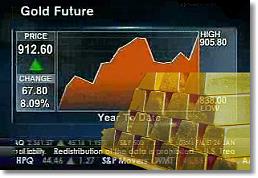 Gold fell from its record-high of $1,038 set on March 17 down to the recent $850 level. But Edelson does not believe this is the end of gold's bull market based on two possible macroeconomic background scenarios for gold. The first scenario Edelson outlines is if the Fed's efforts to save the U.S. economy and financial system succeed and the credit crisis eases. Under this scenario, the Fed's recent actions of slashing interest rates and pumping money into the economy are successful — the U.S. economy recovers and global growth resumes. As a result, the credit crunch eases, and money flows through the pipeline. The big commercial and investment banks finally stop taking massive write-downs on bad mortgage securities, foreclosures shrink, home prices stop hemorrhaging, and home sales pick up. Businesses start hiring and consumers resume spending. In this scenario, many on Wall Street would say that gold's bull market would be over. However, if the Fed is successful at turning the U.S. economy and credit crisis around, it will only be because it flooded the system with hundreds of billions of paper dollars, creating wild inflation. If the economy were to pick up on top of that, between inflation and resumed economic growth, global demand for gold would soar. The argument could then be made that when the economy turns back up, the Fed will head off inflation by aggressively raising interest rates, choking off the bull market in gold. But, from late 2004 to mid-2006, the Fed raised interest rates 17 times, in steady quarter-point increments to 5.25% from a low of 1%. And over that period, gold surged 127%! Read Full StoryAll Recent News
|
|
|
|
Pillar of the Community
United States
2600 Posts |
Bobby, I was just listening to a financial analysis segment on public radio which adds to this.
Apparently, one of the problems the FED is having with turning to economy around is that even though they have lowered the Fed Funds Rate rapidly, along with an infusion of cheap capital for lenders to access, the banks are not making these funds available at very cheap rates. Lenders have been reevaluating "risk purchase costs" and have determined that they have been greatly undervaluing their true costs. Most importantly, they have been spreading the risk exposure across the entire loan portfolio in effect over-charging those with extremely good credit and under-charging the marginal credit risks. It was these marginal credit borrowers that are the sub-prime customer and their "risk cost" is obvious. They summarized with the suggestion that all borrowings are going to be more costly in the future. If the cost of money goes up, it can only drive gold prices even higher, as gold producers are very highly leveraged.
Jim
|
|
Pillar of the Community
Australia
3841 Posts |
Why do people keep talking about demand and don't bother to look at the supply side? Or they are not capable of looking up figures for it.
My partial coin collection http://www.omnicoin.com/collection/gxseriesMy numismatics articles and collection: http://www.gxseries.com/numis/numis_index.htmRegularly updated at least once a month. |
|
Pillar of the Community
United States
5318 Posts |
I'm not sure I see the same connection between the Fed's rate cuts and the end of a bull market on gold--or for that matter any other commodity run. On that point, here's an excerpt from The Economist of 9.5.08: Quote:
"Jeff Frankel, a Harvard economist, has long argued that low real interest rates lead to higher commodity prices. When real rates fall, he points out, commodity producers have more incentive to keep their asset—whether crude oil, gold, or grain—in the ground or in a silo, than to sell today. Speculators, in turn, have more incentive to shift into commodities. There is no doubt that commodities have become an increasingly popular investment category—in fact they bear many of the hallmarks of a speculative bubble." I've noticed that as central banks sharply cut rates, a speculative run often ensues--particularly in uncertain economic times. Predictably, the pundits for that particular commodity or asset will cite a new level of demand or reduced supply that will inevitably establish a "new reality" for prices. Everything seems so certain--until the bottom drops out. Mind you, I won't presume to understand the complex supply/demand factors behind commodity prices, but I'm naturally skeptical when similar reasoning is employed to assert a "new plateau" for prices. Edited by KurtS
05/12/2008 2:15 pm
|
|
Pillar of the Community
Australia
3841 Posts |
Interest rates do have a major impact on mining operation cost. Most often when starting a new mine, a lot of funds have to be borrowed from a mixture of the banks and investors - these figures don't come cheap and they are often in terms of hundreds of millions of dollars, if not billions in the long term run. The story does not end there as interest rates have impact on daily people's lives as well as their psychological view of how much confidence they have in the dollars.
My partial coin collection http://www.omnicoin.com/collection/gxseriesMy numismatics articles and collection: http://www.gxseries.com/numis/numis_index.htmRegularly updated at least once a month. |
|
Pillar of the Community
United States
615 Posts |
Considering I don't see the Government spending less money in the future... I see the dollar falling more.
Real low rates cause increasing leverage as well as higher raw material cost. So low real rates are a double edge sword. They help the economy at first, but they cause bubbles if left unchecked. Bubble burst and you have deleverage liquidity problems with increasing raw material cost.
-SWUSC
|
|
Pillar of the Community
United States
5318 Posts |
Obviously, I have little knowledge of the mining end to gold supply. It sounds to me that if lending costs are reduced while gold is high, there is more incentive to develop new mines?  I'm totally guessing here because I don't know the industry. |
|
Pillar of the Community
Australia
3841 Posts |
KurtS, the simple answer is yes. You got to understand that there is a time lag between high metal prices against exploration, developing new infrastructures, exploiting and marketing. Mining is not something that you can just pop up in a few days time. It usually ranges from easily 3-5 years and even longer for a full production. With exploration included, I wouldn't be too surprised if it takes over 5 years. The first metal shock price came in 2003 and now is about time that some mines are about to open for production. There are even bigger ones coming into the market at 2010, 2012 as far as I am aware of for gold and copper mines.
People always have a tendency to forget that supply is an important factor to pricing. Mining alone contributes to perhaps at least 70% of the current demand, with the rest usually from recycling and investment. Makes me wonder why people ignore such a huge percentage.
Just for a matter of fact, mined gold these days usually comes from solid rocks and it can be from 0.6g-5g/metric ton. (and 5g/t or more is said to be absolutely fantastic) Yes, you blast the rocks, grind them up, wash them and have special tanks to filter them. Yet companies still make a profit out of it. Yes you read it right, even from 0.6g/t of gold - makes you wonder how much water and electricity is used. Not a business that you can make a joke out of in particular some of the more dominant mining companies.
Does anyone know which country produced the most gold last year. If you answer is South Africa, yes it used to be for the past 50 years. Now it isn't the case. Answer may be surprising.
Edited by gxseries
05/12/2008 3:29 pm
|
|
Pillar of the Community
United States
621 Posts |
Largest gold producer would be China.
|
|
Pillar of the Community
United States
5318 Posts |
Gxseries--that lag time is understandable. I've also heard similar figures for the quantity of rock a modern mine processes to retrieve gold--amazing! Long ago, we had a gold rush in California, where the first miners could actually pick gold off the ground. Not so today.
|
| |
Replies: 9 / Views: 926 |
|










 Posted 05/12/2008 11:47 am


