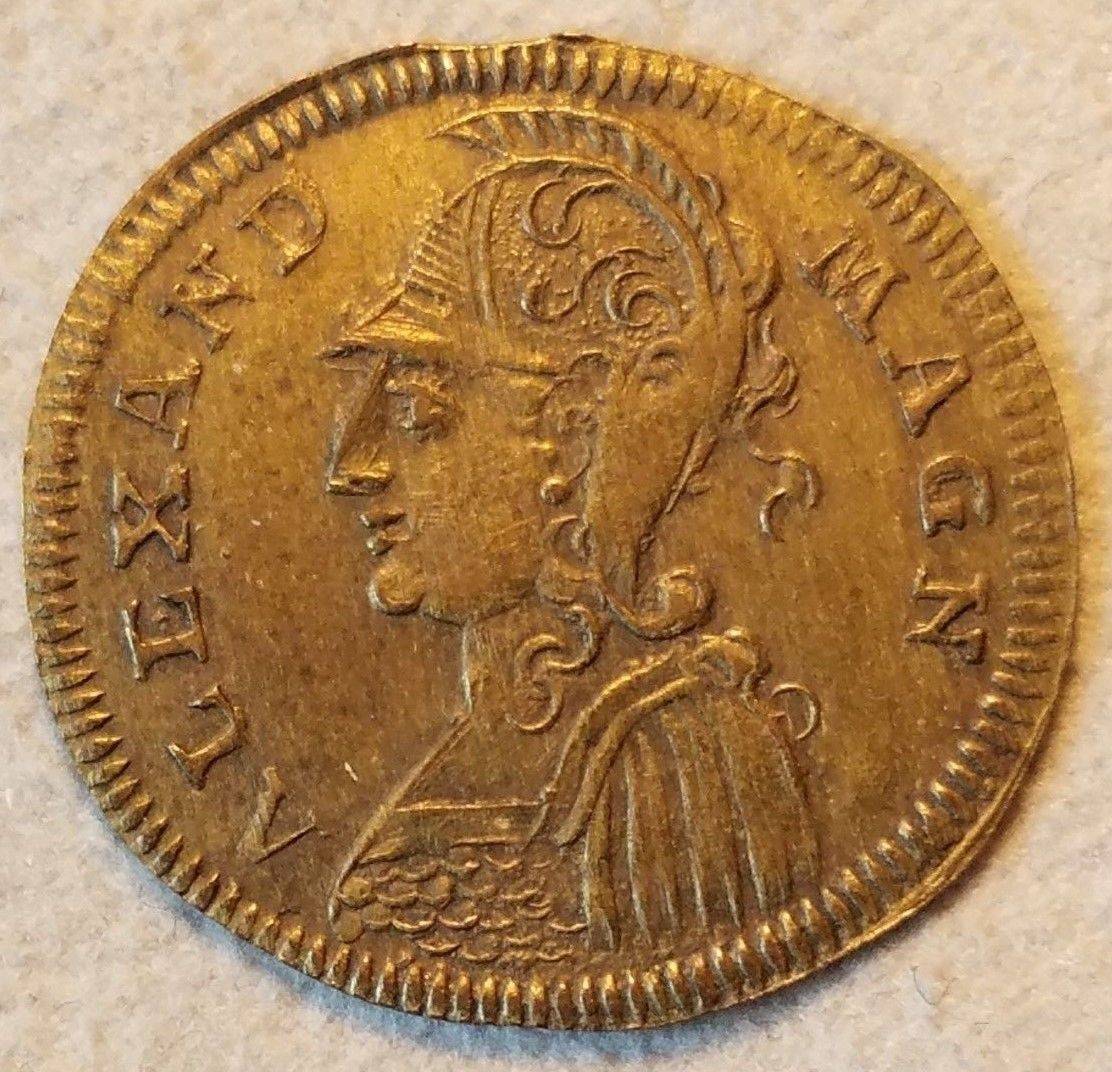
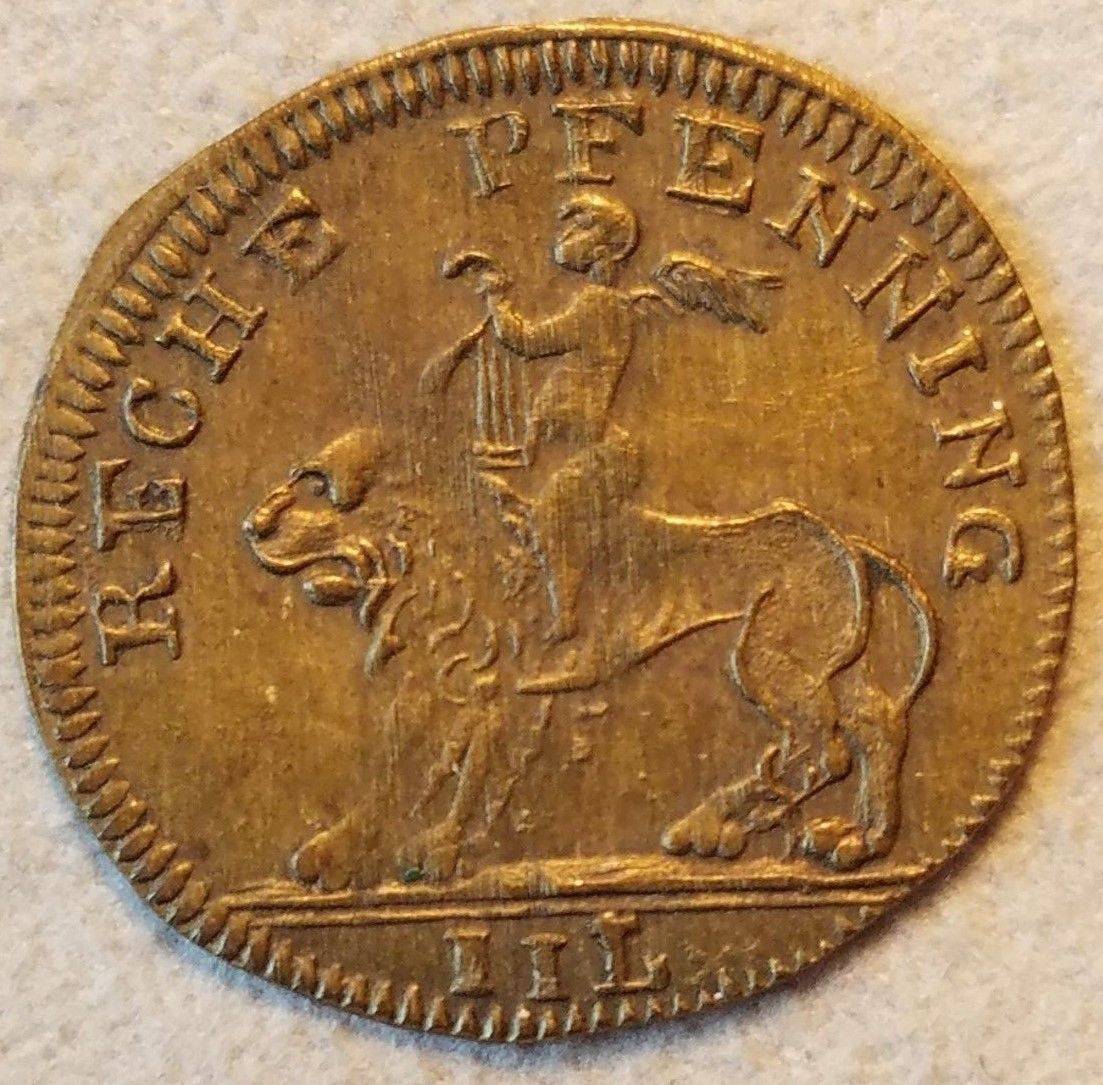
I am pretty sure my Lauer jeton is brass or bronze, definitely not gold (I should be so lucky!) but it IS is remarkably good shape.
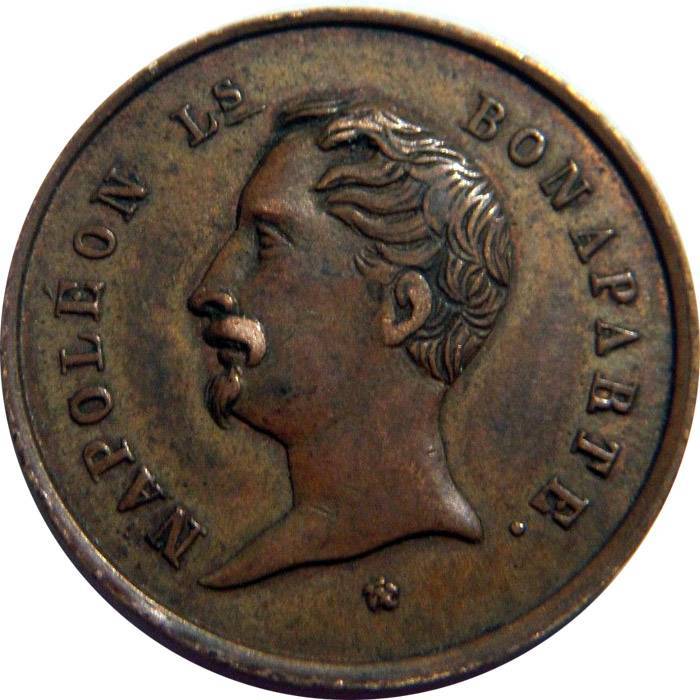
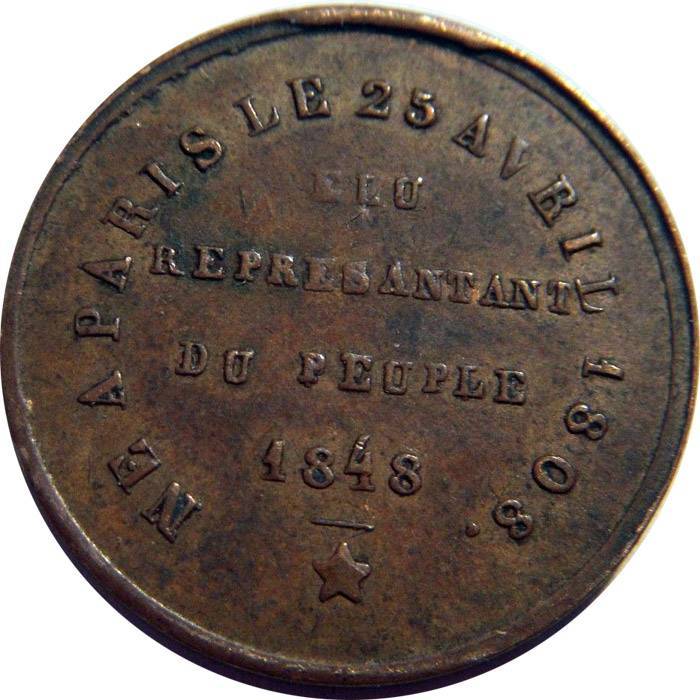
This 1848 Napoleon III medalet recently came my way -- it has a few issues, but nothing that a bit of proper conservation can't reasonably address. It is brass and around 23.5mm.
It is a bit scarce and I have seen them with, or, most commonly, without the attaching loop; the ones with the loop still present are the scarcer types, and command a premium.
The obverse has a left-facing bust of Louis-Napoleon Bonaparte of France, the future emperor Napoleon III. A rosette is underneath the bust.
On the reverse, the text reads, in French, "Ne à Paris le 20 Avril 1808./Elu/representant/du peuple/1848" (Born in Paris on 20 April 1808/Elected as (the) representative of the people 1848)
There is a small exergue line with a star beneath it.
Louis-Napoleon Bonaparte (later Napoleon III) was born in Paris on the 20th of April 1808, the nephew of Napoleon I Bonaparte. He would make three attempts at a coup-d'etat against the French monarch Louis Philippe; the first two attempts (1836 and 1840) resulted in imprisonment in London at first -- then outright exile -- and much ridicule, something which would later shape the young Emperor's personality.
By the mid 1840s Louis-Napoleon had finally achieved a level of status among the English nobility in King Street, meeting 19th c. luminaries such as Disraeli and Dickens. He eventually met and married Elizabeth Ann "Bess" Haryett, an actress who used the stage name Harriet Howard. Together with her son from a previous marriage (to a married scion of the Martyns) and Napoleon's two illicit sons from romantic adventuring during his time in exile, they began to use Ms. Howard's wealth obtained from the Martyn family towards making plans for a return to France and third coup attempt.
As luck would have it, the Orleans monarchy in France was in deep trouble, economically and politically; civil unrest resulted in the foundation of the French 2nd Republic, whose leadership gratefully accepted Louis-Napoleon's return and candidacy for the Presidency; backed by support from Alexis De Tocqueville and Victor Hugo, the nation promptly elected him President of the People and the Republic. His first few years were spent rebuilding the economy and helping industrialize the growing nation.
By 1851, according to the new Constitution, he was expected to step down from office. Instead, he led his third and final coup, declaring himself the Emperor Napoleon III; he wrote a new Constitution which concentrated most of the power in his rule, and with a strong Army backing him, he switched to policies of repression and persecution against his opponents. His wife, unable to tolerate him, soon left him.
Despite the heavy-handed censorship, he was committed to his beloved France; some of his accomplishments include the rebuilding of Paris, allowing women to enter the workforce and hold civic office, strengthening ties with England, a victory against Russia in the Crimean War, a laissez-faire economic approach which allowed free markets and trade to flourish, extensive infrastructure building, social justice and labor reforms -- he was the first to introduce the concept of trade unions, workplace regulations, and limited working hours to the nascent French industries -- the foundation of several major universities, a well-funded secular public education system, and French colonial expansion in Asia and Mexico.
By the end of the 1860s France was much better off than it ever had been; but the Catholic Church in particular was not happy with Napoleon's promulgation of secular education or his apathy towards the Church in general; despite that, and a resurgent opposition, a vote on his continued leadership of France in 1870 was a resounding success for Napoleon, with nearly a 4.9:1 vote advantage over the opposition - future PM Leon Gambetta.
His eventual fall from power would occur based mainly on three things: ill health, ill temper, and a failure to continue investing in the French army and navy. Prussia, now leading all of the German States towards unity under Bismarck, was itching for a reason to knock the French down a few pegs, and was able through careful trickery executed by way of diplomacy to incite Napoleon (who was paranoid enough already about plots to overthrow his leadership) into declaring a war against Prussia, with disastrous results for France and Napoleon. Less than 8 months after declaring an ill-advised war on Prussia, Paris fell to the fierce Prussian war leadership of Steinmetz, Bismarck & Moltke; Napoleon was taken as a royal prisoner at the Battle of Sedan and held until March 1871 when the signing of a truce with France and the formation of the 3rd French Republic resulted in Napoleon being released as a prisoner by Bismarck.
Soon exiled for a final time to England by the 3rd French Republic in that same month of March, and in increasingly poor health, he spent the remainder of his short life at the estate of Camden Place in Chislehurst, Kent. During his brief stay there, he was able to meet Queen Victoria, who reportedly greeted him warmly. He died of complications, probably sepsis, following two surgeries to remove a severely inflamed gallbladder in January 1873.
The French territorial losses during the Prussian War, and the blows to sovereignty and national pride, would later serve as one of the casus belli leading up to World War I.







 First Page
 Previous Page


 Posted 07/01/2018 12:22 am