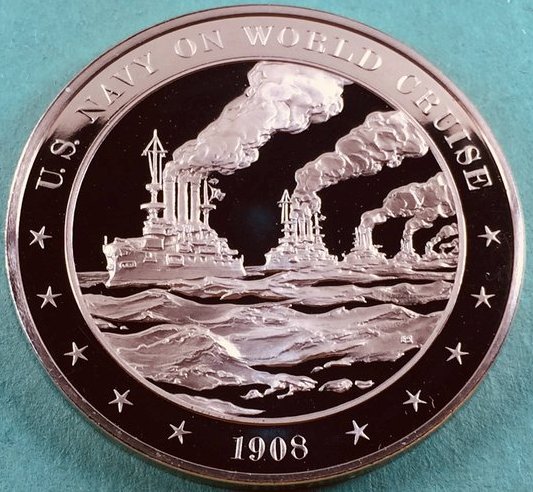
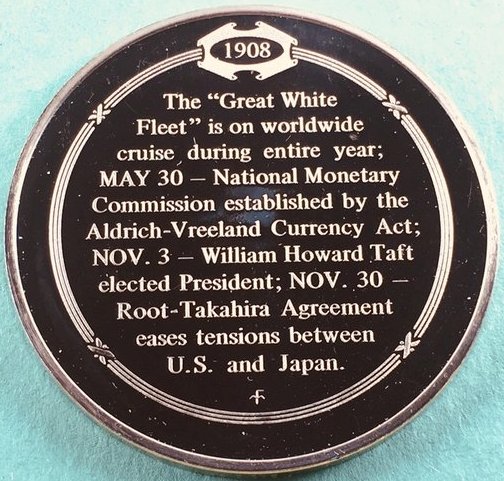
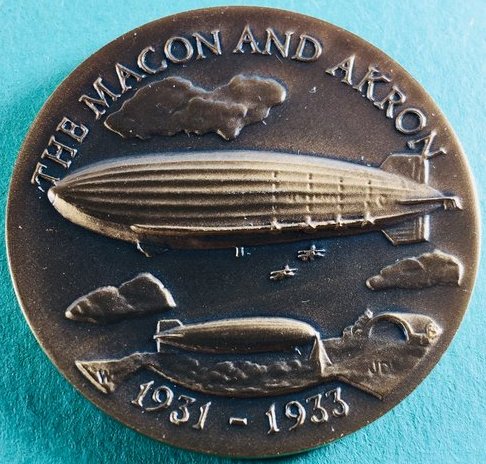
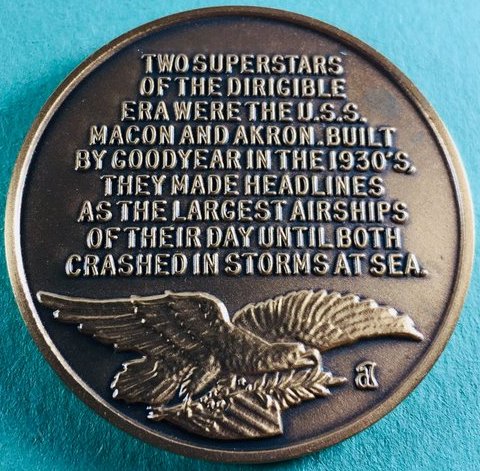
Anyway, my Big Lucky Nickel Collection has added two Lucky Pennies (bottom) and The Chicago Souvenir Lucky Nickel. Now I have 6 of these. I believe they date from the 1930's give or take 10 years. There isn't much info I can find on them, and I don't know much about them, but when I run across a cheap one in good shape, I can't resist.
If I carried one of these 3 inch plus honkers in my pocket, I'd be LUCKY if my pants didn't fall down. If anyone knows of a website on these, please let me know. Thanks!
1972 Babe Ruth Longines Symphonette Whittnauer Sterling Silver Medal This is a popular medal with both collectors of medals and sports memorabilia. The Curse of the Bambino was a superstition evolving from the failure of the Boston Red Sox baseball team to win the World Series in the 86-year period from 1918 to 2004. This misfortune began after the Red Sox sold star player Babe Ruth, sometimes nicknamed as "The Bambino", to the New York Yankees in the off-season of 1919-1920. Before that point, the Red Sox had been one of the most successful professional baseball franchises, winning the first World Series and amassing five World Series titles. After the sale, they went without a title for decades, even while the Red Sox won four American League championships from 1946 to 1986, as the previously lackluster Yankees became one of the most successful franchises in North American professional sports. The curse became a focal point of the Yankees-Red Sox rivalry over the years. Talk of the curse as an ongoing phenomenon ended in 2004, when the Red Sox came back from a 0-3 best-of-seven deficit to beat the Yankees in the 2004 American League Championship Series and then went on to sweep the St. Louis Cardinals to win the 2004 World Series. I thought this was a decent short watchable biography video which I will include here.
Quote: Anyway, my Big Lucky Nickel Collection has added two Lucky Pennies (bottom) and The Chicago Souvenir Lucky Nickel. Now I have 6 of these. I believe they date from the 1930's give or take 10 years.
James Maitland Stewart (May 20, 1908 - July 2, 1997) was an American actor and military officer who is among the most honored and popular stars in film history. Jimmy Stewart reportedly did not like the name "Jimmy". I have not seen another of these medals, and this is not in the best of condition, having some tiny dark spots, but I just had to have one.
Stewart was known for his distinctive drawl and down-to-earth persona. Many of the films in which he starred have become enduring classics. He also had a noted military career and was a World War II and Vietnam War veteran and pilot, who rose to the rank of Brigadier General in the United States Air Force Reserve, becoming the highest-ranking actor in military history. He was awarded the Presidential Medal of Freedom, America's highest civilian award, by his friend President Ronald Reagan at the White House in 1985.
Who doesn't love Jimmy Stewart? My favorites movies he acted in were the westerns. "Winchester '73" tops my list. If I had a chance to ask one question about that movie, I would ask why, before taking his shots to win the rifle, why did he lay it sideways and then sharply turn it upright before firing?
I just watched the 3 hour "How The West Was Won" in the past week. He had the opening scene and was one of the main characters, playing Linus Rawlings, a trapper, and mountain man for a good third of the movie. Right now, I am sure I have at least a half dozen movies of his recorded on my smart TV. "It's a Wonderful Life" is a must watch every year around Christmas. He is one of my favorites to see on the yooo toobe clips of Dean Martin Roasts or when he was on Johnny Carson's Tonight Show.
Rich Little did a great impersonation of him, many others have too, but I think Rich Little was the best. No ... Jimmy Stewart did Jimmy Stewart the best!
Jimmy Stewart is one of my 8x10 pictures hanging in my man cave. He wore this same hat in all his western movies. This is the one.
He was born in Indiana Pennsylvania, near the border of Indiana. There is a Jimmy Stewart museum there and his statue stands outside the courthouse which is also part of this medals theme.
This is the one I won but was not available after I paid for it a ways back. This is the one on the way! I couldn't believe my eyes! Looks better than any of the others I have seen and got it for a song.
A large nickel based medal approximately 40 mm. I do not know who minted this (yet) but I have seen them in bronze as well. ( image will improve when I get take a new picture ) Obverse: 350th Anniversary 1620-1970 A Pilgrim couple standing on a rock. Reverse: The Ship That Founded A Nation - The Mayflower Image of The Mayflower at sea in full sail.
So yes, we all know that the Mayflower came to America with the Pilgrims but here's my condensed story, taken from various places and worded as short as possible.
The Pilgrim Fathers, or Pilgrims, originally were a group of religious reformers, or separatists, in Scrooby, Nottinghamshire. Scrooby Manor, William Brewster's home, became a meeting place for the dissenting Puritans. The group formed the Separatist Church of Scrooby. The Scrooby congregation was persecuted by Tobias Matthew, Archbishop of York. Their homes were raided several members of the Scrooby separatists were imprisoned. In 1608 persecuted Scrooby separatists left England for Amsterdam Netherlands. In 1618 one of the Scrooby separatists, the church elder William Brewster, criticized the The King of England and the Anglican Church. Authorities in England go to the Netherlands to arrest Brewster but he escapes arrest. Jamestown founder John Smith recently published book "A Description of New England" and some of the separatists wanted to come to America as well and joined with others and hired two ships. The Mayflower and another ship, The Speedwell were to both set sail for the mouth of the Hudson River. On September 6, 1620 The Mayflower left Plymouth bound for North America. There are rumors that that the master of The Speedwell had intentionally sabotaged his ship to avoid having to make the treacherous voyage to North America. Some passengers abandoned the trip and returned with The Speedwell, while others joined the already over crowded Mayflower. The passengers total 102 people. Some were referred to as the "Saints" and others, the skilled craftsmen who were not religious separatists and were known as "Strangers". They kept segregated to themselves on the 66 day voyage. When land was spotted The Mayflower was off course ending up on the tip of Cape Cod, conditions did not allow further sailing to the south and they first set foot on land on December 21, 1620. They selected a coastal site suitable for their settlement. They name it New Plymouth, after the English town from which the Mayflower departed. Before going ashore the passengers signed an agreement of rules, "The Mayflower Compact" to ensure peace between the two groups carried by the Mayflower ship to America. The pilgrims suffered a terrible winter. Many died of disease and others from the harsh conditions without adequate shelter. 45 of the 102 Pilgrims died. I assume all of the passengers were "Pilgrims" at that point, both "Saints" and "Strangers" and learned to work together. Wampanoag Native American Indians led by Chief Massasoit taught the colonists farming techniques and helped them to survive in the colony. The First Thanksgiving recognized by the Pilgrim Fathers was a celebration of the arrival of fresh supplies and new colonists in 1623. The First Thanksgiving celebration lasted for three days and featured a feast that included different types of waterfowl, wild turkeys and fish procured by the colonists, and five deer that were brought by friendly Native American Indians.
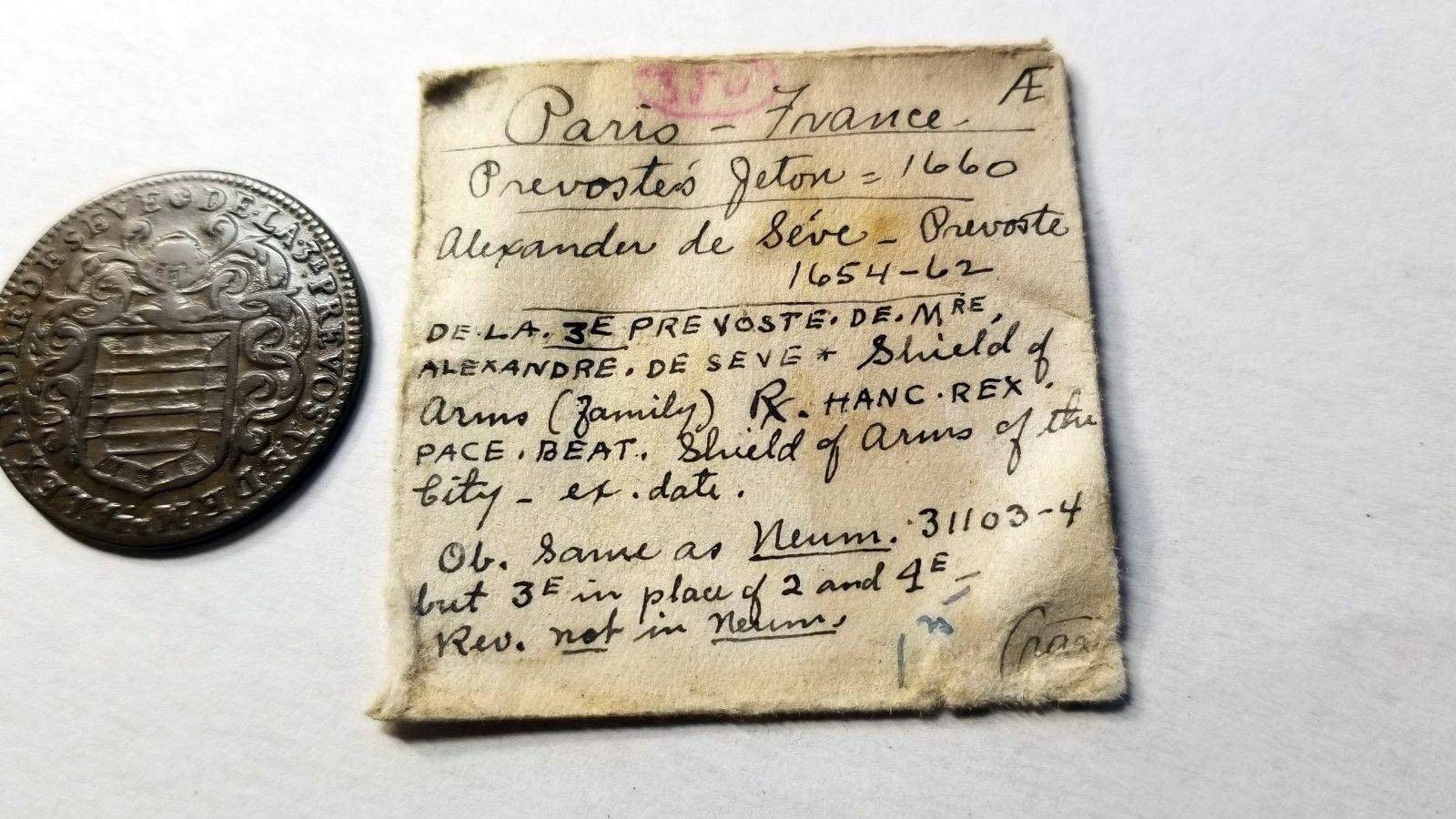
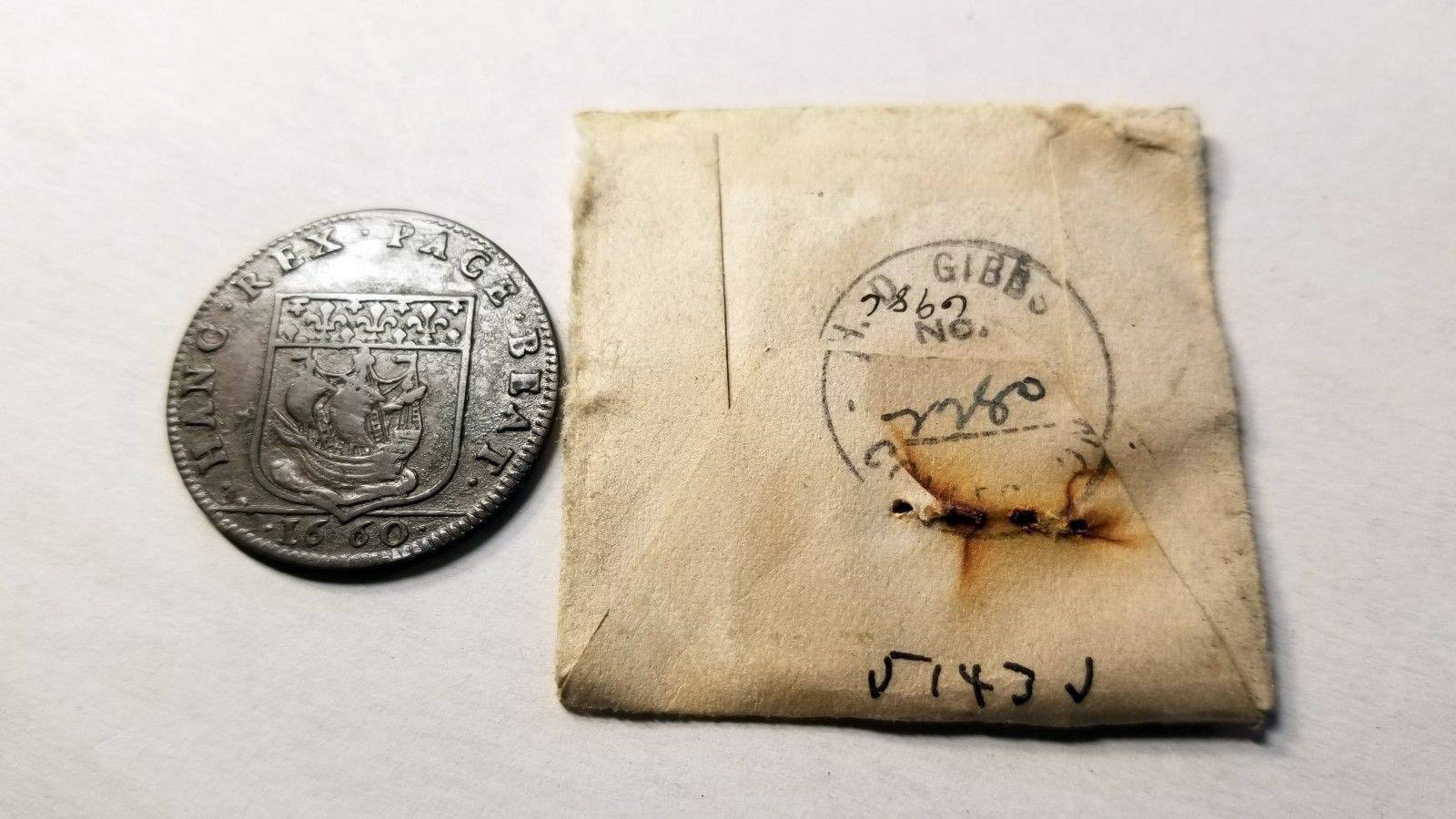
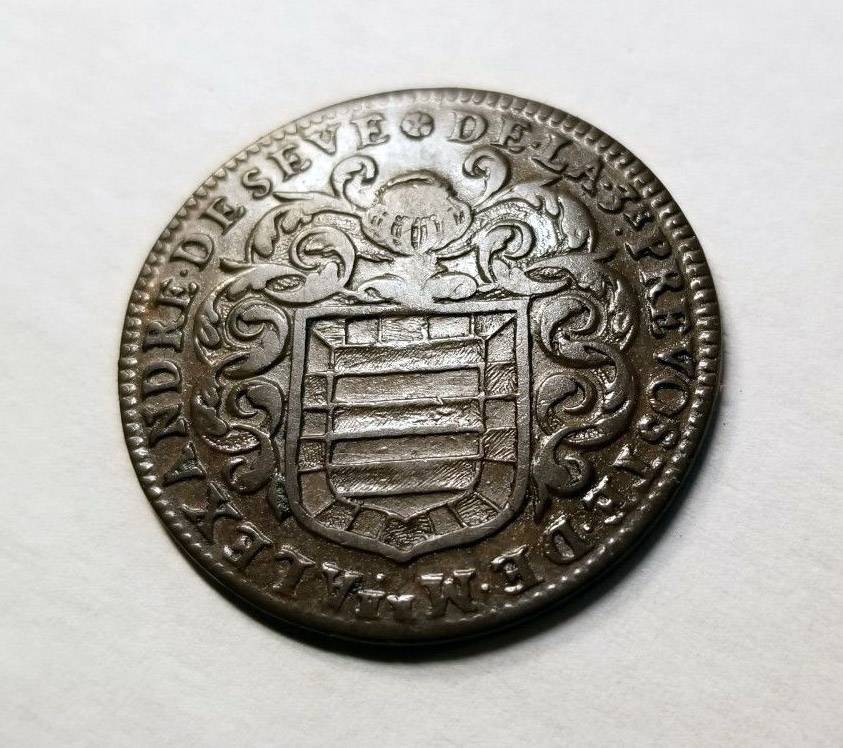
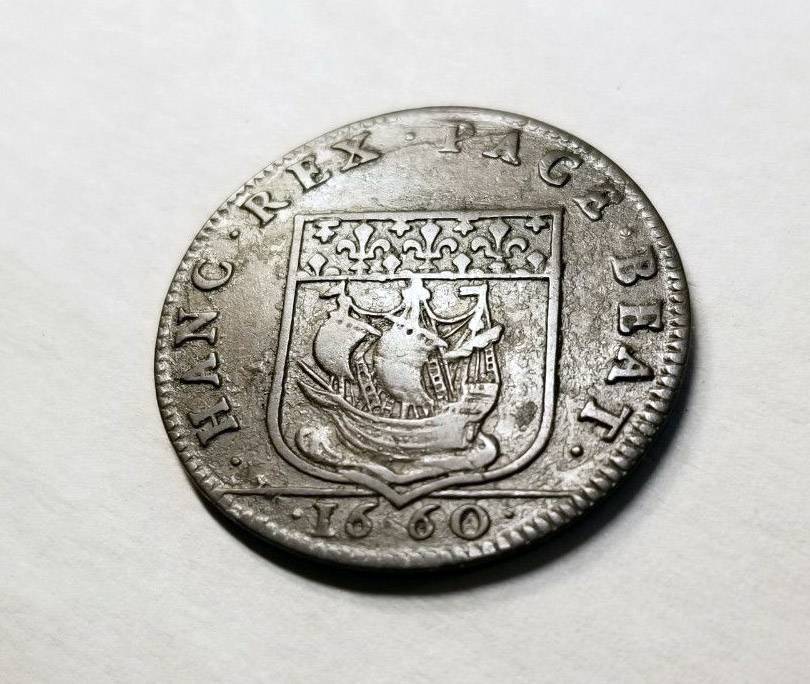
1660 Jeton, France. AE, 27mm, 6.3g. Feuardent 3588 / P. Corre 4548. EF. ex: Gibbs (1953)
This 1660 French jeton is part of a (very) large jeton collection which was sold off piecemeal in the 1950s. Nowadays, you can find tokens with this provenance (H. D. Gibbs) in many places, scattered about, still showing up for auctions with surprising regularity: Germany, France, The Netherlands, and right here in the US, nearly 65 years after they were first put up for sale in New York.
The obverse is that of the coat of arms of the 3rd Provost of the Merchants of the City of Paris, Alexandre de Sève. In the late 16th c., Paris had, among several others, a Provost of the Merchants (who was in charge of all merchant companies/guilds and much of the city governance, a sort of mayorial role.) Being Provost of the Merchants was a very important position which carried great authority and great prestige as well.
M. de Sève was provost in Paris from 1654-1662.
The reverse depicts the coat of arms of the City of Paris. The legend, in Latin, reads HANC REX PACE BEAT. This is a really short way of expressing the theme of the jeton: the King's peace (brings) joy.
The French Treaty of the Pyrenees was signed on 7 November 1659 between France (under Louis XIV) and Spain (Philip IV), ending a nearly 25-year-long state of war. It was a decisive win for France, which gained a significant amount of territory in exchange for agreeing to cease supporting Portugal and renouncing his right of claim to Barcelona and its lands. This accounted for the "peace" being referred to on the jeton...
...but what about the "joy?" Sure, peace was in and of itself joyful, and the reclamation of large amounts of territory was worthy of praise, but the main joy being referred to here is the marriage of the Bourbon king Louis XIV to his cousin, the Infanta Maria Theresa of the Austrian Habsburgs in Spain. As part of the marriage, the Infanta had to renounce her right to succession of the Spanish throne -- by doing so, it prevented France and Spain from becoming a de facto union, and forced Spain into a subservient role.
Despite her husband's nearly constant infidelity (he had anywhere from two to four mistresses, depending on sources) she bore him six children; tragically, only one would survive childhood (the Dauphin Louis, firstborn), and even he preceded his father in death, preventing his succession to the French throne -- although his second son, Philip, would later be a very important historical figure. Maria Theresa passed away in 1783.
The peace and joy were not to last. French setbacks over the next 30 years reignited the quarrel between Habsburg and Bourbon, and the spark that would eventually send much of Europe back into war (the War of the Spanish Succession to determine the fate of the Spanish Empire and the French throne) was triggered when Charles II declared Louis XIV's grandson -- Philip -- as the rightful heir to the Spanish throne by way of Maria Theresa.
(Spain allowed for female succession to the throne and the persistence of the order of succession through females, and France did not, with strict primogeniture limiting the right of succession to male heirs.)
The thought of a unified Spanish/French kingdom was terrifying to much of the rest of Europe: Britain, the Netherlands, and most of the Holy Roman Empire soon pledged to go to war to prevent the union of the two crowns, and once again, the peace was broken.
(Any errors are mine, so please forgive me if you find something wrong.)
Great stuff paralyse, I did find several of H. D. Gibbs items available. Now that guy was a collector! Imagine France and Spain as one country. What a different world it would be.
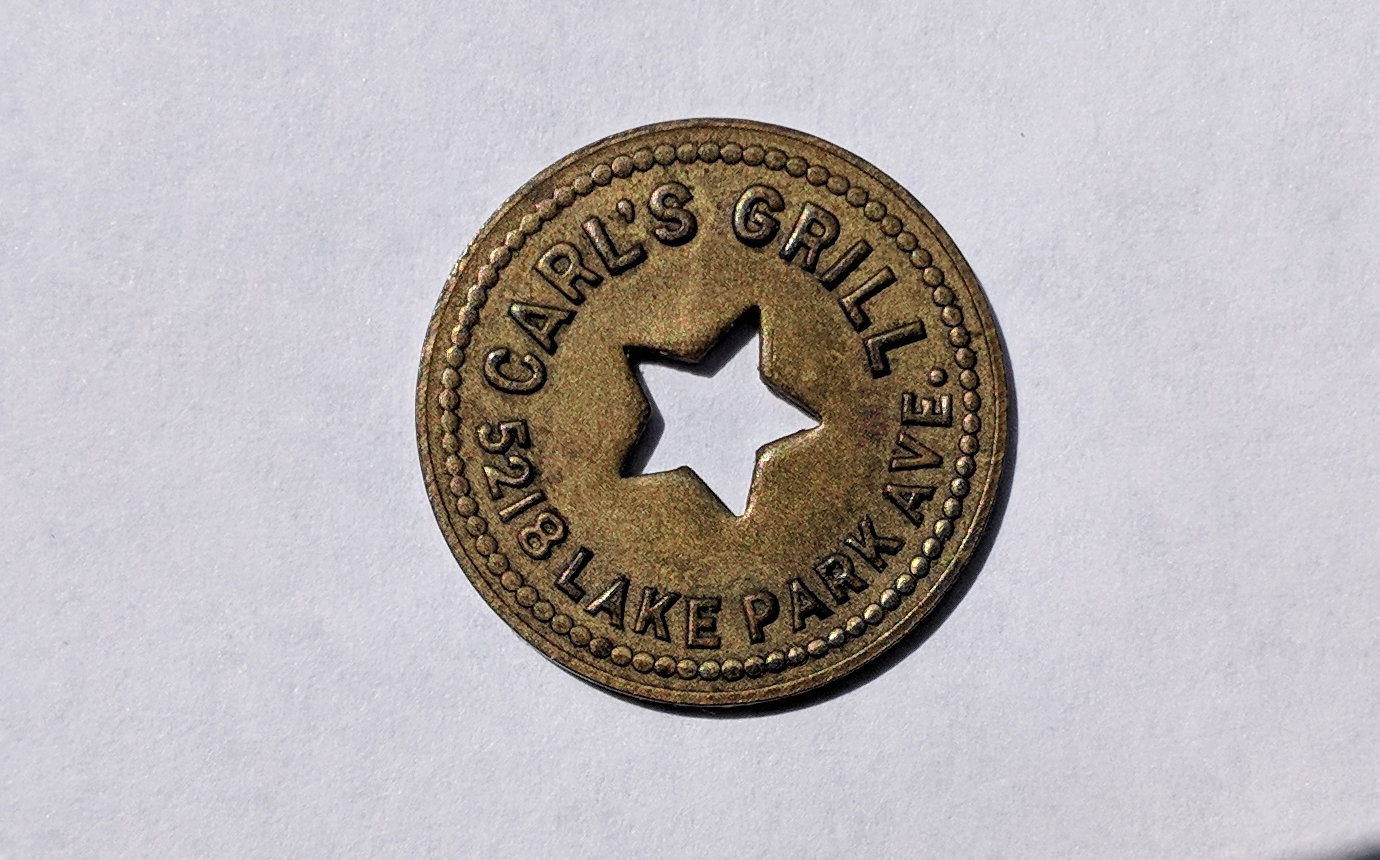
Well, I think I'll start small, and maybe soon I'll have something really interesting/worthy to share. This is a fairly common merchant token from Chicago. What makes it unusual, is that despite being common, TokenCatalog.com didn't have a picture of it...until a couple days ago. :) (reverse was over 300k, didn't have time to edit)
Considering that as of 1700 Spain still held most of North and South America, the Netherlands, its continental territories, and many islands in the Caribbean and Pacific, if they had entered a union of state with the French and their holdings in Canada, Southeast Asia, Africa and the East Indies, the amount of land they held combined would have been massive.
The remaining major territories would be held by the British Isles, Scandinavia, most of the Middle East, the Baltics, the Mediterranean (Greek/Italy), the Ottoman and Holy Roman Empires, Russia, aboriginal Australia and most of Asia including the Japanese and the Chinese/Koreans (under the Qing Dynasty.)
If a unified France and Spain had decided to aggressively expand their territories, the only likely European nations/states with the military strength to potentially resist an invasion would be the English and the German States/Austrian Habsburgs, and that's pretty much what set up the War of the Spanish Succession.
The combination of the French armies and the Spanish navies would have been effective against, say, England, which had been weakened through civil war and more recently the further unrest of the Glorious Revolution (the Dutch drove the catholic James out of power and William restored Protestantism.)
The fractious German States might not have been able to form a military alliance between, say, Saxony and Bavaria and their rivals in Prussia. if threatened by an expansionist Franco-Spanish Empire.
To say that such an outcome would have drastically changed European history and almost all of modern history as we know it would not be an overstatement. Imagine if the English had lost their colonial possessions in North America to the Spanish and the French had taken Austria, Bavaria, and the lands from the Rhine to the Vosges...
beancounter thanks for your most welcome Carl's Grill Chicago token. Congrats on your picture being added to TokenCatalog.com and all are welcome whether common or rare, beat up or mint in this thread.
paralyse, thanks for the historical view and your response to my "imagine if" post. Very interesting.
IndianGoldEagle, I especially like the Great White Fleet medal. I have one in silver. It was an impressive navy of the time and Roosevelt spoke softly and carried a big stick parading his power around the world.
Disclaimer: While a tremendous amount of effort goes into ensuring the accuracy of the information contained in this site, Coin Community assumes no liability for errors. Copyright 2005 - 2026 Coin Community Family- all rights reserved worldwide. Use of any images or content on this website without prior written permission of Coin Community or the original lender is strictly prohibited. Contact Us | Advertise Here | Privacy Policy / Terms of Use








 First Page
 Previous Page


 Posted 07/11/2018 11:11 pm