Coin Community Family of Web Sites Join Thousands of Coin, Bullion, & Money Collectors
Join Thousands of Coin, Bullion, & Money Collectors Specializing in Modern Numismatics Vancouvers #1 Coin and Paper Money Dealer Coin, Banknote and Medal Collectors's Online Mall Royal Canadian Mint products, Canadian, Polish, American, and world coins and banknotes. 300,000 items to help build your collection! Shop for APMEX Bullion on eBay!


Username:
Password:
Save Password
Forgot your Password?


This page may contain links that result in small commissions to keep this free site up and running.

Welcome Guest! Registering and/or logging in will remove the anchor (bottom) ads. It's Free!

Cleaned Coins

To participate in the forum you must log in or register.
Author Previous TopicReplies: 7 / Views: 3,341Next Topic  
Valued Member
gawd0wns's Avatar
Canada
464 Posts
 Posted 05/13/2008  12:13 pm Show Profile   Bookmark this topic Add gawd0wns to your friends list Get a Link to this Message Number of Subscribers
Does anyone have any tips on discerning whether a coin has been cleaned (with chemicals, tools, etc)? Sample pictures of cleaned coins would also be extremely helpful!

Pillar of the Community
SeatedNut's Avatar
United States
2797 Posts
 Posted 05/13/2008  2:13 pm  Show Profile   Bookmark this reply Add SeatedNut to your friends list Get a Link to this Reply
gawd0wns,

We're not ignoring you. This is a very tough subject to answer quickily. I am not at a place where I can access the photos I need for examples. Hang in there and I'll get back to this with examples.

Caveat ... I only have U.S. examples. Others may have some Canadian examples to share.
Valued Member
gawd0wns's Avatar
Canada
464 Posts
 Posted 05/13/2008  2:35 pm  Show Profile   Bookmark this reply Add gawd0wns to your friends list Get a Link to this Reply
Take your time... I have never graded, and I'm sure it will take a while to learn properly. Since I have never graded, this will give me a place to start, U.S. or Canadian, I don't mind. Would one clean U.S. coins differently than Canadian coins?
Pillar of the Community
1sikevo's Avatar
United States
1130 Posts
 Posted 05/13/2008  2:41 pm  Show Profile   Bookmark this reply Add 1sikevo to your friends list Get a Link to this Reply
Small lines going the same direction is a good sign of cleaning, so are dirt hidden in the devices. Cleaned coins also lose their luster.
Harder to spot coins that have been dipped but they are unusually bright and flashy.

If you go into my gallery (below my sig), the following coins were noted as cleaned by ANACS.

1856 Flying Eagle cent
1877 Indian Head cent
1909-S VBD Lincoln Cent
1856 Seated half dollar
Edited by 1sikevo
05/13/2008 2:48 pm
Pillar of the Community
KurtS's Avatar
United States
5318 Posts
 Posted 05/13/2008  6:02 pm  Show Profile   Bookmark this reply Add KurtS to your friends list Get a Link to this Reply
I also agree it's a tough subject, and particularly hard to quantify by photos (which makes ebay a tricky venue to buy coins).
I've found that every coin series has different aspects that stand out from cleaning, where the only coins I can discern as cleaned are those I know well--color, luster, details, etc. Sometimes photos are enough to go buy on harshly cleaned coins, but usually it's the subtle cleaning that's most critical in terms of value.
Edited by KurtS
05/13/2008 6:26 pm
Pillar of the Community
Snooba's Avatar
Australia
1360 Posts
 Posted 05/14/2008  09:51 am  Show Profile   Bookmark this reply Add Snooba to your friends list Get a Link to this Reply

Quote:
Does anyone have any tips on discerning whether a coin has been cleaned (with chemicals, tools, etc)?


"Another process that is used to clean coins, both copper and silver is called whizzing. Whizzing is a process that uses high pressure water and a brush in a swirling motion to clean the coin. Coins that have been cleaned using this process are easily detected with a 10x magnifying glass. The tiny scratches are usually not seen with the naked eye, however, when looking under a 10x glass the scratches are easily detected. No coins are going to endure hundreds of fine scratches in a swirling arrangement.

"Silver coins that have been cleaned are usually dull and sometimes the toning is left around the finer details of the coin. For example, look out for older silver coins that have a flat dull looking surface with blackish color around the small stars or other details in the coin. These coins are most likely cleaned.

"There is a process of cleaning silver coins that is called dipping. Dipping is generally accepted between collectors, since the only effect is the removal of surface yellowing or browning on uncirculated coins. The dipping solution was invented by a chemist that developed the process. Even so, a reside is left on the surface of the coin and it can be detected by major encapsulation services."

(This is directly quoted from smccoins ebay page.)


"If the coin has been cleaned with an abrasive, the coin will have hairlines. Also, abrasive cleaning often leaves some crud in the recesses of the coin (untouched dirt or left over abrasive).

"If the coin has been dipped, it may or may not be detectable. A bright white 1801 half dollar is immediately suspect. Although it is possible for such an original coin to exist, it is unlikely. Also dipping can strip the lustre off of the coin, with the end result that there is no lustre where you would expect it to be for a coin in said condition (XF and better coins).

"Copper/bronze/brass coins that have been cleaned have an unnatural color, often looking like a toned gold coin. Even after they re-tone, they tend it tends to be uneven and a slightly odd color (watch out for dark areas).

"Exactly the other way around, silver coins that have been cleaned tend to be extremely uniform in color after they re-tone, including the tops of the letters and protected areas. Silver coins with natural toning will usually show some variation in the color at these places. Be aware that a uniform slate gray color can be produced on silver very easily with a number of chemicals. Finally, a heavily toned and subsequently dipped silver coin will tend to have a gray appearance caused by surface roughness rather than tarnish. This can be detected by careful examination with a strong magnifier.

"The ANA advises that sudden "hard line" changes in color do not occur on naturally toned coins. Naturally toned coins exhibit a gradual change in color or darkness."

(This is directly quoted from Telesphere Numismatics web site.)


"Magnification is the best way to differentiate weakly struck coins from worn-die and lightly whizzed coins. On weakly struck coins, flow lines will still be present and luster will still "cartwheel." Worn-die coins may not have much "cartwheel" but still may have radial flow lines often the result of die erosion. Whizzed coins will appear smooth, and because the flow lines have been disturbed, they will not have normal "cartwheel" luster, but rather a diffused look.

"In yet another form of surface alteration, the surfaces of Proof coins are heated to actually melt the hairlines or other defects. This method may involve anything from a match held under the surface for a few seconds to a high temperature torch selectively applied to a specific area. Coins altered in this manner sometimes have a wavy look or different "depth" to the mirrored surface. These clues are especially noticeable on Proof gold coins, since the surfaces are so delicate. Also, many Proof gold coins have "orange-peel" surfaces that are flattened by this method. If the mirrored fields vary across the surface of a coin, heat treatment of the fields is often the cause.

(This is directly quoted from the PCGS web site.)

Edited by Snooba
05/14/2008 09:57 am
Valued Member
gawd0wns's Avatar
Canada
464 Posts
 Posted 05/14/2008  10:40 am  Show Profile   Bookmark this reply Add gawd0wns to your friends list Get a Link to this Reply
Thanks for the replies. It sounds like quite a bit to consider. I have often seen silver dollars on ebay, which look like pieces of lead. Now I know why!
Pillar of the Community
SeatedNut's Avatar
United States
2797 Posts
 Posted 05/14/2008  10:50 am  Show Profile   Bookmark this reply Add SeatedNut to your friends list Get a Link to this Reply
We should probably discuss circulated coins and uncirculated coins separately since the diagnostics are very different.

For circulated coins, use everyday examples as templates. A common, uncleaned circulating coin will display even wear starting at the high points of the design. It will acquire coloration (staining or toning) uniformly on the surface, but this may be rubbed off on the highest points if the coin circulated after toning was acquired.

Cleaned circulating coins may display surface scratches or abrasions from contact with a wire brush, rubbing with a cloth or other cleaning tool. These scratches are normally most evident in the fields and are uniformly in the same direction. Magnification may be needed to see them, but on harshly cleaned coins the naked eye can pick this up.

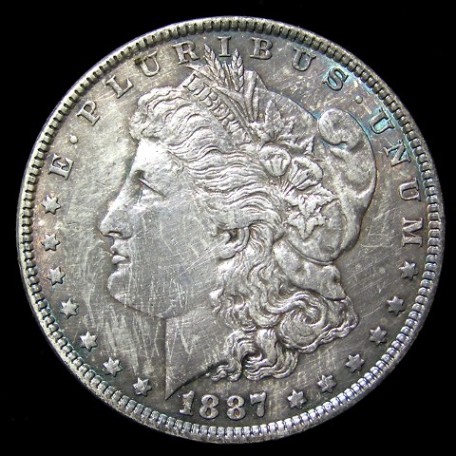
Another diagnostic is residue (dirt or toning) in the recesses of the design with clean fields on the rest of the coin. Normal abrasive techniques can't reach the recesses, so that material remains. Here's an example that shows both scratches and residue left in the recesses:


Cleaned-Coins

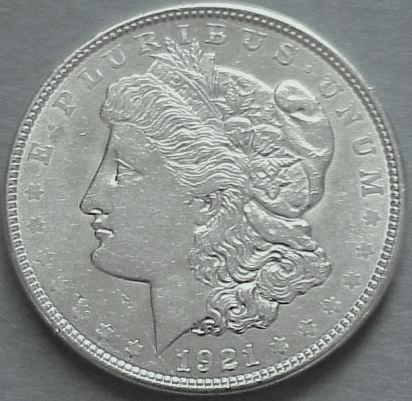
A uniform color (either dull or shiny) may also indicate a previous cleaning. If the coin looks different from other normal circulating examples, be suspicious. Here's an example:


Cleaned-Coins

Note the uniform color on this 87-yr-old coin. You can see wear on the high points of the design that indicate circulation, yet it displays no coloration or toning anywhere on the coin. This coin show some toning.

For uncirculated coins, the biggest problem is "dipping". If an uncirculated coin acquires toning, some coin collectors can't stand it when their prize doesn't look like it just came from the press. The minting process leaves the newly stamped planchet with "mint luster" caused by the high pressure and metal flowing into the recesses of the die. It creates a cartwheel effect that can be viewed by holding the coin where light reflects toward your eye and rotating the coin. It will appear like windmill blades or cartwheel spokes. Coin dips use a form of acid that removes sulfur oxides from metal surfaces (toning) and some of the original metal, too. If dipped numerous times, the surface luster and cartwheel effect are lost. This is very hard to see from a photo and single dips may be undetectable. But ask yourself ... will a 100-yr-old uncirculated coin look the same today as it did in 1908. Unless it was stored in the correct environment (uncontaminated and airtight), the answer is "no". All will acquire some color. Pure white examples of silver coins probably have had some help. Bright red coppers even more so. Finding high-mint-state examples with untouched surfaces is very hard to do.

Thanks for listening ... I'll post more examples as this post progresses.
  Previous TopicReplies: 7 / Views: 3,341Next Topic  

To participate in the forum you must log in or register.


Disclaimer: While a tremendous amount of effort goes into ensuring the accuracy of the information contained in this site, Coin Community assumes no liability for errors. Copyright 2005 - 2026 Coin Community Family- all rights reserved worldwide. Use of any images or content on this website without prior written permission of Coin Community or the original lender is strictly prohibited.
Contact Us  |  Advertise Here  |  Privacy Policy / Terms of Use

Coin Community Forum © 2005 - 2026 Coin Community Forums
It took 0.33 seconds to rattle this change. Forums