| Author |
 Replies: 14 / Views: 8,175 Replies: 14 / Views: 8,175 |
|
|
New Member
United States
3 Posts |
could anyone help with what I have here?  |
|
|
|
Pillar of the Community
7234 Posts |
That's very common on LMC's - was a commom place to have the reverse dies overpolished getting them letters gone. If you roll search cents you will see this area affected quite often |
|
Bedrock of the Community
United States
79001 Posts |
Just as Mark said it, a very common place to get overpolished. You will see this a lot when CRH. No extra value for this, but it's still interesting.
Errers and Varietys.
|
|
Rest in Peace
United States
17900 Posts |
Worth saving as an example, but not much value.
|
|
New Member
 United States
3 Posts |
Thanks guys, I'm new to this and just learning. Got a lil excited for a sec....lol
|
|
New Member
United States
3 Posts |
Caught my attention as I found it with another 72-d that seems normal except they both look almost new.
|
|
Rest in Peace
10197 Posts |
Jrp, yep, just a grease filled strike or product of trying to repair problems on the dies.
|
|
Moderator
 United States
195559 Posts |
 to the Community! |
|
Bedrock of the Community
United States
17884 Posts |
Not over polished, possibly some grease, and it is also opposite the base of the Lincoln bust that requires a lot of metal to fill. During the strike the big open void of the bust fills first and then the reverse lettering starts filling. If strike duration is to short, or pressure isn't high enough you get weak or missing letters in that area on the reverse. Same reason why you see weak or missing details opposite a large Cud. The Cud fills first and until it does there is no pressure to fill the other side. Edited by Conder101
12/08/2017 11:19 am
|
|
Bedrock of the Community
United States
94367 Posts |
Keep looking! to the CCF! |
|
Pillar of the Community
United States
1696 Posts |
Here's another possibility: is the planchet thicker on one side than another, with the thinner edge next to the "States of"? I have a couple of 1972-D cents like that; the weakness of the strike is due to the unevenness of the planchet.
|
|
Bedrock of the Community
United States
17884 Posts |
If it is a tapered planchet you will see similar weakness on the obv as well.
|
|
Pillar of the Community
United States
7587 Posts |
 as mentioned above, a Greaser and very common. |
|
Pillar of the Community
United States
5964 Posts |
to the Forum. It looks like a Greaser to me. Excess grease sometimes fills voids on the die and blocks normal formation of devices on the coin. It can completely block some, and usually affects nearby devices to a lesser extent. Edited by CoinMasters
12/09/2017 11:03 am
|
|
Pillar of the Community
United States
1696 Posts |
Here is an example where I think the weakness is not due to a grease-filled due, but insufficient strike-up due to the misalignment of the dies hitting the planchet. Note the planchet is thinnest on the side where the strike is weakest: 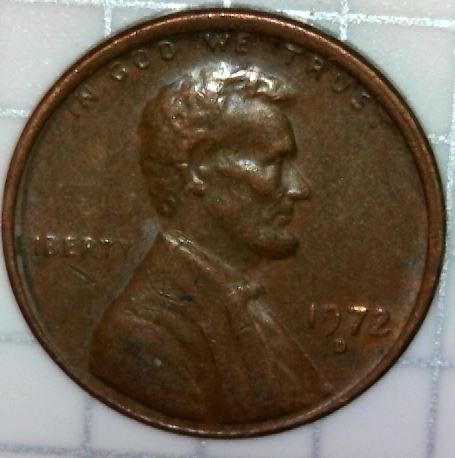 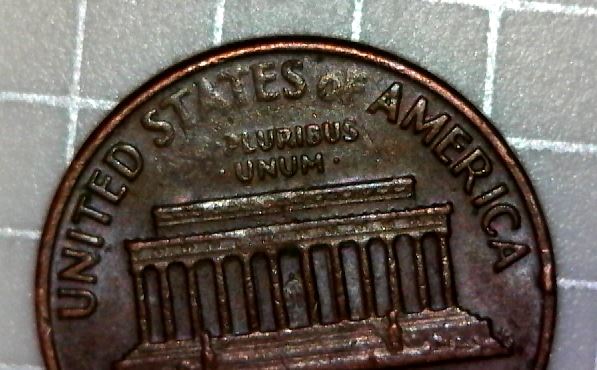 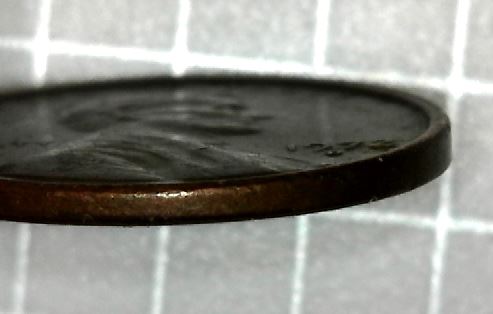 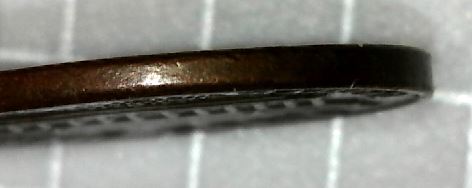 jrp183- what does the edge of your coin look like above "states of"? Is it thinner there? I'll defer to the experts here, however! |
| |
Replies: 14 / Views: 8,175 |
|






 Posted 12/07/2017 8:16 pm





