Dr. Courteau identifies 36 different varieties (76-110 inclusive)of this series. A number of new varieties have been documented.
Dr. Courteau separated this series into three primary groupings. Group I (76-88 inclusive) have a coinage (upset) die-axis. Group II (89-100 inclusive) have a medal (straight) die-axis and perfect letters. Group III (101-110 inclusive) also have a medal (straight) die-axis, but defective "A.s" in CANADA (usually the 3rd).
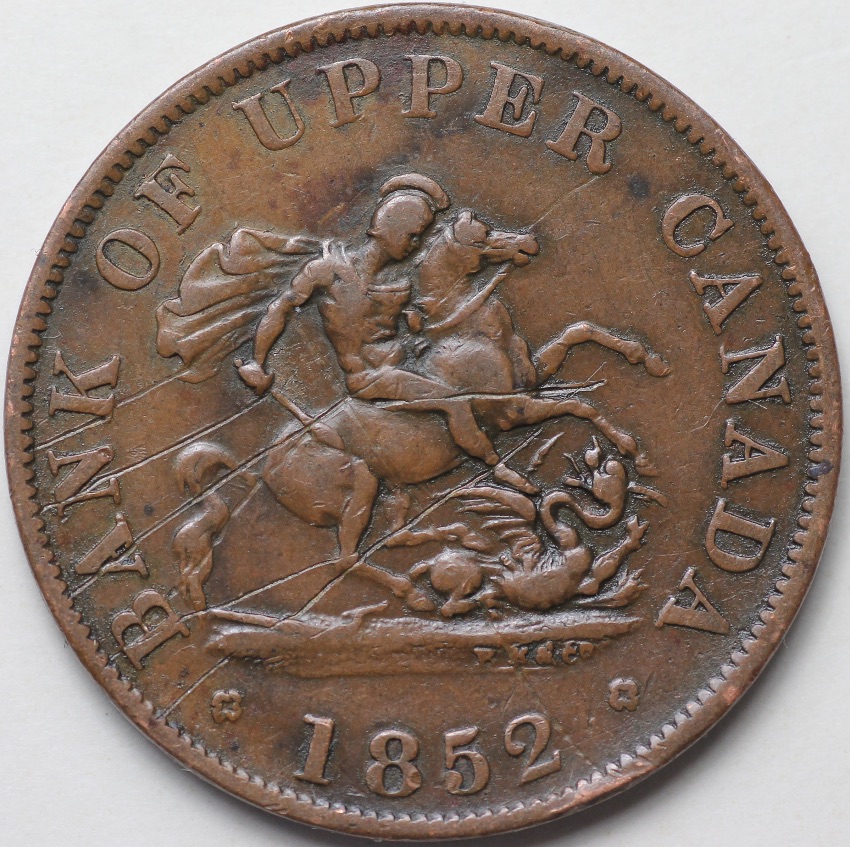
You claim yours is a coinage die-axis, thus this is a group I.
Dr. Courteau is concerned whether the Man's left foot is fully struck, 1/2 struck, or missing. And the placement of the numeral 2. Whether or not the Stands of the T and N in TOKEN are fully or weakly struck. The Strike of the outline of the Union Jack (opposite the KE in TOKEN). The completeness of the St. Andrews cross frame opposite the E in TOKEN. And a host of other details.
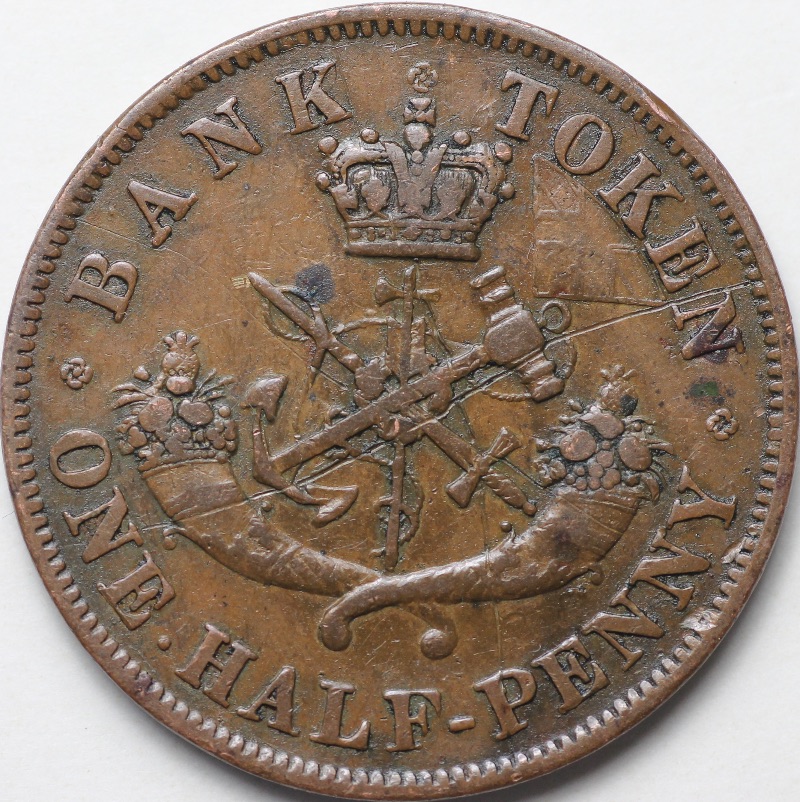
After all is said and done, yours appears to be variety 84. The quotation from page 13 of Courteau's work concerning variety 84 is as follows:
"Obv. Man's l. foot is half struck. Stand of N of CANADA with its left weakly struck. Perf, and brok, dies, wavy crack to letter C on ground, close to r. rosette.
Rev. The U.J. outline below letters does not extend to bottom of Shield, St-Andrews cross frame below E is broken in the middle. Sometimes with die-crack to F to the left. R. 1."
A cut and paste of my expansion of variety 84...
84 R-1 Coinage Die Axis.
Obverse Characteristics:
A round Knob is to the Dagger Hilt.
The upper outline of the left Wing of the Dragon shews well.
The left-side of the Stand of the left Upright of the N in CANADA is complete, but not as strongly struck as the right-side. Note - Doctor Courteau describes this as 'weakly struck.'
The remaining Legend is Perfect.
The Date is Perfect.
The left-end of the numeral 2 is on-line with the right-side of a Denticle.
The numeral 2 is nearer the numeral 5.
The left-side of the numeral 2 is nearer the Denticles.
An imaginary line from the right-side extremities of the numeral 2 (the upper right corner of the vertical of the base, and the apogee), extends to the right end of the Stand of the right Upright of the initial H in the abbreviation below the ground.
Two very faint Lines are below the Man's right Arm.
The Man's left Foot is half struck. Variety 79 also has a half-struck foot.
The upper section of the Foot (betwixt the tip of the right Wing of the Dragon and the Belly of the Horse) is weakly struck. On high-grade specimens, faint remnants of the lower section of the Foot, below the right Wing of the Dragon are detectable.
The left Bridle Rein is weakly struck.
No horizontal lines below the left Wing of the Dragon shew.
The Belly of the Horse is double-cut.
Some specimens are found exhibiting Shift-Entry doubling.
Some specimens are blurred, which is probably the result of a loose die.
Die-Clash marks are behind the Man's Back and above the left Wing of the Dragon.
The Die-Clash marks above the left Wing of the Dragon are mimics of a segment of the Anchor Rope Dots. The segment terminates near the terminal of the same Wing.
The Die-Clash mark behind the Man's Back is from the lower section of the Anchor Shaft; the line extending to the right is from the Anchor Arm.
Extensive vertical rippling encompasses the area betwixt the Man's Hip and right Fist.
The rippling is inconsistent with any reverse design element.
Note - Early Die-States do not exhibit the Clash-mark.
From perfect and broken dies.
A Die-Crack is the initial C (below the ground).
This very crooked and irregular Die-Crack is from the centre of the Denticle to the immediate left of the right Rosette, extending to the initial C in the abbreviation R H & Co., below the ground.
Note - This Die-Crack is similar to variety 86. Variety 84 originates from the left section of the Denticle and extends to the base of the same 'c', whereas the Die-Crack on variety 86 originates from the right section of the same Denticle and extends to the left of the same 'c'.
A Die-Crack is to the O in OF.
This faint Die-Crack is from the left-side of the Denticle above the left-side of the O in OF, extending to the upper left section of the same letter.
Latter die states have the Die-Crack exiting the lower section of the left-side of the same letter, on-line with the left-side of the inner circle, and exiting to the vertex of the 3rd and 4th Mantle Folds.
Note - This Die-Crack was not mentioned by Doctor Courteau.
A Die-Crack is to the O in OF. (another).
This faint Die-Crack is from the centre of the Denticle to the immediate left of the O in OF, extending through the left-side of the same letter, and exiting to the corner of the 4th Mantle Fold.
Note - This Die-Crack was not mentioned by Doctor Courteau.
A Die-Crack is to the Mantle.
This diagonal Die-Crack is from the centre of the 2nd Denticle to the immediate right of the F in OF, extending slightly to the left of the corner of the 3rd Mantle Fold. This Die-Crack runs close to the same letter.
Note - This die-Crack was not mentioned by Doctor Courteau.
Reverse Characteristics:
The Anchor Ring is Perfect.
The Anchor Rope ends with a Dot and a small line.
The Battle Axe has a hole.
Four Dots are betwixt the Feather and Anchor Shaft.
The Legend is Perfect.
The outline of the Union Jack does not extend to the bottom of the Shield.
The outline of the Union Jack from the mid-section of the E in TOKEN to the terminal, is slightly double-cut. Both branches are of the same length.
The St. Andrew's Cross frame below the E in TOKEN is broken in the middle.
This is a long break. The 'break' is actually a very weak section of the St. Andrew's Cross frame. The upper half of the Cross frame shews well; only a stubby end of the lower half shews well.
A line is from the left-side of the Ring Band near the upper end of the Anchor Shaft, extending to the upper section of the 2nd Dot of the Anchor Rope betwixt the Feather and Anchor Shaft.
The inner ornamental Balls are not connected to the Cornucopia.
Some specimens are found having random markings encompassing the Anchor.
At present, the author is unable to identify these as Die-Clash marks. The markings are not consistent on the specimens.
From perfect and broken dies.
A Die-Crack is to the F in HALF.
This straight Die-Crack is from the right-section of the Denticle betwixt the L and F in HALF, extending to the upper section of the left-side of the Upright of the same F, nearly touching the left-side of the Stand of the same letter. The Die-Crack exits the Serif of the same letter and curves to the vertex of the Cornucopiae.
Note - This Die-Crack is similar to that of variety 82, but each originates from different Denticles, and each follows divergent routes.
Thus:
84 Perfect - no Die-Cracks
84A A Die-Crack is the initial C (below the ground).
84B Die-Cracks as above, plus a Die-Crack is to the O in OF.
84C Die-Cracks as above, plus a Die-Crack is to the O in OF. (another).
Die-Cracks as above, plus a Die-Crack is to the Mantle.
Die-Cracks as above, plus a Die-Crack is to the F in HALF.
This is the Die-Crack progression.
Concerning your token, scratches and all, a little cleaning should not have any adverse affect on the value. Absent any cleaning, die-cracks and clash marks (if there are any) may remain forever hidden. If mine I would try a little liquid dish soap and work it in with a soft bristle tooth brush. If this is not sufficient, a soak in Acetone. And if really stubborn, MS-70 or similar solution, followed by a rinse in Acetone and a dusting of WD-40.
p.s. Yes, I am fully aware of the current taboo against cleaning.
Enjoy
doug
Edited by colonialtokens
12/19/2017 7:06 pm







 Posted 12/19/2017 12:20 am



 run out of room to post with my token.