@moxking, I'm doing my best with the titles. I acknowledge that it is a bit of a challenge to write titles that are informative and helpful, without loading them up with numismatic jargon. Glad that you liked my final result.
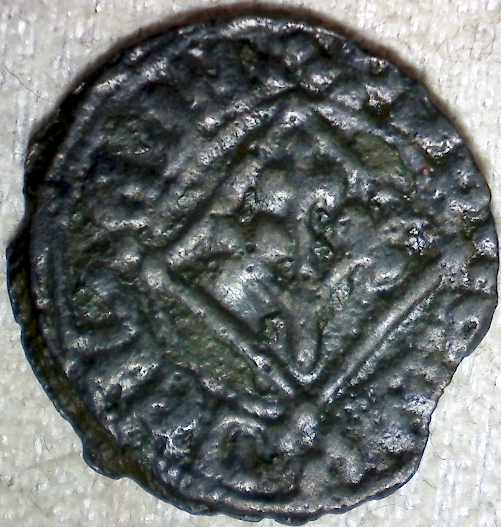
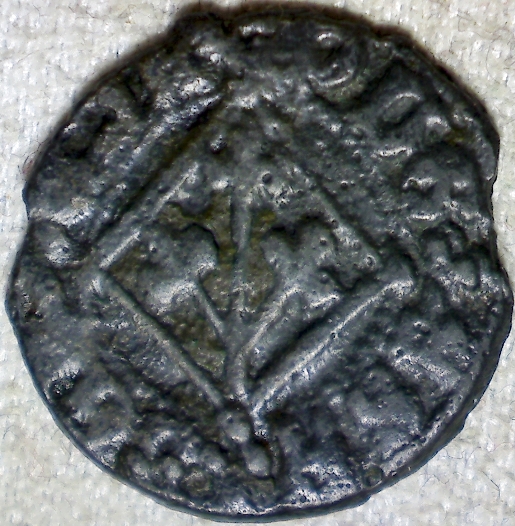
@finn, yes good questions, for which I'm afraid I don't have loads of answers. In general, the Pugesa seems to be a very low value coin so, I'm thinking it severed as very small change. This is only my second coin of the 14th Century that is not silver, and the other being a copper Cruzado of royal Spain. The weight of these two pieces are similar--roughly 2 g, but the diameter of the Pugesa is only 18 mm vs. 22 mm for the Cruzado. Spain must have had pretty significant copper deposits (as compared to elsewhere in Europe) as medieval copper coins seem to be very rare outside of the Iberian peninsula. In my brief reading on this subject, it seems that the Pyrenees had at least some of these deposits, although it isn't clear to me why Toulouse wasn't also generally minting copper coins too as this region of France also shares this mountain range.
For what it is worth, here is the Google translation of the es.wikipedia page on Pugesa (cleaned up slightly by me for readability, although I'm not 100% sure that I have the correct relationships among the denominations):
Quote:The pugesa is an old local Catalan coin from the Lerida area, minted from the end of the 13th century until the 15th century. It was minted in copper and brass, and was worth a quarter of a "money unit". 1
The name derives from the Occitan city Lo Puèi, from where it originated. 2
The creation of the pugesa probably had to be based on the excessive value of the royal money (each "money unit" was equal to one quarter of a silver coin) and also of its divisor, the half money (obol), in economically depressed areas or at very low price levels, which needed a smaller fraction. Thus arose the need to coin obolos or quarters of "money units". This value of a quarter of "money unit" was already called pugesa previously, although there was no physical currency that had this value. With the creation of the pugesa, this value stopped being a unit of account to become a physical currency. 3
The best-known pugesa was that of the city of Lleida, always carrying the triple heraldic lily of the city in front and back, and the legend "PUGESA DE LEIDA", with slight variations. Its approximate weight and diameter was 2 g and 18 mm respectively. Pugesas medias were also issued.
Pugesas were also coined in towns near Lerida, such as Àger, Agramunt, Almenar, Balaguer, Camarasa, Cubells, Fraga, Ponts and Vilanova de Meià . 4
The devaluation of the money of
The Royal Mint, from the 15th century, caused the disappearance of the pugesa, being replaced in some populations by local senyals of copper or brass, valued at a "money unit". 2
These types of local currency had fiduciary character, that is to say, they had no appreciable intrinsic value but rather circulated as exchangeable currency for official currency, guaranteed by a deposit in gold and silver in the respective municipalities where they were minted. 1












 Posted 01/01/2018 6:35 pm


