| Author |
 Replies: 73 / Views: 8,816 Replies: 73 / Views: 8,816 |
|
|
|
Pillar of the Community
United States
5362 Posts |
In a photograph you can see things that are not there especially when dealing with low pixilation. So I agree the sellers pictures of the coin in the scratched holder look far better than the PCGS photos. I prefer to see the best quality picture not a sub-par view under unknown lighting. As to expertise in this series, I do believe I qualify as one of a handful of true experts in the Cap and Ray series. I am more familiar with this series than the Portrait 8Rs. One absolute fact that people are missing in this discussion is that a numismatic forgery can match a genuine coin EXACTLY. You can not rely on precise correspondence as enough in authentication. Otherwise the Micro-O Morgans must be genuine. PCGS, NGC and ANACS all encapsulated those varieties as genuine and we all know that every one was WRONG. One thing that does not add up here is the appearance of the spots on the coin that the new owner says are INCUSE. I will resort to a sketch to describe what I mean. 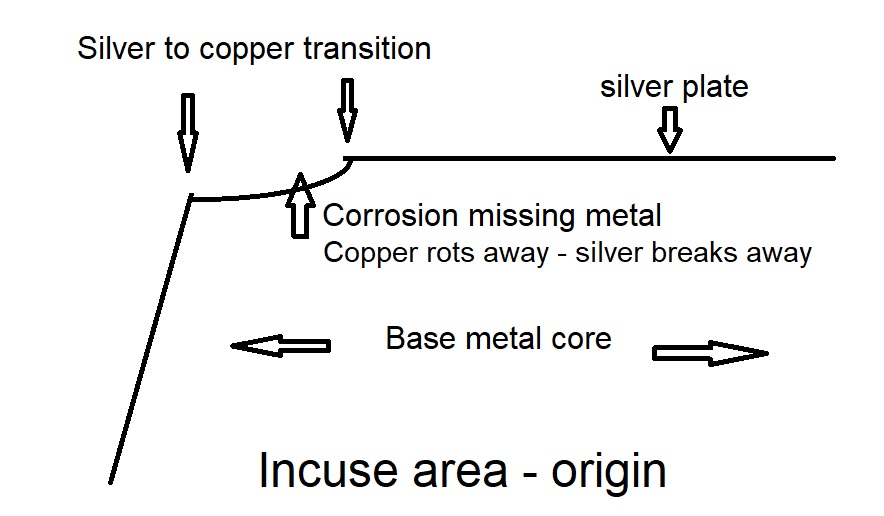 20021sc 20021sc Is this what you are seeing? Here are a few from your coin where I see a clear raised silver edge above the corrosion. 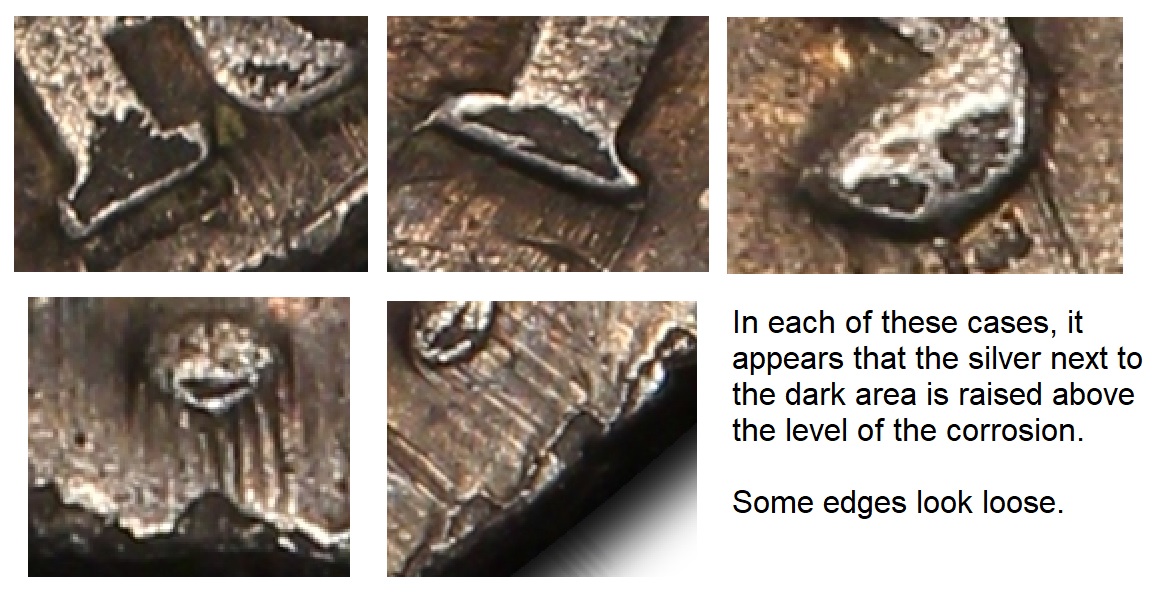 Here are similar silver edges each on a confirmed counterfeit. 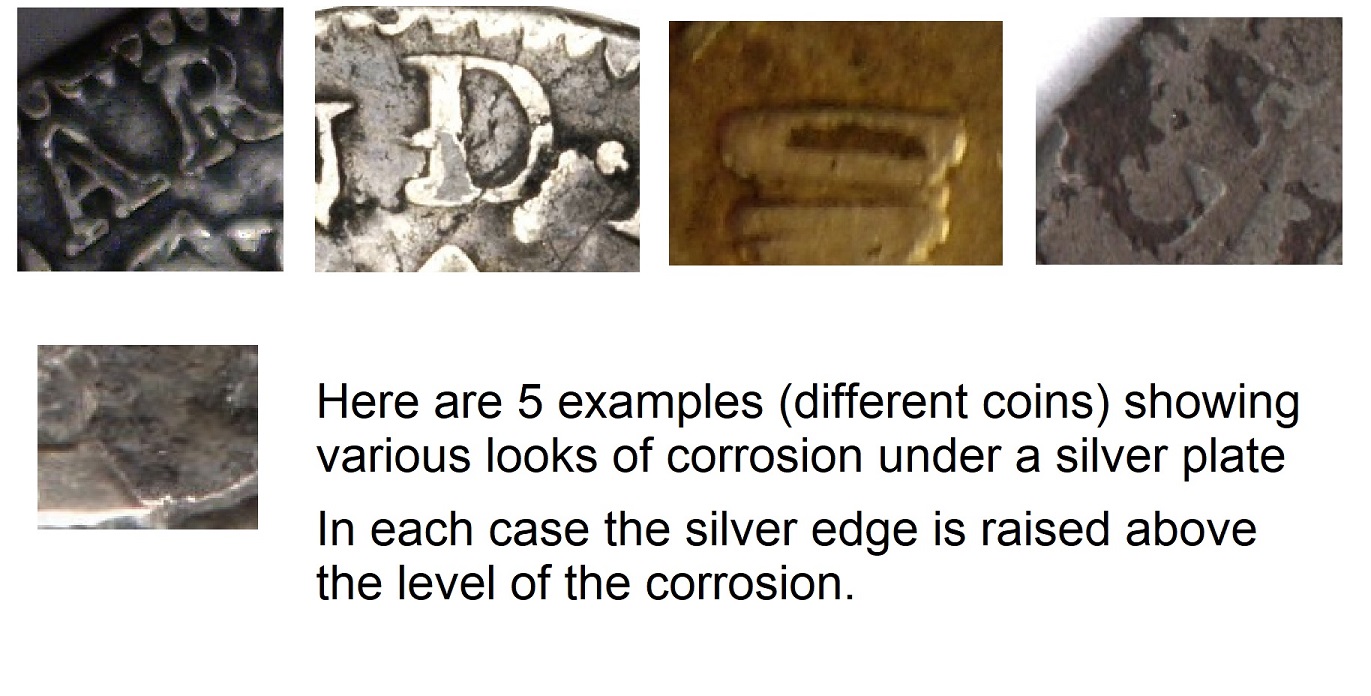 |
|
Valued Member
 United States
93 Posts |
swamperbob : It is difficult to tell in all of the dark areas if it is fact incuse. If you wouldn't have brought it up, I would have never noticed. Again, I'm now using a 40x loupe and can see the surfaces well in natural light. In these hard to tell places, if it is incuse, it is not deep drop offs (maybe that's a matter of opinion though), seems to be an even surface level (counting the black areas) for the most part where these transitions in coloring are. And it does not look like a build up of dirt like in a mound raising above the lettering either, but I would guess dirt that has filled the incuse areas if it is truly dirt, tarnished copper, or whatever it is. Again, I'm guessing as best I can in most areas. I can't rule out silver tarnishing for making and filling these black areas, maybe you can, you know more than I know, no doubt about it.
But in other places - the first 6 in the date, the second 6 to a lesser extent, the 2 in "20 Gs" - and you can indeed tell the dark areas (and some silver colored areas too) are DEFINITELY BELOW (incuse) the surface of the silvered letters & numbers. The 2 in 20 Gs doesn't have as much black in those suspected incuse areas when you look at it compared to other letters, so it's quite apparent there.
The G in 20 Gs is the best spot to see what does appear to be a silver layer that is "loose" or looks like a plating to my untrained eye anyway.
Your bottom left picture of the dot and the edge of the coin, where on the coin was that taken? It looks like layering is gone there and I wanted to see more of that area, but not sure where that was. I know, I should be able to find it on the coin in my hand, but I just am having a hard time there.
The five pictures you provide of known corrosion under a silver plate: The first pic looks way more extreme than anywhere on mine, but maybe. The second pic on the D : The right part of the D that is dark looks similar, but not the left side of the D where it is apparent the plating is coming off. Other then the G I mentioned in 20 Gs, no where else did I see an apparent "flaking" or "looseness" of the plating if there is any, especially like on the left of that D in your pic. And that G on mine is more of a flaking of a pitting type nature than a complete piece that flaked off. I know that's not a very good description, but that's where I noticed a flaking look the most. The 3rd pic's answer is no, I don't see that. 4Th pic: Nope, not like that either. 5th pic: not really.
And what about the eagle side? There does not seem to be any of these incuse areas or black areas like on the cap side? Seems to be a completely different story on the opposite side. I would think the plating theory would say that that side has a heavier plating is why? I don't know. But then it takes me back to that post strike heavy gouge in the center of the eagle. If it were plated, it would seem to me that the gouge is so deep there that the underneath element would be exposed?
Realeswatcher from what I'm taking thinks maybe a planchet (or die maybe), defect could have caused this? I kind of feel the same way, but am certainly no expert and - I know I've said this many times - I just want to know if the coin is real because I don't collect counterfeits and want a real example. Swamperbob, I can see how you would rule out a defective die since there would have to be a build up on the die to do these incuse areas, but isn't that possible that a die could have a build up?
And realeswatcher : Thank you for the heads up on the other 1866, but after all this, I'm stepping back for awhile. At least until this issue is hopefully resolved.
I did inform the seller of there is a suspicion of the coin's authenticity and that I intend to contact PCGS Monday to see what I can find out. And I would keep him informed. He seems like he's taking it pretty good and certainly seems surprised PCGS could make such a mistake on such a rare coin.
Again, Thanks to all. Swamperbob, I hope these answers of mine help some?
|
|
Pillar of the Community
United States
5362 Posts |
20021sc The picture of the stop is the one between the 10 Ds and 20 Gs. I rotated the image. It looks like the plate there is peeling away very slightly near the edge. I would suggest that before you spend any more money on collecting that you spend $100-200 on a binocular grading scope. The ANA sells a very low cost scope that is great at 30X. The binocular feature is essential it will allow you to see depth clearly. You do not need to start with a lab scope that costs $500. But you do need something better than a monocular 40x loupe for authentication. The first picture of mine that you ask about is an extreme case of the loss of subsurface material on a counterfeit with a silver surface. It is in fact the only one its type that I have ever seen and I classify it as one of the rarest forms of forgery identified by Bordeaux in 1796. The surface is a silver impression of a genuine 8R. This foil was laid over and "glued" to a core of copper. It is a purely "mechanical bond". The letters and all details began to collapse as the material underneath, presumably the "glue" deteriorated. The tops of individual letters actually sagged downward at the center while the edges of the letters stood taller. The black in this case is silver sulfide - natural black silver corrosion. Each of the photos shows a different form of silver plate and all are contemporary counterfeit types. The second picture of a D is from a standard late Sheffield Plate coin made after 1820 with a very thin plate. It is a hot weld type but the subsurface may not have been properly prepared and some minor delamination resulted. The photo shows two small pieces of silver plate that became loose. The small one located on the upright of the D is a fold over from the upright. The larger one in the field next to the D is raised slightly above the surface and could be pulled off. This form of detachment with minimal corrosion is scarce and normally points to an initial bonding failure. This is the technique that was used on most C&R types and often overlies German Silver. The Third photo is of an extremely early Sheffield Plate coin made no later than 1796. It is thick sheffield with a ribbon edge. The core is nearly pure copper 99%. The silver and copper are hot bonded and the wear exposed the core at the coin's high points. There is no hint of delamination anywhere on the surface - typical of the early Birmingham Sheffield Counterfeits. The forth photo of a corroded C is a cold rolled Sheffield where the bond in large areas failed and significant corrosion developed under very large areas of the coin's surface. The cold welded technique relied on the weight of the rollers to bond copper to silver. The bond produced was not the greatest and therefore most examples are easily detected. The fifth picture came out poorly but shows a seam between a bonded section of an 8R - the C at the far left is the only detail visible - the rest is the core only showing almost no detail remaining due to corrosion. I do suspect that your coin is likely a thin hot welded Sheffield like the coin in the second picture. Here is a certified example of a Cap & Ray Sheffield. It is the Riddell # 221. 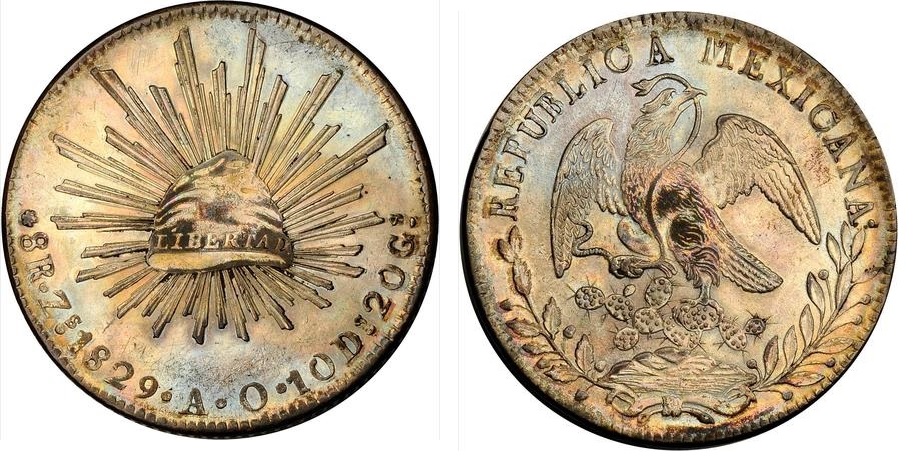 Here is a PCGS certified example of the Riddell # 237 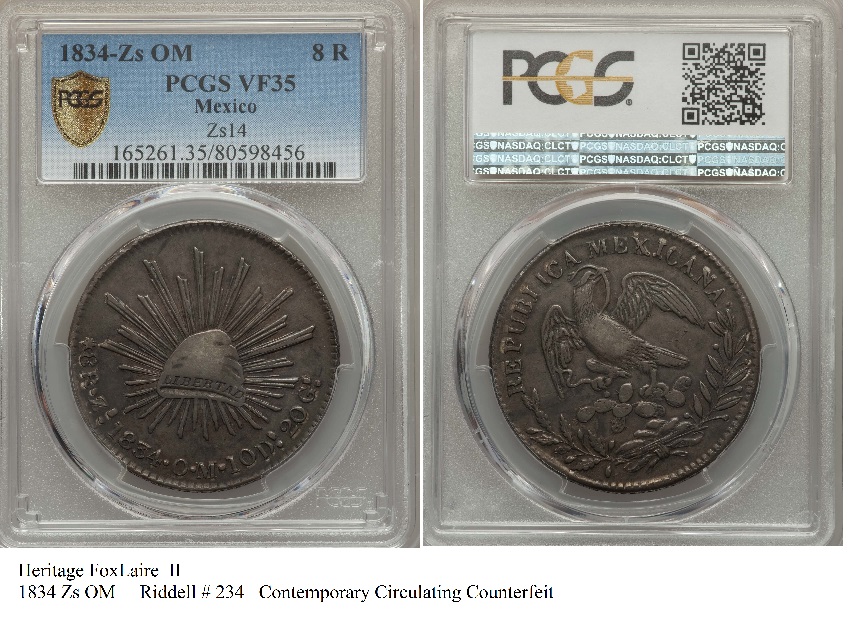 Here is another example fro PCGS 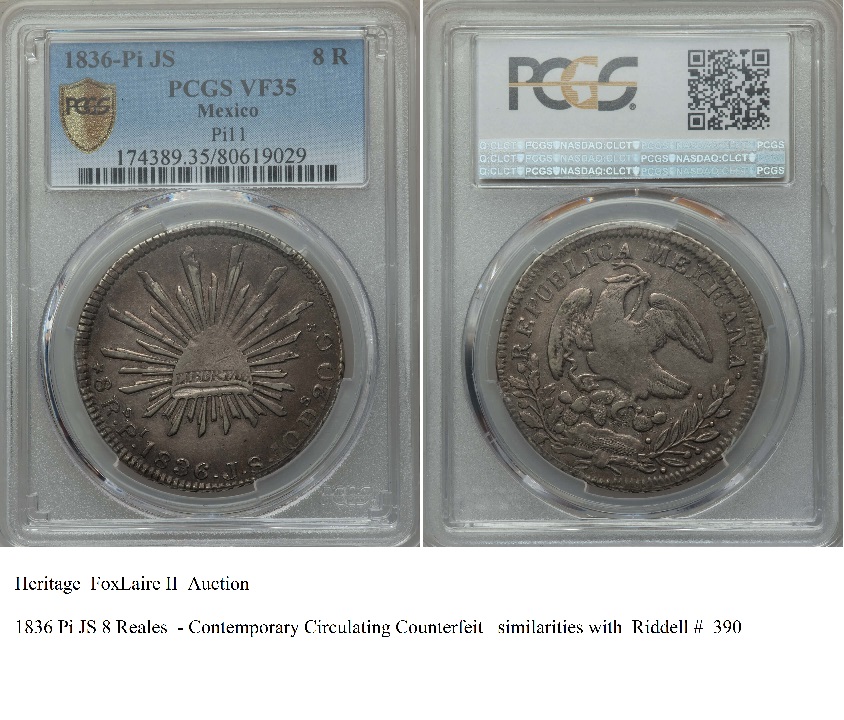 Another PCGS 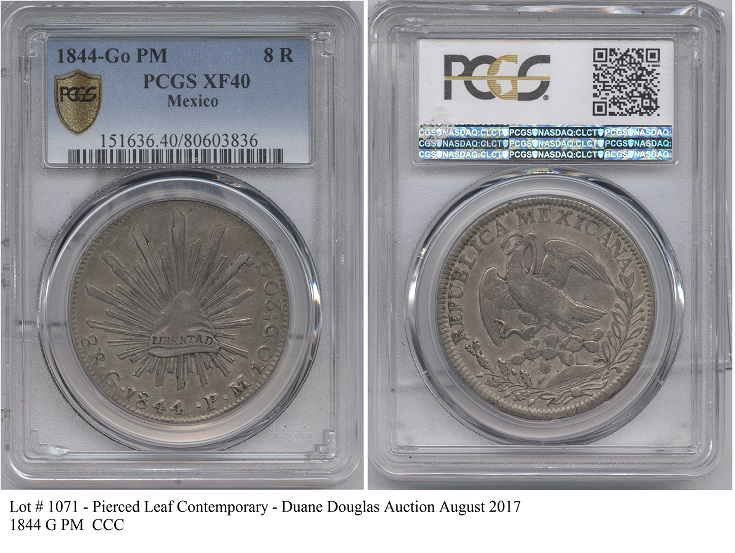 One from NCS which is now NGC 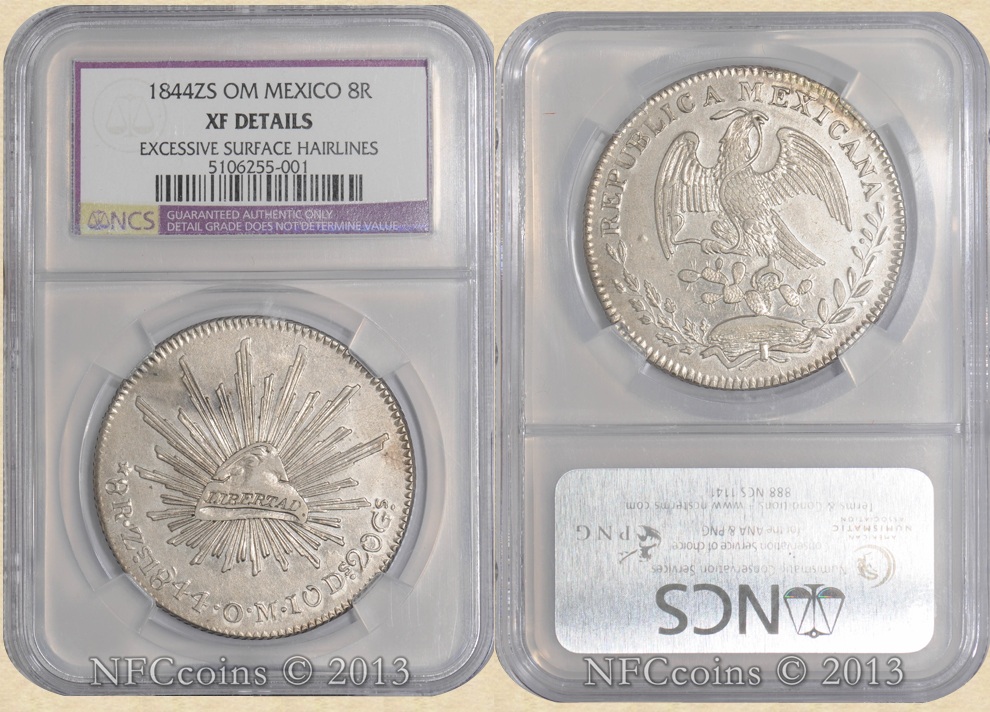
|
|
Valued Member
United States
93 Posts |
Swamperbob : Thank you very much! Excellent advice (even on the binocular grading scope. I agree, will be money well spent). But also mainly because I have more doubts now than ever before that the coin may be legit. All based on what you made clear (the light bulb finally went off in my head after your last reply).
I called PCGS this morning and I was NOT impressed with the answers I received. The woman in customer support said first off I should send it back to them for a "holder test" at my expense. No problem so far. Then she said they would authenticate it inside it's holder. If it was counterfeit, they would simply put their "X" on it (and "deface" the holder she said) and return it to me. Nothing more, nothing less. NOT WHAT I WANTED TO HEAR!
I explained to her that a couple of experts I've been in contact with said the coin needs to come out of it's holder more than likely to be authenticated properly. She said in that case, I would have to join PCGS (I'm not a member and never will be after this experience), fill out a submission form and have it retested at my expense all over again. I asked what if it was found to be a counterfeit, would PCGS reimburse me what I paid for the coin? She was very vague about answering any more questions and said to join PCGS and to go to their web site and read their rules about that.
I've decided: Nope, not going to do all that. I've contacted the seller (waiting on his reply as I write this) and requested that I return the coin for a full refund as I'm still in my 14 day window for that option.
After your last post swamperbob, I can see why you think it is what it is and you may certainly be right. I'm not playing any games on "what ifs" with PCGS when it comes to this kind of money.
A lesson well learned by me at my late stage of the game.
I only hope this thread goes on for a long time as I would think it should be a BIG wake up call to numismatists as to what some of the policies are at PCGS.
Thank you and everyone that commented on this subject. I learned a LOT.
And I will update the thread on how the return goes. it's the route I decided on. And I'm so glad I posted this when I did. Although it still may leave doubts as to the authenticity of the coin, I'd rather be "safe" than sorry.
I know you wanted to know more about the origin of the coin, swamperbob & I will keep you informed through this post on anymore updates, but this coin is going back to where I received it from.
|
|
Pillar of the Community
United States
1767 Posts |
https://coins.ha.com/itm/mexico/wor...bnail-071515Not to add fuel to the fire but realeswatcher makes a good point. I did go to the Heritage sale of April 2016 and did view several high priced Chihuahua Mint Cap and Rays. IMO all but one are possibly legitimate. For me it was a learning lesson that these types indeed were struck on worn dies and did produce SOME of these diagnostics but not with incuse areas, Sheffield peeling etc. - having said that one example appears to be silver electrodeposited with a 1866 date. See this link. Moving forward since I do not attend many big time auctions anymore IN PERSON however I will be at the NYITL this Saturday. Will check out a few Cap and Rays just for kicks ... notice a copper? underlayer on this piece say on the reverse of the eagle's breast and right wing? However ... still learning this form of counterfeiting ... as mentioned in my new book Forgotten. This could be nothing ... but then again this appears to me to be a light film of silvering ... which has been WORN AWAY in these areas? Remember silver electrodeposition is a light silver film unlike a thick Sheffield plate - no incuse areas here or peeling - a worn away lower copper layer revealing itself -if it's that? Still on the learning curve with this one and these types. JPL.
Edited by colonialjohn
01/08/2018 4:53 pm
|
|
Pillar of the Community
United States
1962 Posts |
Bob... how many contemp ctfeits of 1866 Chihuahua mint emissions would one expect to see - PARTICULARLY ones that copy a known strike pretty exactly? The answer, of course, is virtually none. So if you were to see that as crumbling plating... are we instead to supposed to think that this piece is a modern numismatic forgery done with Sheffield Plate? ************* That aside, I meant to directly upload this last pic the other day and thought I did but apparently got distracted. An 1865 Ca with rather similar crumbling legend lettering (voids/recesses): EDIT as I'm about to post this -- HA, John... the piece you JUST linked (as I'm preparing/submitting this post) is the piece I'm showing... actually a 1865, not 1866, but certainly close enough to compare. VERY similar effect seen, indeed... frosty "odd" color. That might just be an effect of dipping or similar at some point. A lot of these FoxLair coins had not the most original surfaces for "clean" graded pieces (yet they still generally sold fairly strongly, I thought). 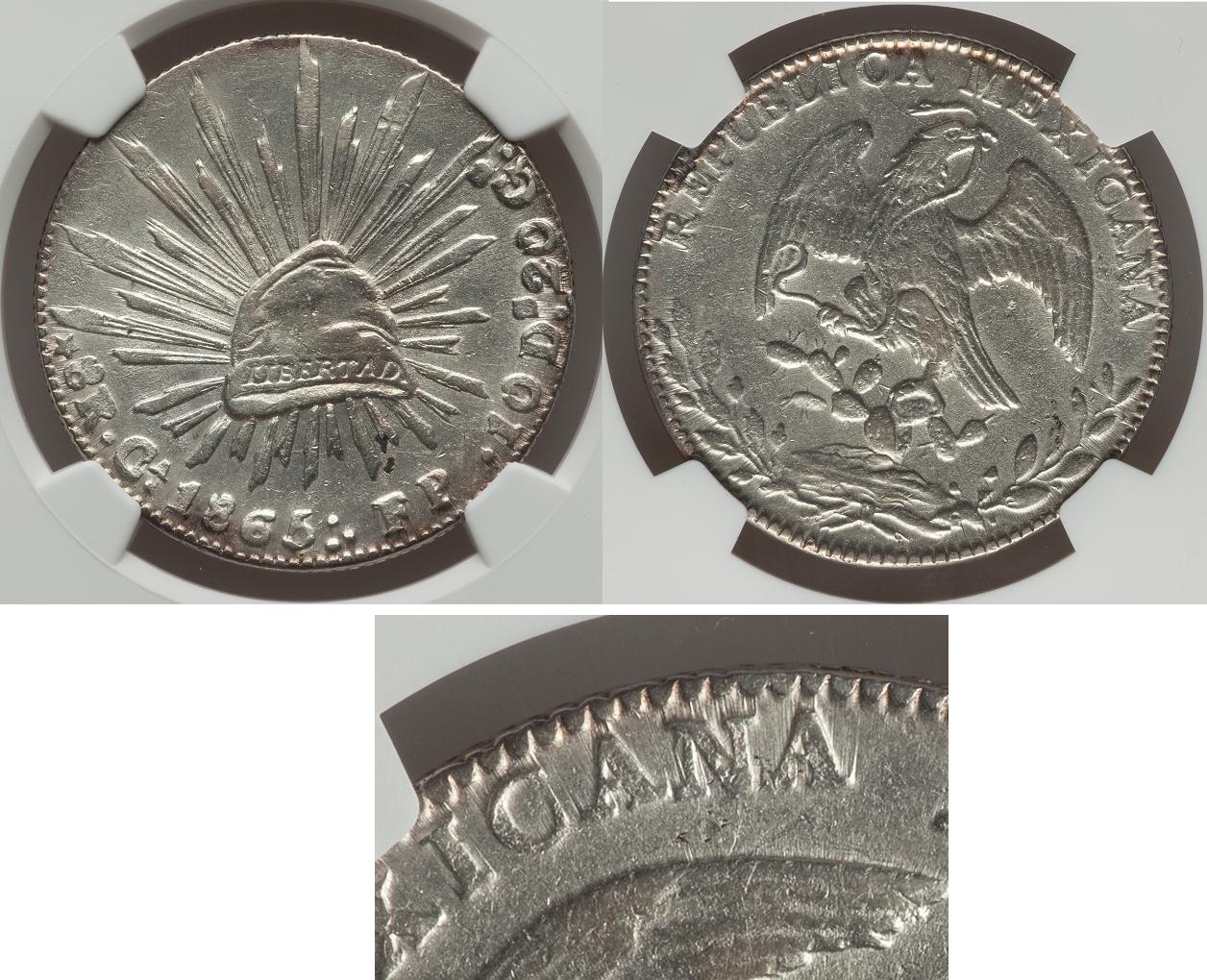 |
|
Pillar of the Community
United States
1962 Posts |
20021sc, you're talking to some nitwit secretary. If they review a coin and their in-house series experts (and/or outside consults if deemed necessary) were to determine "questionable" or even flat out "not genuine", it would be taken care of.
In a case like this where such a determination would be HIGHLY debatable... perhaps more difficult. An authenticity guarantee (and how it is implemented) is NOT the same as "You'll love MyPillow or your money back!".
Sellers just LOVE this btw... don't really know what they're buying, then comes back and says "hey, AFTER I bought this, I asked around and some guy on the internet said he thinks this could be fake so I want to return it".
Is this about the 4th coin or so that has had the exact same process on here over the past few months? AND, it needs to be noted, I recall at least a couple being quite newly listed Buy It Nows...
|
|
Pillar of the Community
United States
1962 Posts |
"One absolute fact that people are missing in this discussion is that a numismatic forgery can match a genuine coin EXACTLY."
Absolutely... My point in showing that more worn 1866 with the (I think) same rev/same rusty die surface is that such a die state WOULD appear to be something that can occur on a genuine example. That trait was sort-of being raised as its own red-flag.
|
|
Pillar of the Community
United States
1962 Posts |
And Bob, there's no doubt the darker areas are recessed/lower than the surrounding "silver"-looking spots. Of course, that is the general idea of a plate that has flaked off in spots... but again, here... seeing how much stress there is around the rims on many 1866 (1865,1867) examples, I think it's tied up in that. Quote:
In a photograph you can see things that are not there especially when dealing with low pixilation. So I agree the sellers pictures of the coin in the scratched holder look far better than the PCGS photos. I prefer to see the best quality picture not a sub-par view under unknown lighting. Bob, step back for a minute and look at the seller's photos. That doesn't look like a reasonably honest surface to you? |
|
Valued Member
United States
93 Posts |
realeswatcher : Unless I do keep the coin (highly unlikely at this point), I suppose I will never know if it is in fact genuine once I send it back (probably tomorrow). The seller answered me and I don't think he's too happy, but he agreed to refund my money except for return shipping once returned. I think he plans to sell or at least offer it to the second highest bidder. The seller told me initially after the auction that the other highest bidder wanted it if I didn't pay or come through (we were discussing shipping and he had different ideas than mine & I suggested USPS Priority small box w/ insurance and signature confirmation and he was abrupt with me and said he's been doing this for 18 years and he knew best). The coin went all over Louisiana, Texas (it went to a small rural post office near Dallas that was NOT a USPS hub and sat there for a couple of days until it was on the road again, should never have gone there I found out), Kansas, Alabama, west Florida, until it finally arrived to me 11 DAYS AFTER he first sent it! Yeah, that was the way to go...Anyway, It was an auction format. There were two other people bidding and the bidding started at 1850.00.
I've asked on here in the short time I've been a member, a couple of other 8 reales people's thoughts on if genuine or not. One may have been a BIN, another an auction, really can't remember right off. I've done both posts in last 5 months while assembling a year set of these C & Rs as I mentioned earlier. Most I've bought have been reasonably priced IMHO and - with the aid of people on this site's comments and reading mainly other posts, not my posts - I can determine much better now if an 8 Reales is genuine or not if I have it raw in my hands. Just today I received an 1822 Iturbide small 1st eagle 8 Reales and I know for a fact it's the real deal. One of many things I picked up from swamperbob's previous posts on other's threads is to look at the rim first! (I can't see the rim's edge good at all on the 1866 slabbed PCGS one). When I opened the envelope today exposing the 1822 coin, I was pleased with it's look immediately. I looked at the rim first and found the two overlaps exactly 180 opposite each other and of the same small duration. I almost knew then it was real without going further. But I weighed it (26.9) and am very happy with it. I did not have time to do a SG test yet, but I feel very confident it is genuine. If this 1866 was raw, I would use the same methods, at least initially. Edge check first. Weight second. SG test third. If all those checked out, I would not have thought to look for this incuse factor, not even the electro plating, Sheffielding, whatever is the suspect going on here. So at least my confidence level is much higher on these than it was a few months ago.
Yes, I probably got some California woman that didn't show me the respect a good company would have (SHOULD HAVE!). And it was a Monday morning out there when I called. But I waited until it was 10 am their time and they had the "doors" open since 7 am PST so plenty of time to get their morning Joe in and settled in for the day. In other words, no excuse.
I even asked her at the end of the call if an expert that had wrote books on counterfeits was to contact them would they be able to speak to an actual grader or a supervisor about this coin. It was a cold NO. That and the fact that after talking to her, I did go to their web site and try to find out what their guarantees, warranties, whatever holds their good name covers. I could find NOTHING out answering what they would do in this type of scenario. I would have to join PCGS like she said to find out any more.
That just doesn't sit well with me. I've got to take the time and money to jump through a bunch of hoops to see what the almighty PCGS decides that may end up costing me well over $2000.00 if the coin is not genuine and it's past the time I can get a refund? And THEY authenticated and graded it? I don't think so. I'm not a millionaire by any means. I know some, but I'm not. Never will be. Just a person that has liked collecting coins for well over half a century now. Expensive hobby. And when you have to deal with people like her like I did today, it just doesn't sit well.
Realeswatcher, I can and do appreciate the time and effort you and everyone else has put on this thread. I do think the coin MAY be genuine indeed and it certainly has created a lot of experts' (your's included!) attention and comments, that's a good thing. I think a lot of people will benefit from reading this post in the future and in many different ways. But the first and foremost I would hope would be education on how to help authenticate these fascinating coins.
I wish the first person you get when you call PCGS' main 800 number and press 2 for customer support (only option to actually talk to someone live if you are not a member) had a better attitude or at least better answers than what I received today. Was my first and last call ever to them, I'd bet on that.
I do wish I had the binocular grading scope swamperbob refers to and I was better in my picture taking skills, but I am lacking the first at present and especially bad in the latter too. The PCGS pics and the seller's pics are all in this thread along with several other examples for comparison.
And colonialjohn : it seems you're shifting to thinking the coin may indeed be legit now? But you do mention that after reviewing several high priced Chihuahua coins, all but one seems legit? But that one may be fake and so might mine. With no hard guarantee from PCGS, I'm not taking that chance. If I never complete the 75 coin set with the only two I'm missing now - a 1823 and now AGAIN a 1866 example, it was fun and I do like what I've put together so far. If I was to take a hit on this 1866 to the tune of over $2K, that would be roughly half of what I have in the entire set! No, I think I'd obtain a Maximilian 1866 Peso for that date and call it good before I risk potentially losing that much money. Hopefully not, but I'm sure you know what I'm saying. Everyone has some limits, this is one of mine.
Please feel free to keep commenting everyone. It has certainly been and continues to be an experience for me. And hopefully not a costly one either. Postage to return versus a high risk loss.... I have to look at it like another 1866 will surface and - even if raw - I may be much happier with.
|
|
Pillar of the Community
United States
1767 Posts |
20021sc I would if I could XRF these incuse areas and detemine the copper values. Is this peeled away silver from poor manufacturing or worn dies as realeswatcher alludes to or is this a Sheffield (bi-layer contemporary circulating counterfeit) of the time. The 1866 I linked to is something more advanced to Sheffield Plating and possibly made by silver electrodeposition. It may not be or just a toning effect. I need the coin in hand and analyze it in the lab. Bob has already proved to me with multiple examples (slab and raw )this form of counterfeiting exist. One of my chapters in my new book "Forgotten Coins" has a separate chapter on how these are made with some Gurney examples. So to make a long story short yours is probably a Sheffield IMO and this link is POSSIBLY a silver electrodeposited issue that sold for $3,000+. This reminds me somewhat when I wrote my XRF paper on Chihuahua casts in a MNA Journal and wrote that some 1811's (and 1812') were not edged and were plain edge. The question came up briefly - are these genuine? Mike Dunnigan said no worries John - at times some piece just were not edged after they left the their casting molds at the Chihuahua mint. Not that anybody ever recorded this phenomenon! So this is new territory - I am not convinced with this Heritage coin that its a manufacturing defect or from worn dies causing this toning differentiation we see in the breast or upper right wing areas. We shall see ... now that my book is published I can devote a little more time to silver electrodeposited CCCs in the Cap and Rays series and not just for Chihuahua mint issues. Your piece has NOTHING to do with silver electrodeposition but as Bob suggests it may be a likely Sheffield plated CCC. JPL
Edited by colonialjohn
01/08/2018 8:53 pm
|
|
Bedrock of the Community
13014 Posts |
Quote:
.I even asked her at the end of the call if an expert that had wrote books on counterfeits was to contact them would they be able to speak to an actual grader or a supervisor about this coin. It was a cold NO. That and the fact that after talking to her, I did go to their web site and try to find out what their guarantees, warranties, whatever holds their good name covers. I could find NOTHING out answering what they would do in this type of scenario. I would have to join PCGS like she said to find out any more. Reales was spot on again. If ithey determines its fake they'll take care of it. That may include buying it back, finding another, money and a lower grade ect. If they need to contact someone outside they'll do it themselves, anyone can write a book that doesn't mean anything to them. You also need to look at it more from the customer service standpoint. They get 100s to thousands of calls a day. All they can tell you to do is send it in, telling them someone on the internet thinks it's fake is just another call of many they get every day for the same thing. The gave you the basic info and that's all they can give you, they aren't the graders or the head guys so they can't make promises. They're there for administrative errors and submission stuff mostly. My point is people often have very unrealistic expectations of exactly what will happen from calling a TPG. TPGs won't make finite decisions based off of pictures they know better than to do that. They have to have a coin in hand to actually make any decisions. |
|
Pillar of the Community
United States
5362 Posts |
Lots of new questions and issues. They should not muddy the waters. None of the comments would change my opinion of the coin. The 1865 Ca FP from the Foxlair collection (owner was Ralph Poucher) is genuine. The dark spots there are clearly (IMO) fire scale and carbon spots in or on the planchet. The loss of metal in some letters is related to a weak strike as the original unstruck surfaces appear to be present. That is an entirely different situation from what I am seeing on the coin that started this thread. The incuse areas of black with standing or loose silver edges remains the primary problem I see with that coin. Quote:
Am I saying it is a numismatic forgery? It could be a modern Numismatic Forgery made using Sheffield plate technology but does that make any sense to anyone? It does not for me because for about $20 the forgers could use a silver planchet and avoid these problems. For a coin worth as much as this one using Sheffield plate is very unlikely. Could it be a circulating counterfeit - yes. Definitely! Quote:
In 1866 could a counterfeiter produce an identical copy of a genuine coin and strike a Sheffield Plate planchet? Probably not to this level. An exact match is technology that has existed for some time but clearly not for more than 50 years based on my knowledge of forgery. So what is it? I think it is an example of genuine dies being used to make a counterfeit. During 1866, I am unaware of any records that describe how they disposed of dies used to make the old 8Rs. Maximillian had introduced a new Peso coin intended to replace the 8 Reales. I would suspect that the production of this coin may be a repeat of what happened earlier in Guadalajara, Guanajuato and Zacatecas on a larger scale. The state of the dies in this case are very worn and exhibit orange peel degradation. These dies may have been discarded as scrap because 8 reales were no longer going to be made. This is the most likely case. The possibility of a mint made fraud (planchet substitution for profit by an employee) can not be totally discounted, however the known examples of that taking place are very few in number. There are more reports from contemporary sources that sale of scrap die was the most serious problem. Only a scientific XRF (lab quality) analysis could be employed to identify trace contaminants that might be able to tell. No guarantee here at all. One cardinal rule that applies to counterfeiters in general is that coins made for circulation are not copies of rare issues. The only exception to that rule appears to be strikes made with worn or stolen dies. There are such examples in the pre-1830 Guadalajara issues. In addition to old reports, I own a thick Sheffield plate example of an 1829 Ga that has a copper core. It has a drill hole that is a period cancellation. It was either a repurposed worn die or a mint made fraud. Either way it is the type of fraud that resulted in early Ga issues being regarded with suspicion by people like the Chinese. In any event, I was really hoping to discover if this date could be added to the group of known fraudulent issues struck with genuine dies. Too bad we will not get that chance. Ralph Poucher ran Foxlaire Inc. and he published an on line magazine on Mexican coins at roughly quarterly intervals. I agreed to produce an article for each issue of his magazine on the topic of circulating contemporary counterfeit issues. I wrote several but only one was submitted and published before Ralph suddenly suspended publication (due to his health). In Ralph's response to my first article he advised me that he owned an example of the coin that was the focus of the article. He not only thought it was genuine but that it was in a PCGS slab. I told him that I had spent years looking for that particular coin in a slab. I offered him $500 for it if he was willing to part with it. He told me that he would either leave the coin to me in his will or sell it to me. That coin is the 1834 Zs OM Riddell # 237 that I showed above. In fact all three of the PCGS counterfeits came from Ralph's collection. He did send me all of his raw counterfeits as a gift a total of 12 coins in all. He saw counterfeits as valueless. Ralph never did leave the 1834 Zs to me nor offer it to me before he passed away. The next time I saw the coin was in the Heritage sale of the Foxlair collection referred to by John Lorenzo above. When I reviewed the entire sale there were three PCGS encapsulated contemporary counterfeits. I had entered essentially buy bids for each of the three. The auctions were terminated in the last seven days before the sale because someone identified them as counterfeits and told Heritage. I called Heritage and discussed the situation with Will Calandar who was not very helpful. He could not or would not put me in touch with the consignor. I told him that these coins were worth a significant amount of money as is but removing them from their holders would drop their value to under $100 each. |
|
Valued Member
United States
93 Posts |
As another side note: The seller has made demands on the return of the coin that are impossible for me due to USPS rules on registered mail for a personal account with them, as he demands it returned no other way. Seems like I'll have the coin for at least a few more days. ebay has assigned a specialist to oversee what I have to do to return the coin and receive a refund. But the next step they told me is to not contact the seller anymore and they will be in contact with me Friday to let me know what to do next. They said the seller already knows what he's supposed to do and they are giving him three days to respond. I am strictly following their orders because they ( ebay) said if I sent it back to him the way he wanted me to - even if it was at all possible - they could not guarantee the ebay buyer's protection for me. Great. |
|
Pillar of the Community
United States
5362 Posts |
Another issue raised by realeswatcher: Quote:
Bob, step back for a minute and look at the seller's photos. That doesn't look like a reasonably honest surface to you? When I look at the seller's pictures, in this case I refer back to the PCGS database and get very large pictures to review. There at high resolution the surfaces do not look like honest surfaces. They look precisely like the pictures I posted at that scale and they look like a Sheffield Plate counterfeit - no more no less. That is why I suggested returning the coin to PCGS for study including my rationale for suspicion. I have succeeded in dealing exactly that with NGC, ANACS and IGC. In all three cases, I was able to speak directly with the graders or the finalizers themselves. I find the attitude of PCGS to be completely non-professional. They show no interest whatsoever in getting the call correct. The condescending attitude encountered is an absolute turn off. If they persist in this type of behavior they will find it will come back to bite them in the posterior. Based on his contact with PCGS, I do agree with 20021sc that a return is in his best interests. It is unfortunate that we may never know for sure, but why should he suffer for the foolish arrogance of PCGS. |
| |
Replies: 73 / Views: 8,816 |
To participate in the forum you must log in or register.
Disclaimer: While a tremendous amount of effort goes into ensuring the accuracy of the information contained in this site, Coin Community assumes no liability for errors. Copyright 2005 - 2026 Coin Community Family- all rights reserved worldwide. Use of any images or content on this website without prior written permission of Coin Community or the original lender is strictly prohibited.
Contact Us | Advertise Here | Privacy Policy / Terms of Use
|
| Coin Community Forum |
© 2005 - 2026 Coin Community Forums |
| It took 0.58 seconds to rattle this change. |
 |
|








 First Page


 Posted 01/07/2018 6:33 pm


