| Author |
 Replies: 14 / Views: 1,180 Replies: 14 / Views: 1,180 |
|
|
Pillar of the Community
United States
628 Posts |
I found a 1980 D Lincoln, very thin, weakly struck, no sign of wear, it weighs only 1.4 grams. ?
Has anyone seen or heard of anything like this?
|
|
|
|
Pillar of the Community
United States
609 Posts |
|
|
Pillar of the Community
United States
527 Posts |
|
|
Moderator
 United States
194500 Posts |
Probably the victim of a chemical experiment.
|
|
Bedrock of the Community
United States
62064 Posts |
If the rims are missing, then it would probably been acid dipped. Under a scope they are not a pretty site. The surface looks like an alka seltzer dissolving. Devices remain the same, just thinner. that is what it sounds like from your description.
|
|
Pillar of the Community
 United States
628 Posts |
This coin has rims. It is roughly half the width of a normal cent. The details are blurry.
|
|
Pillar of the Community
United States
2751 Posts |
If the design is complete but uniformly blurry on each face, then it's an acid job.
Error coin writer and researcher.
|
|
Pillar of the Community
United States
527 Posts |
Correct me if I am wrong, but if more than half of the coin was eroded away by acid, then the details would be barely distinguishable and blurred, not just weak. If the details have sharp edges, but are weak, then it would have to be a thin, defective planchet resulting in a weak strike. Pictures would still be great.  |
|
Pillar of the Community
United States
527 Posts |
Oops I missed this.  Quote:
The details are blurry.
If that is the case, the I would deffinately say acid. |
|
Bedrock of the Community
United States
17884 Posts |
Quote:
Correct me if I am wrong, but if more than half of the coin was eroded away by acid, then the details would be barely distinguishable and blurred, not just weak. The acid works on all the surfaces relatively evenly so even down to paper thin the details remain clearly distinguishable though "blurry". |
|
Bedrock of the Community
United States
62064 Posts |
Here is a few examples: 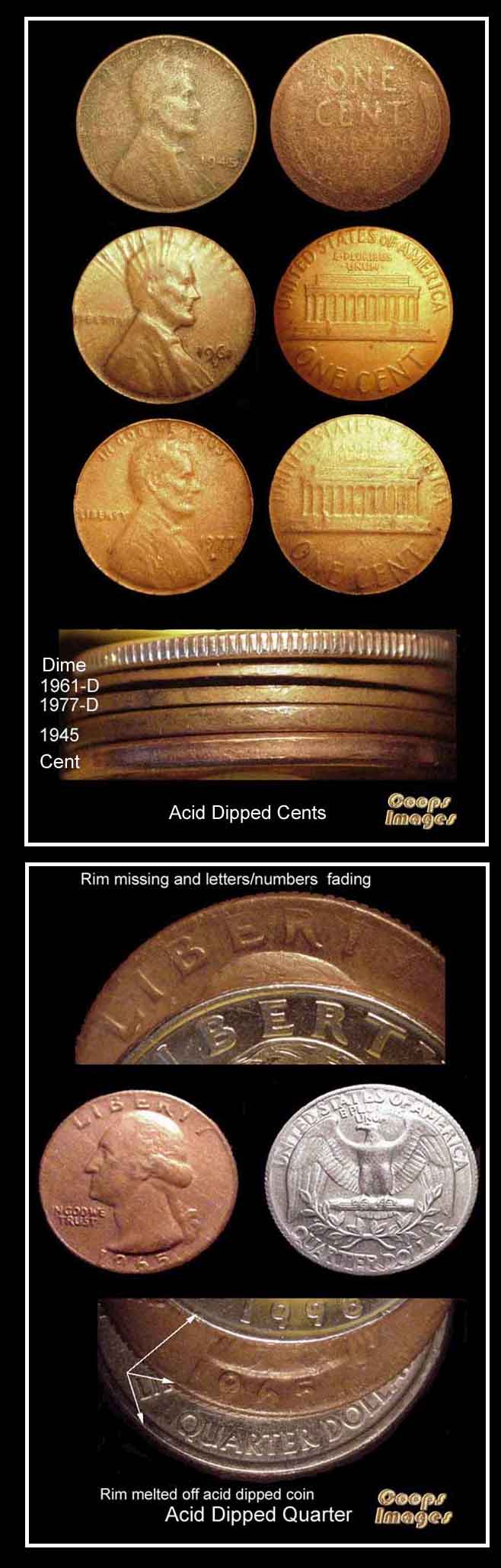 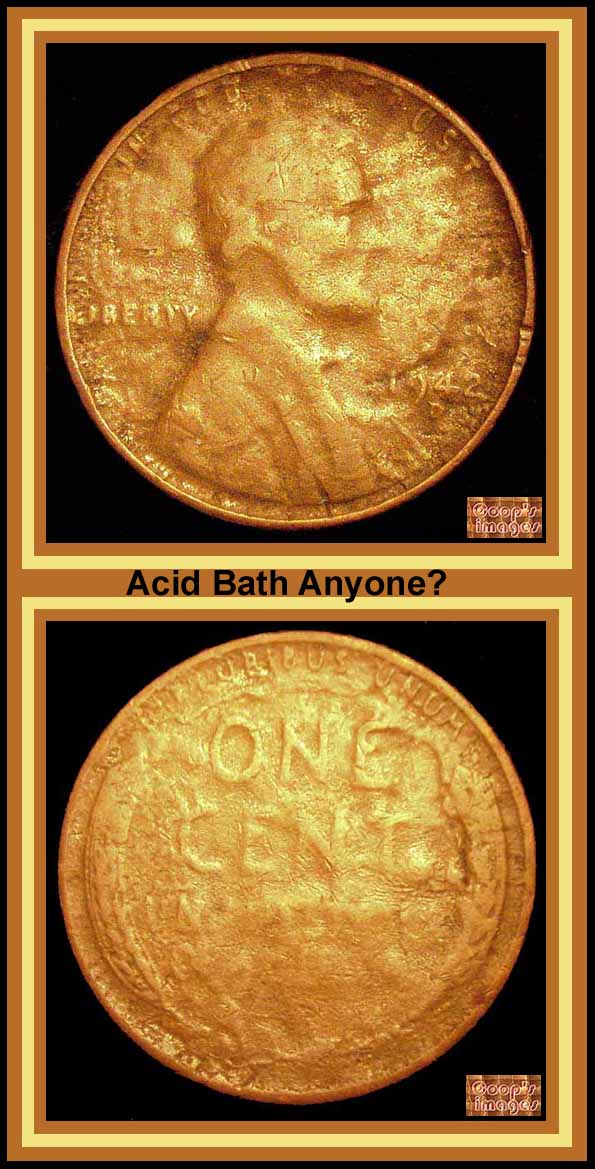 |
|
Moderator
United States
194500 Posts |
As always, some good pictures, Richard!  |
|
Pillar of the Community
United States
527 Posts |
Thanks for the correction there guys, I have never seen a coin acid bathed that thin before. I would have expected major blurring by the time it was half gone. Great pics and info. Thanks again. |
|
Pillar of the Community
United States
628 Posts |
The coin I have looks very muck like the 1977 D in coop's photos. As always, thanks very much for the info.
|
|
Bedrock of the Community
United States
62064 Posts |
OK, let's ask another question. Why would they dip Cents in Acid?
Growing up in the 1960's you could buy a soda in a bottle for 10 Cents plus the bottle deposit of 2 Cents. (If you made off with it, then you gained to cents.) So kid would take cents in Chemistry class and put them into a test tube and add a strong acid to it. The coin would foam and dissolve in the tube, you dumped out the acid into the sink and cleaned it with water to see your coin. When you compare it with a dime in size, the dimensions were close to a dime. You would use it in a soda machine and get one 10 Cent bottle for one Cent. If you look again to the 1961 Cent pictured above you can see the lines on the upper half. These were probably caused by the acid bubbling upwards in the tube and wearing/dissolving some of the coin faster and others slower. You can see different sizes of thickness and this is probably cause by more/less time spent in the acid. So I have given them the nick name: "pop money" because this was just one means to an end. Today acid is used to clean/destroy coins. Note the quarter on the above image. Someone placed this one in a small container and remove one just one edge to simulate a missing clad. Usually there is a means to an end when errors are created. Knowing what they have in mind will help you to keep from getting burned on buying them. Trial by error is something the best teacher.
|
| |
Replies: 14 / Views: 1,180 |
|







 Posted 05/22/2008 2:34 pm





