











 Posted 02/04/2018 8:17 pm


gidjit,
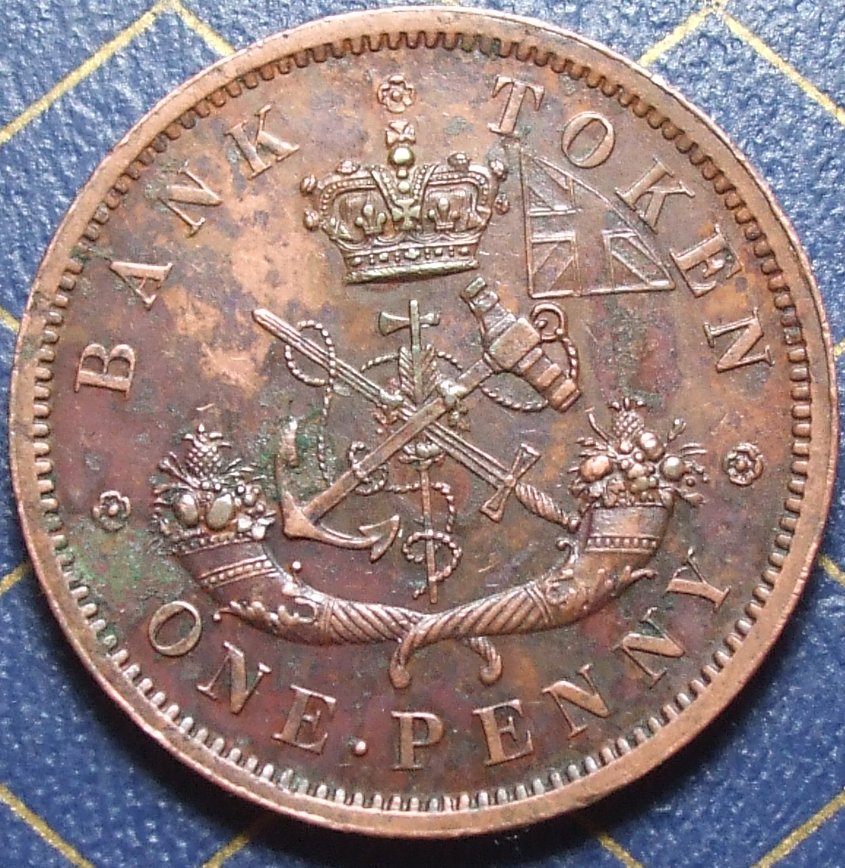
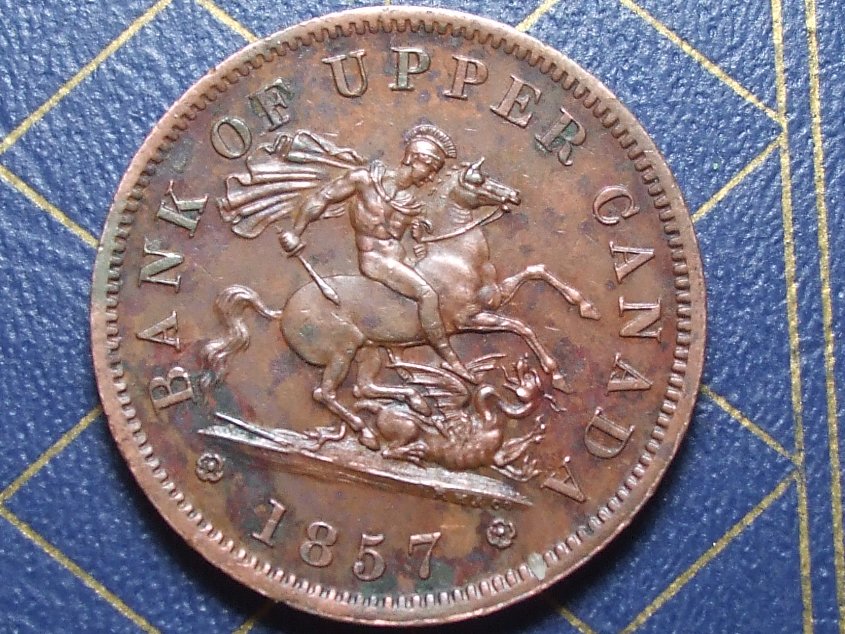
Your ensample is Dr. Courteau variety 317, having a rarity factor of 2 (on a scale of 1-10).
I would give your ensample a technical grade of AU 58, having environmental issues. I believe your ensample has also been cleaned.
A cut-and-paste:
Doctor Courteau first separates the St. George Bank of Upper Canada 1857 ONE PENNY tokens series according to the size of the Dots within the obverse Rosettes. Secondly, Doctor Courteau separates these groups according to the Dot patterns of the Anchor Rope. Doctor Courteau indicates the pattern of lines below the Man's right Arm. When ecessary, Doctor Courteau often indicates the shapes of and number of Knobs on the Dagger Hilt. Doctor Courteau further identifies whether the 7 points to the centre, right-side, left-side, or is centred betwixt two denticles. Doctor Courteau identifies whether the 7 is close to or distant from the Denticles. Doctor Courteau discusses the strike of the Grass Blades (opposite the right-side Cornucopia). Finally Doctor Courteau identifies various Die-Cracks.
Concerning the St. George Bank of Upper Canada 1857 ONE PENNY tokens series, Doctor Courteau oftentimes make mention of the obverse F. On many varieties the F is 're-cut.' This is actually a misnomer, as the letter itself is not re-cut. What is being identified is a small horizontal line in the field which is on-line directly to the left of the Stand of the F. Sometimes Doctor Courteau made mention of a re-cut F, an F not re-cut, or made no mention concerning the letter. When mentioned by Doctor Courteau, the data is supplied within the Comprehensive Narrative Section and indicated as such by 'normal type.' Where the data was not mentioned by Doctor Courteau, the author supplied and inserted the information within the section and indicated as such but the use of italics.
Doctor Courteau makes mention of the number of Oak Leaves in the left quadrant of the Oak Leaf Wreath at the junction of the Sword, Fledgling, and Anchor Shaft. All varieties have the Oak Leaf Wreath consisting of either two or three small Oak Leaves within the left quadrant (betwixt the Sword and Anchor Shaft). Of the three leaf varieties, two are upper leaves and one is a lower left-side leaf. The two upper leaves are near the Sword while the lower left-side leaf is attached to the Anchor Shaft. Some varieties do not shew the lower left-side leaf. On some varieties, only the tip of the lower Oak leaf will shew. On many varieties, Doctor Courteau made no reference concerning the number of Oak leaves. When mentioned by Doctor Courteau, the data is supplied within the Comprehensive Narrative Section and indicated as such by 'normal type.' Where the data was not mentioned by Doctor Courteau, the author supplied and inserted the information within the section and indicated as such but the use of italics. Care must also be taken as not to confuse the central Stem of the Oak Wreath for the lower Oak Leaf. The Stem was not mentioned by Doctor Courteau, and the author referenced the completeness of the stem on all varieties, (whether missing, weak, or complete), and again indicated as such by the use of italics.
On many tokens the primary characteristic diagnostics may not be readily apparent. The characteristics may be weakly struck, damaged, or worn beyond positive attribution. Some tokens struck from latter states of a die, having extensive Die-Cracks, may not have enough remaining medal mass to fully shew the full complement of design details. In such cases the investigator must resort to secondary or tertiary markers in order to ascertain a specific variety. Normally, by a preponderance of all the evidence, an accurate assessment can be determined. Unfortunately though, the tedious process of elimination is sometimes painstakingly time-consuming. The author never used to have grey hair. Perhaps this is the culprit.
Many characteristic diagnostic die-markers (to be discussed), are not readily discernable on lower grade tokens. The die-markers may be well concealed under an over abundance of dirt, grime, and crud. The determination must be made as to which is more important, to carefully remove the dirt, grime, and crud, or not being able to make a positive attribution of the token by Doctor Courteau variety.
317 R-2 The inner Dots within the obverse Rosettes are large.
Dots are: 8 X 5 X 4.
Obverse Characteristics:
The Mantle to the left of the Man's right Arm is forked and does not extend to the Man's right forearm.
The outline of the Mantle opposite the Knobs of the Dagger Hilt, forks into two branches. The upper branch is much heavier than the lower and neither branch extends to the Man's right forearm. A heavy well defined pleat is in the void betwixt the upper branch of the fork of the lower outline of the Mantle and the pleat of the 6th and 7th Mantle Folds. The entire Mantle is distant from the right Arm of the Man.
The 6th and 7th Mantle Folds are separate. The hollow is narrow. The outer edge of the outline of the 6th Mantle Fold is nearly straight.
The 7 is on-line with the left-section of the 4th Denticle to the immediate right of the numeral 5.
The top of the 7 is on-line with the top of the 5.
An imaginary line across the top of the 7 is on-line with the vertex of the upper and left Lobes of the right Rosette.
A fork is below the Man's right Arm, a long thin line is above.
A line runs across the muscle mass of the Man's right forearm, and exits into the field and separates into two branches of equal size and length. The lower branch extends horizontally towards the Man's Back, and at the mid-point of the line, turns diagonally upward and parallels the upper branch. The upper branch is from the point of origin of the lower branch, and extends diagonally upward a short distance, then turns rightward and extends towards the Man's Back. The two branches run close to and parallel to each other and terminate on-line with each other. A third longer, line emanates from the Man's left forearm on-line with the top of the upper branch and extends diagonally upward, touching the left-end of the upper branch, and parallels the two lower branches, and extends a bit further, but terminates before reaching the Man's Body.
Two Knobs are to the Dagger Hilt.
The lower Knob is oval, distant from, and clearly separated from the Man's right Hand. The upper Knob is small, and its atop the apex of the lower Knob.
The F in OF is re-cut.
The left Bridle Rein is perfect.
The left Leg of the Dragon is perfect.
A small Dot is in the field to the left of the Man's Helmet.
This Dot is on-line with the Shoulder Strap and the 1st P in UPPER, and on-line with the mid-section of the left-side of the Crest of the Man's Helmet.
Note - The Dot may not be readily discernable on lower grade specimens.
Some ensamples exhibit Die-Clash Marks behind the Man's Back.
Multiple strikings of the characteristic mimic of the lower section of the Anchor Shaft are behind the Man's Back.
From perfect dies.
Reverse Characteristics: The same as varieties 316 and 318.
The Anchor Rope Dots are: 8 X 5 X 4.
The relief of the Dots within the sector to the left of the Sword is poorly executed. The lower terminal Dot is small and away from the Anchor Rope. The remaining seven Dots of this group are of uniform size and shape. The Dots are very close together and connected
to each other, except for the 6th and 7th Dots, which are separated. The upper terminal Dot is close to the Sword. The relief of the Dots within the second sector is also poorly cut. The left terminal Dot is close to the Sword. This Dots within this group are of uniform size and shape, and are separated from each other. The relief of the Dots within the third sector is adequately cut. The terminal Dots are close to the Fledgling and the Anchor Shaft, respectfully. The Dots are of uniform size and shape, and well separated from each other.
Note - The details may not be readily discernable on lower grade specimens.
The Anchor Ring is perfect.
The Grass Blades are perfect.
The Grass Blades are heavy. The left-end of the upper Grass is on-line with and very close to the apex of the fruit. The lower Grass Blades is fully connected to the fruit at 2 o'clock. The lower Grass Blade points to the mid-section of the upper Lobe of the right Rosette.
Note - Diligence must be exercised here. The upper Lobe is understood as having the orientation of the Rosette Denticles at 6 o'clock. The first impression one has is te blade points to the left Lobe, but what appears to be the left Lobe is actually the upper Lobe.
An Oak Leaf is above the Anchor to the left.
The upper 'thumb-like' portion of the lower left Oak Leaf betwixt the Sword and Anchor Shaft is well struck. The remainder of the leaf is missing.
The Oak Wreath Stem is strong.
The left Anchor Brace is wide and extends to the vertex of the Fluke.
The Anchor Rope Dots terminate with two medium sized, separated, but close Dots.
A faint Dot is to the left of the terminal Anchor Rope Dots.
Note - The Dot may not be readily discernable on lower grade specimens.
A faint Dot is in the field to the right of the Anchor.
This Dot is directly above the left-side Pineapple leaf of the right cornucopia, on-line with the 2nd (from the bottom) Dot of the Anchor Rope above the right end of the Anchor Arm.
Note - The Dot may not be readily discernable on lower grade specimens.
From perfect Dies.
Thus:
317 Perfect - no Die-Cracks.
doug
Your ensample is Dr. Courteau variety 317, having a rarity factor of 2 (on a scale of 1-10).
I would give your ensample a technical grade of AU 58, having environmental issues. I believe your ensample has also been cleaned.
A cut-and-paste:
Doctor Courteau first separates the St. George Bank of Upper Canada 1857 ONE PENNY tokens series according to the size of the Dots within the obverse Rosettes. Secondly, Doctor Courteau separates these groups according to the Dot patterns of the Anchor Rope. Doctor Courteau indicates the pattern of lines below the Man's right Arm. When ecessary, Doctor Courteau often indicates the shapes of and number of Knobs on the Dagger Hilt. Doctor Courteau further identifies whether the 7 points to the centre, right-side, left-side, or is centred betwixt two denticles. Doctor Courteau identifies whether the 7 is close to or distant from the Denticles. Doctor Courteau discusses the strike of the Grass Blades (opposite the right-side Cornucopia). Finally Doctor Courteau identifies various Die-Cracks.
Concerning the St. George Bank of Upper Canada 1857 ONE PENNY tokens series, Doctor Courteau oftentimes make mention of the obverse F. On many varieties the F is 're-cut.' This is actually a misnomer, as the letter itself is not re-cut. What is being identified is a small horizontal line in the field which is on-line directly to the left of the Stand of the F. Sometimes Doctor Courteau made mention of a re-cut F, an F not re-cut, or made no mention concerning the letter. When mentioned by Doctor Courteau, the data is supplied within the Comprehensive Narrative Section and indicated as such by 'normal type.' Where the data was not mentioned by Doctor Courteau, the author supplied and inserted the information within the section and indicated as such but the use of italics.
Doctor Courteau makes mention of the number of Oak Leaves in the left quadrant of the Oak Leaf Wreath at the junction of the Sword, Fledgling, and Anchor Shaft. All varieties have the Oak Leaf Wreath consisting of either two or three small Oak Leaves within the left quadrant (betwixt the Sword and Anchor Shaft). Of the three leaf varieties, two are upper leaves and one is a lower left-side leaf. The two upper leaves are near the Sword while the lower left-side leaf is attached to the Anchor Shaft. Some varieties do not shew the lower left-side leaf. On some varieties, only the tip of the lower Oak leaf will shew. On many varieties, Doctor Courteau made no reference concerning the number of Oak leaves. When mentioned by Doctor Courteau, the data is supplied within the Comprehensive Narrative Section and indicated as such by 'normal type.' Where the data was not mentioned by Doctor Courteau, the author supplied and inserted the information within the section and indicated as such but the use of italics. Care must also be taken as not to confuse the central Stem of the Oak Wreath for the lower Oak Leaf. The Stem was not mentioned by Doctor Courteau, and the author referenced the completeness of the stem on all varieties, (whether missing, weak, or complete), and again indicated as such by the use of italics.
On many tokens the primary characteristic diagnostics may not be readily apparent. The characteristics may be weakly struck, damaged, or worn beyond positive attribution. Some tokens struck from latter states of a die, having extensive Die-Cracks, may not have enough remaining medal mass to fully shew the full complement of design details. In such cases the investigator must resort to secondary or tertiary markers in order to ascertain a specific variety. Normally, by a preponderance of all the evidence, an accurate assessment can be determined. Unfortunately though, the tedious process of elimination is sometimes painstakingly time-consuming. The author never used to have grey hair. Perhaps this is the culprit.
Many characteristic diagnostic die-markers (to be discussed), are not readily discernable on lower grade tokens. The die-markers may be well concealed under an over abundance of dirt, grime, and crud. The determination must be made as to which is more important, to carefully remove the dirt, grime, and crud, or not being able to make a positive attribution of the token by Doctor Courteau variety.
317 R-2 The inner Dots within the obverse Rosettes are large.
Dots are: 8 X 5 X 4.
Obverse Characteristics:
The Mantle to the left of the Man's right Arm is forked and does not extend to the Man's right forearm.
The outline of the Mantle opposite the Knobs of the Dagger Hilt, forks into two branches. The upper branch is much heavier than the lower and neither branch extends to the Man's right forearm. A heavy well defined pleat is in the void betwixt the upper branch of the fork of the lower outline of the Mantle and the pleat of the 6th and 7th Mantle Folds. The entire Mantle is distant from the right Arm of the Man.
The 6th and 7th Mantle Folds are separate. The hollow is narrow. The outer edge of the outline of the 6th Mantle Fold is nearly straight.
The 7 is on-line with the left-section of the 4th Denticle to the immediate right of the numeral 5.
The top of the 7 is on-line with the top of the 5.
An imaginary line across the top of the 7 is on-line with the vertex of the upper and left Lobes of the right Rosette.
A fork is below the Man's right Arm, a long thin line is above.
A line runs across the muscle mass of the Man's right forearm, and exits into the field and separates into two branches of equal size and length. The lower branch extends horizontally towards the Man's Back, and at the mid-point of the line, turns diagonally upward and parallels the upper branch. The upper branch is from the point of origin of the lower branch, and extends diagonally upward a short distance, then turns rightward and extends towards the Man's Back. The two branches run close to and parallel to each other and terminate on-line with each other. A third longer, line emanates from the Man's left forearm on-line with the top of the upper branch and extends diagonally upward, touching the left-end of the upper branch, and parallels the two lower branches, and extends a bit further, but terminates before reaching the Man's Body.
Two Knobs are to the Dagger Hilt.
The lower Knob is oval, distant from, and clearly separated from the Man's right Hand. The upper Knob is small, and its atop the apex of the lower Knob.
The F in OF is re-cut.
The left Bridle Rein is perfect.
The left Leg of the Dragon is perfect.
A small Dot is in the field to the left of the Man's Helmet.
This Dot is on-line with the Shoulder Strap and the 1st P in UPPER, and on-line with the mid-section of the left-side of the Crest of the Man's Helmet.
Note - The Dot may not be readily discernable on lower grade specimens.
Some ensamples exhibit Die-Clash Marks behind the Man's Back.
Multiple strikings of the characteristic mimic of the lower section of the Anchor Shaft are behind the Man's Back.
From perfect dies.
Reverse Characteristics: The same as varieties 316 and 318.
The Anchor Rope Dots are: 8 X 5 X 4.
The relief of the Dots within the sector to the left of the Sword is poorly executed. The lower terminal Dot is small and away from the Anchor Rope. The remaining seven Dots of this group are of uniform size and shape. The Dots are very close together and connected
to each other, except for the 6th and 7th Dots, which are separated. The upper terminal Dot is close to the Sword. The relief of the Dots within the second sector is also poorly cut. The left terminal Dot is close to the Sword. This Dots within this group are of uniform size and shape, and are separated from each other. The relief of the Dots within the third sector is adequately cut. The terminal Dots are close to the Fledgling and the Anchor Shaft, respectfully. The Dots are of uniform size and shape, and well separated from each other.
Note - The details may not be readily discernable on lower grade specimens.
The Anchor Ring is perfect.
The Grass Blades are perfect.
The Grass Blades are heavy. The left-end of the upper Grass is on-line with and very close to the apex of the fruit. The lower Grass Blades is fully connected to the fruit at 2 o'clock. The lower Grass Blade points to the mid-section of the upper Lobe of the right Rosette.
Note - Diligence must be exercised here. The upper Lobe is understood as having the orientation of the Rosette Denticles at 6 o'clock. The first impression one has is te blade points to the left Lobe, but what appears to be the left Lobe is actually the upper Lobe.
An Oak Leaf is above the Anchor to the left.
The upper 'thumb-like' portion of the lower left Oak Leaf betwixt the Sword and Anchor Shaft is well struck. The remainder of the leaf is missing.
The Oak Wreath Stem is strong.
The left Anchor Brace is wide and extends to the vertex of the Fluke.
The Anchor Rope Dots terminate with two medium sized, separated, but close Dots.
A faint Dot is to the left of the terminal Anchor Rope Dots.
Note - The Dot may not be readily discernable on lower grade specimens.
A faint Dot is in the field to the right of the Anchor.
This Dot is directly above the left-side Pineapple leaf of the right cornucopia, on-line with the 2nd (from the bottom) Dot of the Anchor Rope above the right end of the Anchor Arm.
Note - The Dot may not be readily discernable on lower grade specimens.
From perfect Dies.
Thus:
317 Perfect - no Die-Cracks.
doug
Edited by colonialtokens
02/04/2018 8:39 pm
02/04/2018 8:39 pm


