| Author |
 Replies: 13 / Views: 5,404 Replies: 13 / Views: 5,404 |
|
|
Valued Member
United States
417 Posts |
I opened up a roll of nickels and found a Russian version of a 10-"cent" piece. On the reverse, there are two plant stalks encircling a 10 with the denomination underneath, and under that, a bar, then the date of 1993. When I turn the coin 180 degrees, the two-headed eagle is pointed towards 2 o'clock. Is this normal of their coinage, or a true rotated reverse?
|
|
|
|
Moderator
 Australia
16991 Posts |
Sounds like an actual die rotation to me. All modern world coins have either zero degrees rotation (like Britain, Australia and the Eurozone) or 180 degrees rotation (like the USA). Any other angle (like 90 degrees or, in this instance, 320 degrees) would qualify as an error.
Rare? Probably not. The coin is a 10 rouble coin, and post-Soviet inflation had made the coin virtually worthless when it was struck; quality control was probably not very high.
There are four varieties of this coin: two mints (Moscow and St Petersburg) both made two edge varieties (reeded edge and plain edge). Moscow coins have a round-topped "3" in the date; St Petersburg coins have a flat-topped "3". The "Reeded-edge Moscow mint" variety is scarcer than the others.
Don't say "infinitely" when you mean "very"; otherwise, you'll have no word left when you want to talk about something really infinite. - C. S. Lewis
|
|
Pillar of the Community
Australia
3841 Posts |
Sap, there is actually another interesting story behind this, that is not only are they reeded and plain, there are two types of planchets involved which is known as non-magnetic and magnetic. One is in nickel-copper and I think the other is plated steel.
Krause is quite inaccurate when it comes to coins of this era and there has been shocking report of how rare and difficult some of them are. For instance, if the Leningrad 1993 10 ruble struck in the old planchet, that is non-magnetic and reeded, it is actually the rarest and if you can find it, it's easily a few hundred dollar coin.
My partial coin collection http://www.omnicoin.com/collection/gxseriesMy numismatics articles and collection: http://www.gxseries.com/numis/numis_index.htmRegularly updated at least once a month. |
|
Valued Member
 United States
417 Posts |
Thank you both for your help! It turns out to be magnetic, plain edged, and has a three like this "3", so I'm assuming it's a Moscow coin.
Sounds like Krause needs to do more researching for accuracy.
|
|
Pillar of the Community
Australia
3841 Posts |
I think there is a mistake somewhere. These images should help: Leningrad: 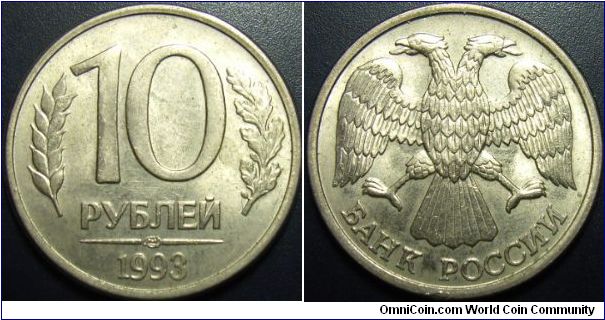 Moscow: 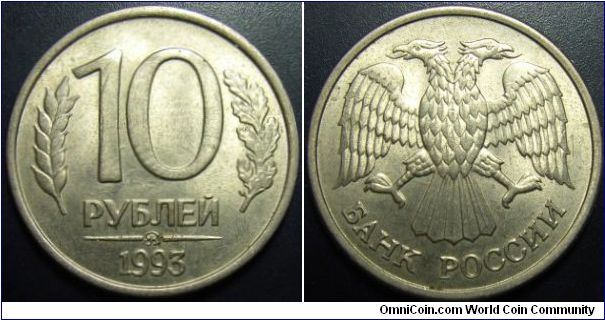 Both are of magnetic type variety. My partial coin collection http://www.omnicoin.com/collection/gxseriesMy numismatics articles and collection: http://www.gxseries.com/numis/numis_index.htmRegularly updated at least once a month. |
|
Valued Member
United States
417 Posts |
It's the Leningrad issue, then. Turn the eagle to 2:00 and that's how the coin looks. It's a definite AU, so that confirms it as a plain edge.
|
|
Pillar of the Community
Australia
3841 Posts |
I wouldn't dare to say such rotation are common but rotation errors of that time is not that rare either. But do definately keep it and I'm sure it has some premium to it.
My partial coin collection http://www.omnicoin.com/collection/gxseriesMy numismatics articles and collection: http://www.gxseries.com/numis/numis_index.htmRegularly updated at least once a month. |
|
Valued Member
United States
417 Posts |
Much appreciation for your help. Anything foreign I do find in circulation ends up in a box (and maybe folder one day), even if it is close to worthless. The other obstacle is someday finding out which dates, countries and face values these 23 Arabic and Asian coins, I have, belong to.
Thank you very much for your help.
|
|
Pillar of the Community
Australia
3841 Posts |
Florida, that's why you have a forum like this! Do feel free to open a new thread and post pictures if possible. Even a scanned image with a scanner can do wonders. Otherwise you can try your luck identifying using this website: http://www.(131231) Not Allowed - Auto-Removed Good luck! My partial coin collection http://www.omnicoin.com/collection/gxseriesMy numismatics articles and collection: http://www.gxseries.com/numis/numis_index.htmRegularly updated at least once a month. |
|
Valued Member
United States
417 Posts |
It's too much of a pain to upload on omnicoin, but the link helped identify 7.
|
|
Pillar of the Community
United States
5318 Posts |
I'm still unclear as to how you tell the difference between Moscow and Leningrad.  I have a stack of 1997-98 Russian 1-5 Rouble coins here, all reeded and non-magnetic. |
|
Valued Member
United States
417 Posts |
Maybe it's a difference in the numerals for the date, for any date. Total guess here.
|
|
Pillar of the Community
Australia
3841 Posts |
It's the mintmark in Russian. Moscow mint has always been MMD or just M whereas St. Petersburg has been known as C||MD or C|| or by it's formal name, Leningrad Mint, LMD or L. Here is my site if you still can't tell the difference between Moscow and St. Petersburg mintmark. Edit: http://www.gxseries.com/numis/rus_n...992_2007.htmWhy did I forget to add the link in? Looks like Kurt got it anyways My partial coin collection http://www.omnicoin.com/collection/gxseriesMy numismatics articles and collection: http://www.gxseries.com/numis/numis_index.htmRegularly updated at least once a month. Edited by gxseries
05/28/2008 12:58 am
|
|
Pillar of the Community
United States
5318 Posts |
That really helps!  I now see a few are St. Petersburg, the rest Moscow. All reeded and non-magnetic. |
| |
Replies: 13 / Views: 5,404 |
|










 Posted 05/27/2008 06:58 am


