| Author |
 Replies: 18 / Views: 2,823 Replies: 18 / Views: 2,823 |
|
Pillar of the Community
United States
5362 Posts |
Note to staff: I realize that there is a grading forum here, however, I am interested in reaching people who know me from my posts on counterfeit coin issues. So according to the Sheldon Scale what grade would you see as appropriate for this coin? Do you see a better method for grading? 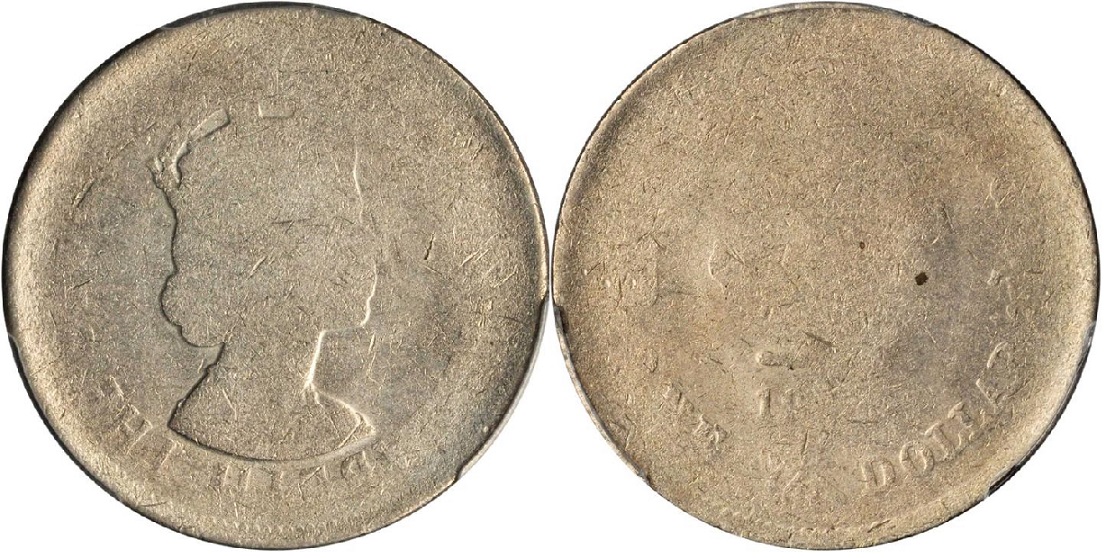 |
|
|
|
Rest in Peace
10197 Posts |
Since there is enough detail left for a ballpark figure, I am hesitant to venture a judgement. I know little of this series of coin, and it's pop figures, beside being foreign which the Sheldon scale is mostly inappropriate. It's down there in a P01 to FR2 (reverse). Then, having followed some of your posts...is this a fake?  This will be instructive I'm sure. |
|
Pillar of the Community
Canada
1747 Posts |
To be able to be graded it must be able to be determined what year the coin is (I thought this was mentioned before somewhere) I am not sure what country this is from if not a british coin.
I cannot see a date, and if there are no specific die markers that would let us determine that, then I would say this is not gradable.
|
|
Pillar of the Community
United States
8715 Posts |
|
|
Pillar of the Community
Canada
683 Posts |
|
|
Pillar of the Community
 United States
5362 Posts |
Optimist-numismatist You have the country correct.
The coin is genuine. It is not counterfeit.
It is a Hong Kong dollar coin struck in Copper-Nickel. The coin has no visible date or mint mark. It is one of three possible KM types KM #'s 31.1, 31.2 or 35. These issues cover dates from 1960 to 1975. Total mintage for the issue is over 150 million coins. All but the KM # 31.2 (an incorrectly positioned mint mark) are junk box value coins (10 for $1.00 US).
If you look closely at the pictures I posted - there is a clue that no one has mentioned so far.
Any further guesses? comments?
|
|
Pillar of the Community
United States
1696 Posts |
Possible weak strike, rather than wear?
|
|
Bedrock of the Community
13014 Posts |
Quote:
To be able to be graded it must be able to be determined what year the coin is (I thought this was mentioned before somewhere) I am not sure what country this is from if not a british coin. It generally needs to be able to be identified. AKA country, year, mint, type |
|
Valued Member
Canada
405 Posts |
|
|
Bedrock of the Community
13014 Posts |
I kinda feel like that got hit with artificial wear
|
|
Pillar of the Community
United States
5362 Posts |
The thing that everyone has missed so far is that the picture shows the coin in a TPG holder. The holder is PCGS. The coin is graded MS 60. 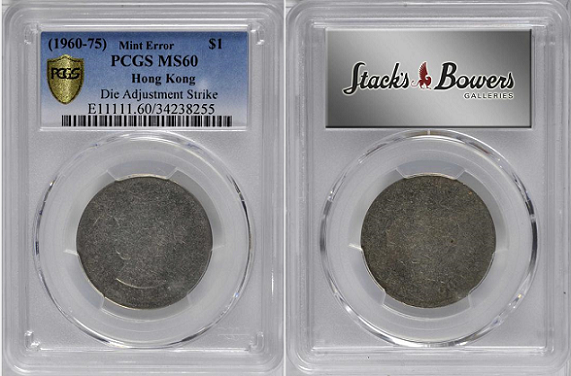 It is the next Stack's Auction in Hong Kong. I do not know about anyone else but referring to this as an MS60 makes little sense to me. They indicate it is a "Die Adjustment Strike". I thought that class was a misnomer. They are low pressure strikes that should be sorted out and discarded as rejects. I think it is wrong to assign a numerical grade to a dateless common coin even if it is a mint error. To say this is worth in excess of $100 is even worse. |
|
Pillar of the Community
United States
1696 Posts |
Quote:
Possible weak strike, rather than wear? So I was right? Partial credit at least? Thanks for posting this. A fun and informative post! |
|
Pillar of the Community
United States
5362 Posts |
aristarchus123 Yes you were correct - sorry I did not mention that. You also were the only person to recognize that much of the surface was unstruck, with the appearance of a planchet.
Now after some time to think about it, does anyone think the grade is actually appropriate?
I think it is incorrect. It raises a series of questions in my mind.
First - is this even properly called a coin? No date and only a fractional image does not make it a coin in my opinion. It is a mint error, hardly a coin. It is more of a planchet than a coin.
Second - even if you see it as a coin, does the Sheldon grading scale actually apply? Does the grade give any relevant information about the coin? It apparently never entered circulation because it is MS. But how would you be able to tell if it did circulate? High point wear is out.
This thing should have been retained in the mint and destroyed. Do they use the Sheldon Scale to grade scrap?
The first couple planchets at the start of a coining run are not struck at all. After a few more cycles of the press the image develops. When a complete full pressure strike occurs a coin is produced that passes inspection. All earlier planchets running through the press are normally captured and destroyed.
I wonder if PCGS gives all blank planchets an automatic MS 60 grade? Does that seems fair? If there is no wear at all - it should be a 70 - right? The grade of MS60 is a technical problem for me - why 60 and not 65 or any mumber at all?
|
|
Pillar of the Community
United States
1696 Posts |
PCGS does grade blank/unstruck planchets at numerical grades higher than 60 (and also in non-ms grades lower than 60). I haven't seen higher than 63, however.
|
|
Pillar of the Community
United States
8715 Posts |
Doesn't a coin have to have an identifiable date to be graded? Even if it's an error such as a blank planchet, shouldn't it just be authenticated and not graded? It makes no sense to me why they grade coins with mint errors that have no date.
|
|
Pillar of the Community
United States
5362 Posts |
It is interesting to note that NGC does not assign a numerical grade to weak strikes unless there is enough detail. So at least for them you first need to have a nearly full strike before using the Sheldon scale. One thing I agree with.
Strike used to be a criteria used to establish a relative grade.
|
| |
Replies: 18 / Views: 2,823 |










 Posted 03/07/2018 6:39 pm


