| Author |
 Replies: 8 / Views: 1,646 Replies: 8 / Views: 1,646 |
|
|
Pillar of the Community
United States
1415 Posts |
|
|
|
|
Pillar of the Community
Australia
1040 Posts |
Very hard to tell from those pics if it is indeed a proof, it may be only a well struck example. However it does seem to have very square rims, and very clear, defined beads and denticles, some of the indicators of a pre dec proof. It also seems to have friction marks on the high points. These came about as the mint originally stored its pre dec proofs in a metal draw with a felt bottom, so the coins would move every time the draw was opened. Scans also tend to flatten the coin, photos are better if you can post one.
Assuming you bought it as a proof, it has an Australian catalogue value of $600 or $185 in uncirculated.
|
|
Valued Member
Australia
372 Posts |
The mintage figure you have is for the proof coin, of 1500.
The mintage for a 1956 florin is 8,090,000.
It does seem cheap for a proof.
|
|
Pillar of the Community
United States
5318 Posts |
Here's a proof '57 Florin for comparison (from Heritage):   |
|
Pillar of the Community
Australia
839 Posts |
doesn't look much like a proof
|
|
Pillar of the Community
Australia
1040 Posts |
Pre decimal proofs look very different to decimal proofs Eddy. Where as today's proofs are struck from specially prepared dies, pre decimals may have been struck from the very dies used for the circulation coins. They may even perhaps be called specimen strikes. They were the first coins struck from the dies and very carefully examined to detect any imperfections. They can be really hard to tell from a normal circulation coin.
I have been trying to find link to a site that explains how to identify them but I can't for the life of me remember where I saw it.
If you look at the coin Kurt posted, you will notice how square the rims are, pretty much perfect right angles. You will be hard pressed to find a regular circulation coin like this, most will have angled, rounded or uneven rims.
Look at the denticles. Each one is perfectly formed and very clear.
These are the first 2 things I look at to determine if a coin may be a proof. And of course, the coin shows full detail in all the lettering and devices, there should be no wear at all, except for the scuffing mentioned above.
And I always buy my proof pre decimals from a reputable dealer. I like to think I can identify one, but I am no expert.
Edited by latman100
06/08/2008 06:23 am
|
|
Pillar of the Community
Australia
839 Posts |
|
|
Pillar of the Community
Australia
655 Posts |
A friend of mine has a couple of proof florins. I notice the proof ones he had displayed smooth field surfaces where a regular florin had a distinctly different frosted type of surface. I don't know if that applies to all years or just some. I think this is one of the proof ones going through my photo allbum. The detail is superb. 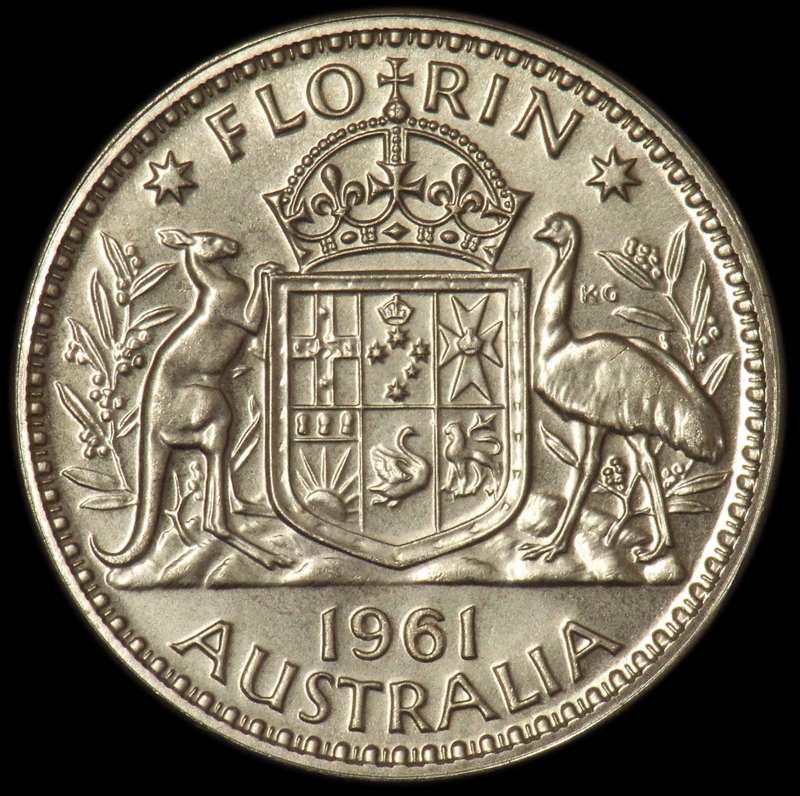 |
|
Pillar of the Community
 United States
1415 Posts |
latman,
THANX for the information.
You have been quite helpful and I learned a lot.
|
| |
Replies: 8 / Views: 1,646 |
|










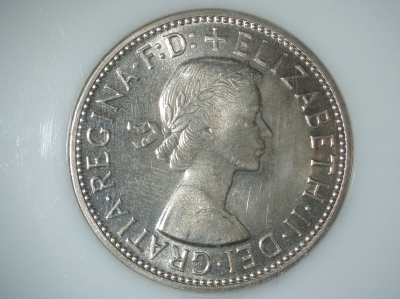 Australia_Florin_1956_Obv.jpg
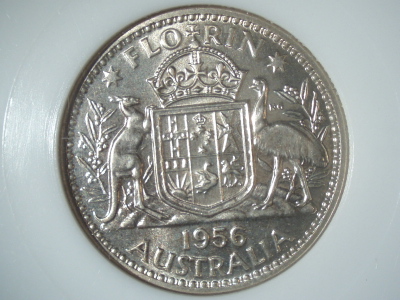 Australia_Florin_1956_Rev.jpg

 Posted 06/07/2008 10:28 pm


