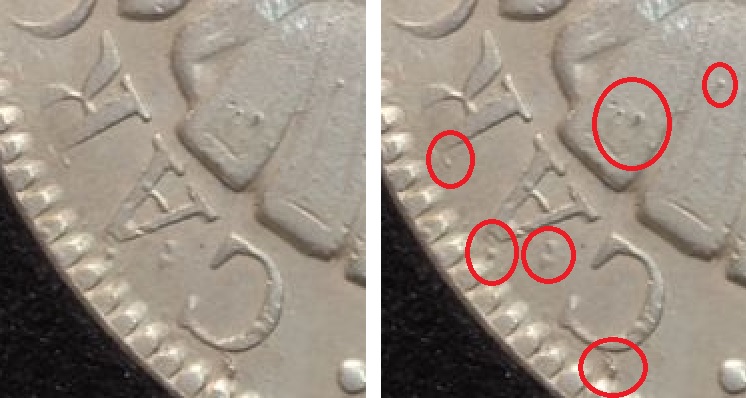
First Page


 Posted 03/15/2018 12:18 am


Quite a few guesses.
TwoKopeiki You have correctly identified the third feature. You say:
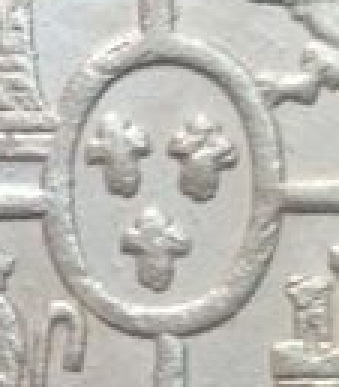
Since I have seen pictures of a block displaying the three Fleur-des-lis in the completed pattern, I have always maintained that the upper left lis must tilt to the right NOT the left on Mexican 8Rs of this matrix era.
So that is 3 pf 4 points identified.
bogdanjovi I agree that the straight upper ribbon is not normal and I could have used that as an item that would make me suspicious because the Portrait was complete on the King Punch for the obverse die. However, I have not studied the ribbon specifically to see if it ever needed to have the ribbon tips engraved. Unlikely but possible - the detail is quite far from the center point.
Squire Wilson You need to understand something about how the Mexican's made dies. The dies were punched one at a time with punches created from a standard matrix (punch) block.
The Matrix blocks were made in Spain and shipped to each of the colonial mints. At the blacksmith shop in the mint, a smith created individual die punches by driving softened steel bar stock or rods into each distinct design. After the design was transferred the head of the punch was trimmed and then the steel was hardened so it could be used to transfer the image to the die face.
Because the designs were added one at a time spacings often vary between punches. So you need to learn what each punch design consisted of for any given period of time. The periods (stops) in the legend are a vary simple point punch. These vary significantly since they were not actually present on the Matrix block. Diameters do vary slightly and placement also varies. I too use the locations of the stops as a way of telling dies apart rapidly.
The mint mark was a single punch in the block. So the standard punch contained the letter M and the o on Colonial issues of Carolus III and IIII. This was not always the case in the Republican mints however. At times two different punches were used.
I rotated the mint mark shown on the coin owned by TwoKopeiki see next.
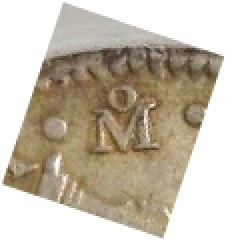
This mint mark is non-standard. The two sides of the M are different heights. The only similar example I have seen was on a counterfeit 8R, however, I can not locate that coin and I am working from memory at present. In any event this odd mint mark has an essentially centered o superscript. It is the right leg of the M that is different.
TwoKopeiki Are you sure the coin with the odd mint mark is actually genuine and not a Class 2 silver counterfeit? What is the date? Do you have complete pictures before it was placed in plastic? PCGS has encapsulated many 8Rs that I believe to be Class 2 silver counterfeits.
Regarding the crown spaced above the shield. I see the variation as possible, but unlikely. Normal seems to be in contact. There is a late date Zs rare issue with the lower arc of the crown present. I have never personally examined this rarity to see if it is actually genuine or not. Of course the gap is also seen on Class 2 Silver counterfeits as well. For example the next picture is taken from a coin in my book which has been XRF tested on several occasions. Using a handheld tester it indicated NO gold at all. The last test done using the newest lab level XRF tester at RTI Labs (accurate to 1 ppm done in 2014) discovered a slight gold trace of 120 ppm (or 0.012%) well below the 2000 ppm minimum needed to prove a Mexican origin in the first decade of the 1800s. The purity level of 999.99 fine was impossible for a mint operation in 1805 but was achieved in the 1890s in Nevada.
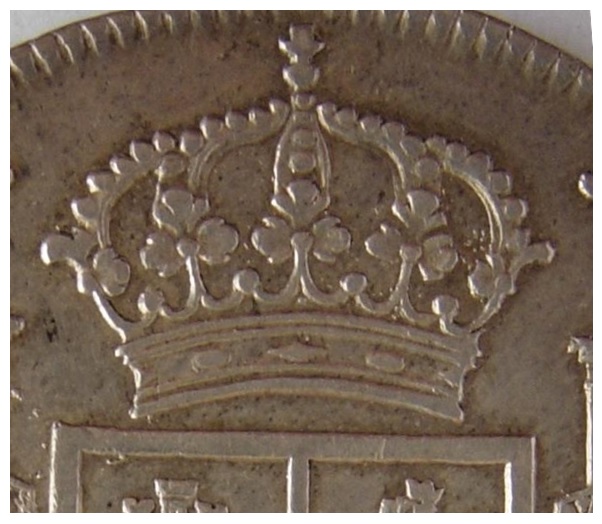
If you notice this particular counterfeit also has many tiny lumps near the designs and on the field which identify the coin as bad for me. However, the TPGs are still encapsulating 8Rs without doing XEF tests.
To all concerned about the bifurcated bases of many letters seen on 8Rs, that is a subject I have theorized about for years. I really prefer to believe that the punches were not different because it fits better with the overall Matrix Punch Block theory. I been searching for coins struck from identical die pairs which show differences in the bifurcation as a way of proving that theory. Like TwoKopeiki I believe that it is due to a combination of strike and die wear or infill. No absolute proof so far.
TwoKopeiki You have correctly identified the third feature. You say:
Quote:
this is the first time I see the top left lily in the fleur-de-lis leaning backwards vs forwards in an 1805.
this is the first time I see the top left lily in the fleur-de-lis leaning backwards vs forwards in an 1805.
Since I have seen pictures of a block displaying the three Fleur-des-lis in the completed pattern, I have always maintained that the upper left lis must tilt to the right NOT the left on Mexican 8Rs of this matrix era.
So that is 3 pf 4 points identified.
bogdanjovi I agree that the straight upper ribbon is not normal and I could have used that as an item that would make me suspicious because the Portrait was complete on the King Punch for the obverse die. However, I have not studied the ribbon specifically to see if it ever needed to have the ribbon tips engraved. Unlikely but possible - the detail is quite far from the center point.
Squire Wilson You need to understand something about how the Mexican's made dies. The dies were punched one at a time with punches created from a standard matrix (punch) block.
The Matrix blocks were made in Spain and shipped to each of the colonial mints. At the blacksmith shop in the mint, a smith created individual die punches by driving softened steel bar stock or rods into each distinct design. After the design was transferred the head of the punch was trimmed and then the steel was hardened so it could be used to transfer the image to the die face.
Because the designs were added one at a time spacings often vary between punches. So you need to learn what each punch design consisted of for any given period of time. The periods (stops) in the legend are a vary simple point punch. These vary significantly since they were not actually present on the Matrix block. Diameters do vary slightly and placement also varies. I too use the locations of the stops as a way of telling dies apart rapidly.
The mint mark was a single punch in the block. So the standard punch contained the letter M and the o on Colonial issues of Carolus III and IIII. This was not always the case in the Republican mints however. At times two different punches were used.
I rotated the mint mark shown on the coin owned by TwoKopeiki see next.
This mint mark is non-standard. The two sides of the M are different heights. The only similar example I have seen was on a counterfeit 8R, however, I can not locate that coin and I am working from memory at present. In any event this odd mint mark has an essentially centered o superscript. It is the right leg of the M that is different.
TwoKopeiki Are you sure the coin with the odd mint mark is actually genuine and not a Class 2 silver counterfeit? What is the date? Do you have complete pictures before it was placed in plastic? PCGS has encapsulated many 8Rs that I believe to be Class 2 silver counterfeits.
Regarding the crown spaced above the shield. I see the variation as possible, but unlikely. Normal seems to be in contact. There is a late date Zs rare issue with the lower arc of the crown present. I have never personally examined this rarity to see if it is actually genuine or not. Of course the gap is also seen on Class 2 Silver counterfeits as well. For example the next picture is taken from a coin in my book which has been XRF tested on several occasions. Using a handheld tester it indicated NO gold at all. The last test done using the newest lab level XRF tester at RTI Labs (accurate to 1 ppm done in 2014) discovered a slight gold trace of 120 ppm (or 0.012%) well below the 2000 ppm minimum needed to prove a Mexican origin in the first decade of the 1800s. The purity level of 999.99 fine was impossible for a mint operation in 1805 but was achieved in the 1890s in Nevada.
If you notice this particular counterfeit also has many tiny lumps near the designs and on the field which identify the coin as bad for me. However, the TPGs are still encapsulating 8Rs without doing XEF tests.
To all concerned about the bifurcated bases of many letters seen on 8Rs, that is a subject I have theorized about for years. I really prefer to believe that the punches were not different because it fits better with the overall Matrix Punch Block theory. I been searching for coins struck from identical die pairs which show differences in the bifurcation as a way of proving that theory. Like TwoKopeiki I believe that it is due to a combination of strike and die wear or infill. No absolute proof so far.