| Author |
 Replies: 15 / Views: 4,428 Replies: 15 / Views: 4,428 |
|
|
Valued Member
United States
284 Posts |
|
|
|
|
Rest in Peace
10197 Posts |
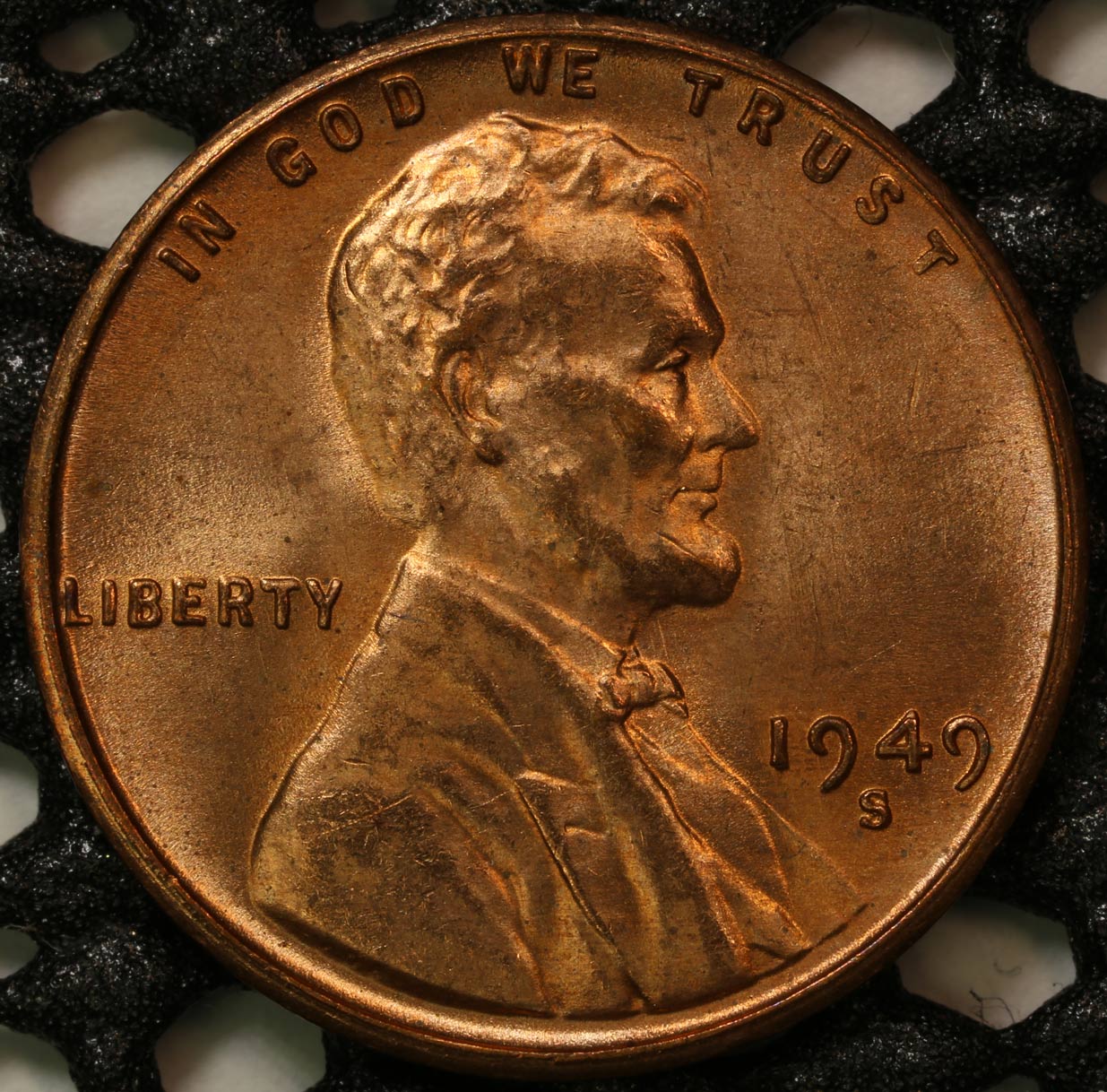
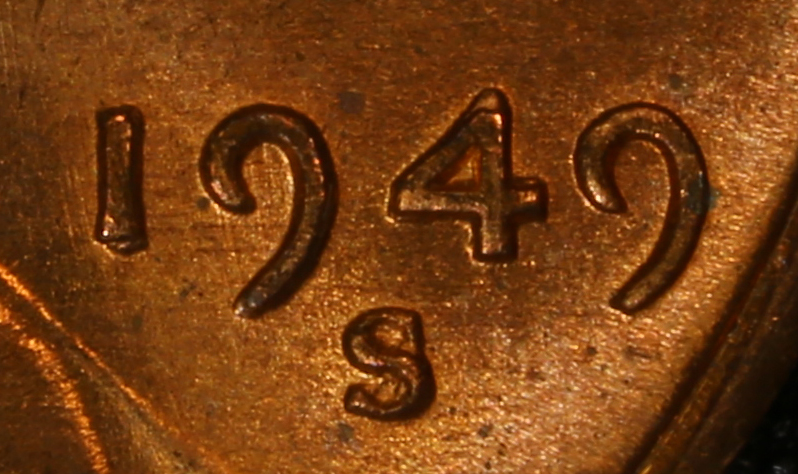
First thing I do is check MM location, if it matches half the attribution is over already. Now let's look at other indications. The lower portion of 1, the lower left crosslet of 4 and upper righ crosslet of 4. Most are a match for the example on coppercoins, but you see the differences? I do, CC doesn't note the upper right crosslet...so on to the check. back in a bit 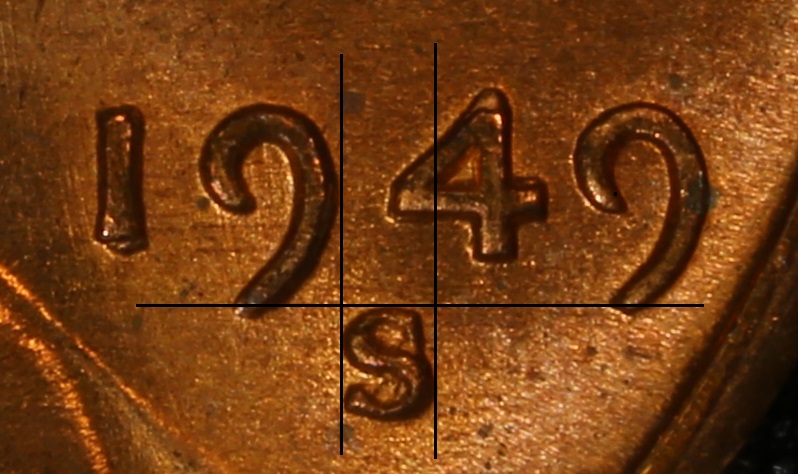 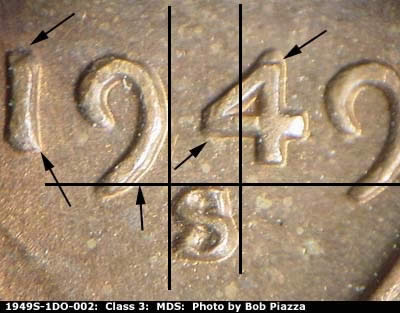 |
|
Valued Member
 United States
284 Posts |
thats good advise. Mintmark location is something I always overlook.
|
|
Rest in Peace
10197 Posts |
Interesting one. All the RPMs have the blunt 4/ sharp tip 4 hubbings, which indicates a MDD for that marker. This comes down to MINUTE mintmark position. Here's the three varietyvista.com listings. Because yours is the lowest, it is 1949S DDO-001 on their site. Nice one. Notice the other subtle differences in the below three images. 002 is higher and a bit to the east. 003 is really close laterally, a bit north, but the key is the rotation of mintmark. yours is rotated CCW. 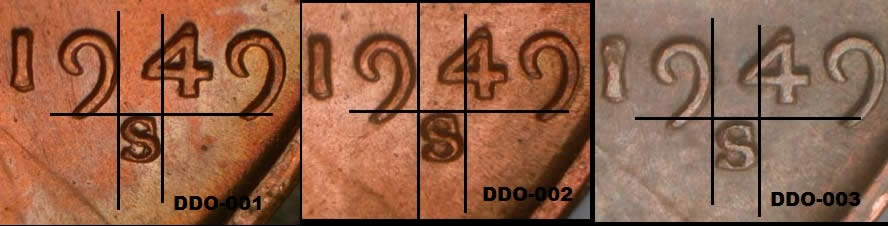 Edited by Crazyb0
03/15/2018 3:38 pm
|
|
Valued Member
United States
284 Posts |
I see a lot of the same die scratches as 103 on CC. I think thats it.
|
|
Rest in Peace
10197 Posts |
Can even see the scratch above the tie w/o expanding pic. That's it on CC and a cross to VV.
|
|
Bedrock of the Community
United States
62064 Posts |
Has anyone figured out how this die was created? I see this as a 1948 hubbing that was altered to remove the '8' and hub with a 1949 hub? Why? I don't know. But the elements are there that convince me that this is what happened: [b]Note the first digit of both years and how the die shows both hubbings: 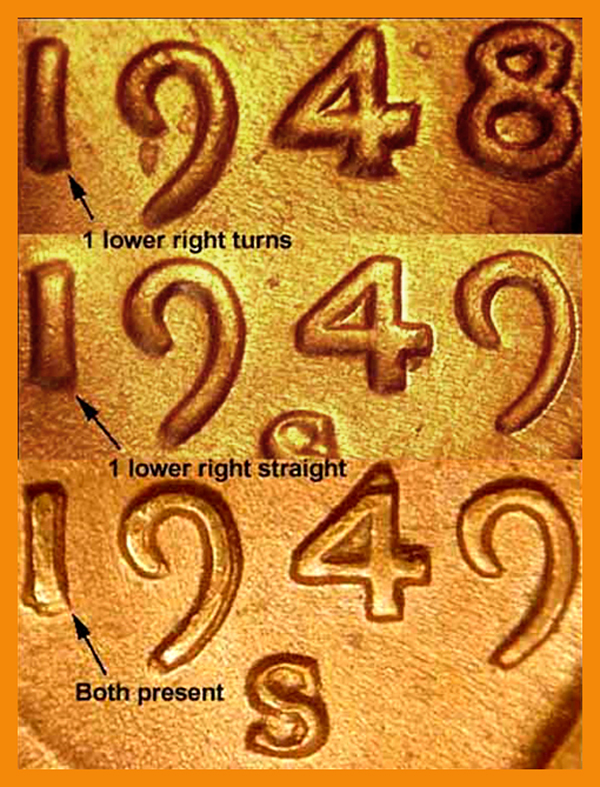 Note the hubbings of the '9's of date: 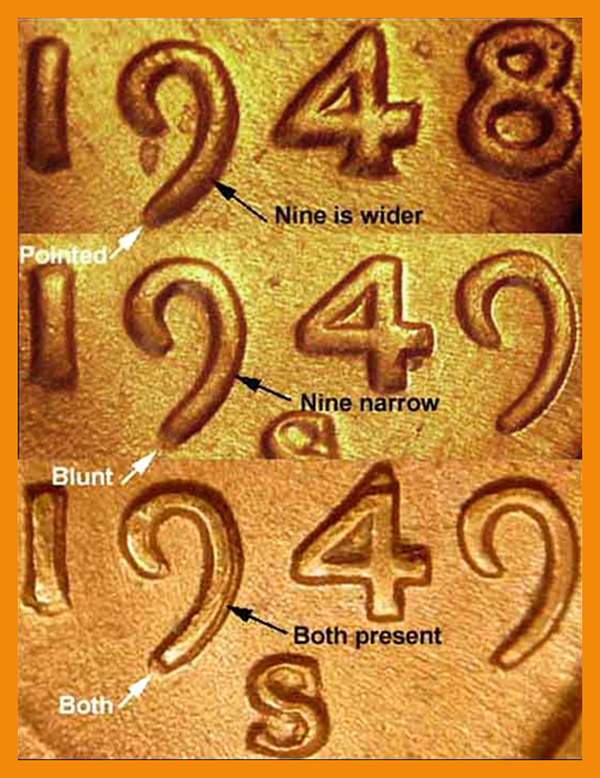 Note the hubbings of the '4's how you can see each one? 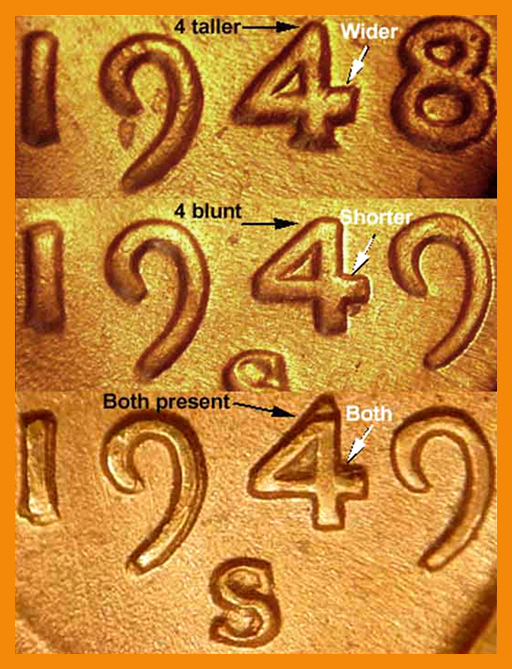 Then the final look at the digits. The '8' is missing of the DDO. There are three different locations for the mint marks, so it was hubbed and then the mint marks were added. It only appears on the San Francisco mints cents. The dies were still being created at Philly. So I figure they needed to make a few more dies and the master die was not available. So they may have created a working die and sent it to San Francisco. That's my theory. Coophome= 1949-S DDO 1 theory Edited by coop
03/15/2018 4:45 pm
|
|
Valued Member
United States
284 Posts |
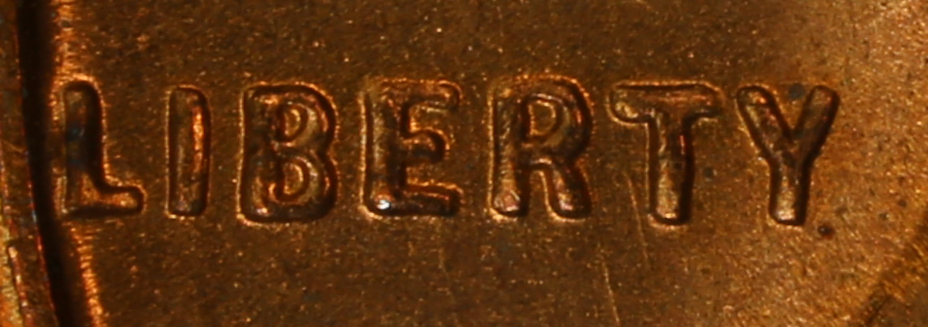
That would explain why those three die varieties on Coppercoins share so many similarities. I wonder if the doubling on Liberty and motto associated with the coin I found are present in the other two coins that have the similar dates. Now I just have more questions, thanks for all the info guys.
Mitch
|
|
Bedrock of the Community
United States
62064 Posts |
Let's see: 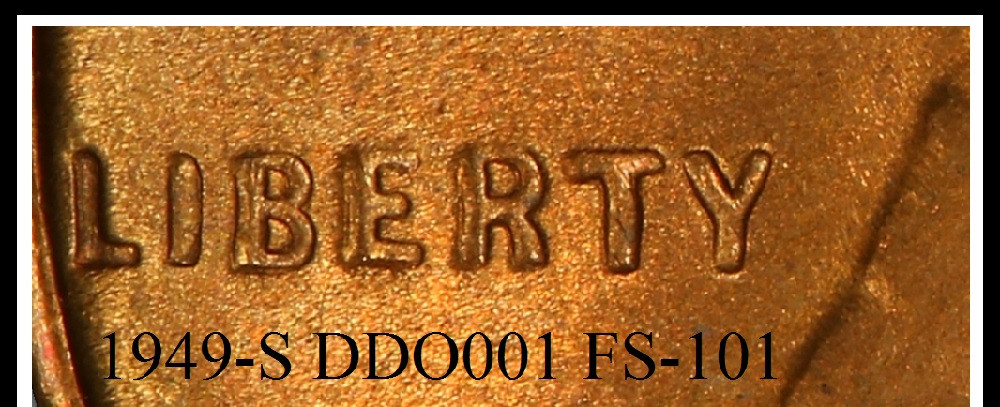 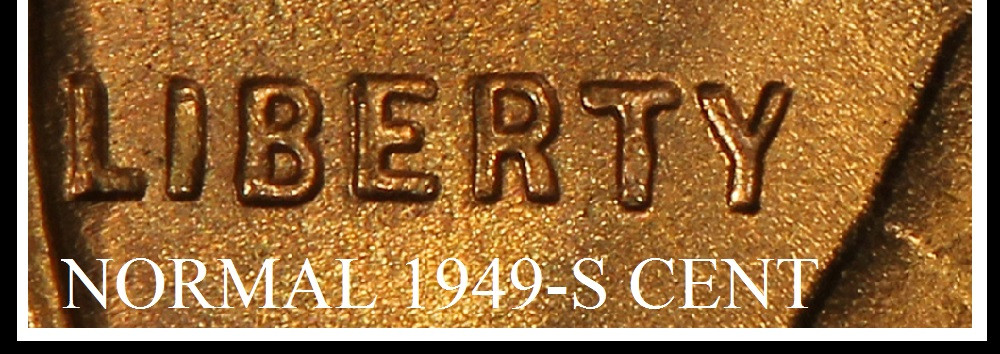 Looks pretty much like normal. Some of the devices like 'R' seem just a bit wider? Edited by coop
03/15/2018 6:57 pm
|
|
Pillar of the Community
United States
3744 Posts |
Monthly mintage figures for 1949-S cents might shed some light on the hubbing issue.
Here are 1949 San Francisco cent mintages by month from the April 1949 to March 1950 issues of the Numismatist:
January - 16,600,000 (April 1949 Numismatist, p. 240)
February - 16,800,000 (May 1949 Numismatist, p.297)
March - 11,000,000 (June 1949 Numismatist, p. 343)
April - 7,850,000 (July 1949 Numismatist, p. 394).
May - none (August 1949 Numismatist, p. 475)
June - none (September 1949 Numismatist, p. 558)
July - none (October 1949 Numismatist, p. 607)
August - none (November 1949 Numismatist, p. 692)
September - none (December 1949 Numismatist, p. 737)
October - 2,105,000 (January 1950 Numismatist, p. 62)
November - none (February 1950 Numismatist, p. 122)
December - 9,935,000 (March 1950 Numismatist, p. 184)
Total mintage - 64,290,000.
David Lange states that the San Francisco mint ceased domestic production from May to September 1949, to strike foreign coins.
I don't know how many coins a working die could strike in 1949, but if it was anywhere near 700,000, wouldn't the most likely use of these dies be the 2.1 million production run in October? If so, why then?
Also, if I recall correctly, every year in the 1940s has a slightly different "4" in the date. Wouldn't this suggest that the last two digits of the date should have been replaced on the master, rather than just the last digit?
This critter is a whale of a mystery.
|
|
Bedrock of the Community
United States
62064 Posts |
|
|
Valued Member
United States
284 Posts |
Ha ha, coop. Even as a coin variation, wouldn't a mintage around 2.1 million make it "common" enough to have been explained long ago? This type of date is out there, on ebay and other sites if you look for it. I'd really like to know what's going on here. Coop's Theory (tm) makes a lot of cents, the mintage numbers are really cool as well. I could post better pics but I'm not sure that's really necessary. There's just enough out there about this coin to make it confusing. Thanks a lot, for all the time, research and comments guys! |
|
Pillar of the Community
United States
3744 Posts |
I spent some time reading the Annual Reports of the Treasurer and of the Director of the Mint, trying to pin down the mintage per die figures. (I highly recommend the Annual Reports for bedtime reading. The riveting discussions of Savings Bond redemption rates and debentures is likely the only known permanent cure for insomnia.) There is hard evidence of 150,000 coins per die from 1913, 1915, and 1923. I can find evidence of 450,000 to 500,000 per die mintages in the immediate prewar years. I can find enough to calculate mintages per die of 850,000+ in the mid-1950s. I can find some evidence for mintages north of a million per die in the ridiculous die overworking era of the early 1960s. For 1949? Nothing. With ranges of 450,000 to 850,000 bracketing 1949, an estimate of 700,000 seems in the ballpark. There are also multiple descriptions of the transition from LDS to VLDS at around the 600,000 to 650,000 figure for the 1950s, which would lend some support for the estimate. At something near 700,000 coins per die, the January-April mintage north of 52 million would suggest around 80 die pairs. The December mintage just south of 10 million would suggest about 15 die pairs. IIRC, Philadelphia shipped dies in boxes of 20. Four boxes of obverse dies would match the die estimate for January-April production, suggesting that San Francisco stopped minting cents in April when it ran out of dies. The December production is more problematic. A box of 20 dies would have exceeded the production, suggesting that the clock ran out rather than the dies running out. I can't come up with any logical explanation of how 77 of 80 dies at the start of the year would have used 1949 hubs while 3 dies used both 1949 hubs and ground down 1948 hubs. It just doesn't make sense. The end of the year mintage would also suggest that 12 of the 15 or so dies in use (or 12+ of 20 in the box) would have used 1949 hubs alone, while 3 would have used both 1949 and ground down 1948 hubs. Again, there isn't a good narrative for this. The stray October mintage is left as a possible explanation of a time when this might have happened. It is worth noting that Philadelphia did not produce any domestic coins in August and only a relatively small number of cents in September and October. If Philadelphia wasn't planning on making working Lincoln Cent dies during those months, but had a request from San Francisco, is it possible that an employee used the 1949 working hub for the second impression on leftover working 1948 dies, after polishing the "8" into oblivion? If so, wouldn't EDS coins show evidence of the polishing? Wouldn't that explain the small differences between the coins? Are there any coins showing this? (I've never seen one showing this.) If working hub to working die doesn't explain this (and it doesn't appear to) then coop's idea of a working hub is the only plausible explanation. But why? Why would anybody do something like that mid-year, and then go back to the original 1949 hub? And if it wasn't mid-year, what could have happened to necessitate two different working hubs being used to make widely disparate numbers of working dies for the same shipment? Again, this is one odd duck of a coin. |
|
Valued Member
United States
284 Posts |
If coops theory was accurate would this be considered an overdate or a retooled date, or is there a different name for when they re date an old die? Just curious not much info when I google the terms I'm thinking of.
|
|
Bedrock of the Community
United States
62064 Posts |
The basic term is doubled die. As of yet, my theory is not generally accepted. But a few of the experts feel there is some merit in my theory. But no way to prove it. No documents about it. The people who were working them are probably all gone now. (coins were struck 69 years ago)
|
|
Pillar of the Community
United States
3744 Posts |
@coop, for what it's worth, I think your theory is spot on. The coins themselves seem to debunk all of the other likely explanations. Again, if this was using a 1949 hub to complete the hubbing on incomplete 1948 working dies, then there would either be evidence of an "8" or die polishing marks - neither of which exist on any of the 1949-S DDO coins I've seen. The biggest puzzle is the question " why?" San Francisco obviously had plenty of obverse dies at the start of the year and again at the end of the year. The rest of the dies obviously were prepared from normal 1949 working hubs. Philadelphia produced a whopping 21 million cents in December 1949. If San Francisco needed a couple dies so badly, why not whack an "S" mm on a couple Philly dies and ship them west? The reason I keep focusing on the stray October production is that there are three dies at issue, no surrounding production months, and the 1949-S DDOs are scarce, but not exceptionally rare. I just can't get my mind around the "why?" issue. All that noted, this was an era of some pretty strange stuff at the mints. Consider the likely intentional date-changing DDOs during the war, the comparatively large number of OMMs on cents, nickels, and one quarter in a short span, and the constant downsizing and eventual closure of the San Francisco mint. (In federal fiscal year 1949-50, San Francisco lost 20 employee slots, ending with just 199 employees. Yes, that useless trivia was in the Annual Reports.) As to records, I wonder if the National Archives and Records Administration (NARA) has the detailed production logs from the Philadelphia mint for 1949? Those logs should show not only daily mintages, but also creation of master and working dies and hubs. There might also be some correspondence between Philadelphia and San Francisco that accompanied the dies or that answered an inquiry about the dies. The other useful piece of information would be the receipt for dies returned from San Francisco to Philadelphia after the end of December 1949 production. Edited by fortcollins
03/17/2018 5:26 pm
|
| |
Replies: 15 / Views: 4,428 |
|









 Posted 03/15/2018 3:29 pm