| Author |
 Replies: 23 / Views: 4,032 Replies: 23 / Views: 4,032 |
|
Pillar of the Community
United States
6130 Posts |
I've had sellers include free coins with listings before, but this one takes the cake. The listing described and pictured 7 ancient Indian coins, I guess the seller didn't want to bother listing this one by itself? I held this one back for a few months to do some research - still coming up empty. I know Ron recently bought a book on these coins, maybe he can ID it? India AR Karshapana Probably Mauryan (c. 320-180 BC) but possibly earlier or later. Obv: Three humans as separate punches, dots around their head; Three arched hill (lower right, sideways), unidentified animal (lower left) Rev: Two unidentified symbols, a "rising sun" and something else.  The "three figures" is a popular type among collectors, and are presented either as three punches, or combined into one. They are believed to be deities, but that's mostly conjecture. Mauryan karshapanas had one "control" punch on the back - one of the two punches on my coin is probably a banker's mark, but I'm not certain which. Interestingly, from what I found online, this type ought to come with the "peacock standing on a hill" punch, but mine doesn't. I was not able to find either reverse symbol listed for any karshapana, three figures type or not. Any ideas?  I'll report back if I find or hear anything Edited by Finn235
04/17/2018 12:04 pm
|
|
|
|
Moderator
 United States
23731 Posts |
Each punch mark represents a letter in Bramhi, the human figure is the letter K but the three dots change it to another letter which I have not been able to find it. I going to need to do some searching on this one. And unusual coin.
|
|
Moderator
United States
23731 Posts |
Steve, I'm afraid this is not going to help much. These are not the three figures but are the signal person mark. The dots around the figure indicates the letter "I" in combination with the figure it is the Brahmi letters "KI". I wasn't able to find a word with the spelling of KIKIKI, which may not be the correct spelling when these same marks appear on one coin. The book I have is pretty extensive and covers all the characters and symbols used throughout Indian coin history. So I'm surprised I wasn't able to find a answer for you.
|
|
Pillar of the Community
United States
1554 Posts |
Mauryan Empire, AR karshapana, series VII (Ashoka and successors, c. 272-175 BC), GH type 584. Obverse symbols: "three standing figures" punched individually, "dog with pup in mouth" and "base supporting three vertical poles, two with slanted tops, all flanked by two arches". R: Single "Triangle headed standard" punch. The "centipede" seems to be an additional mark or remnant of an undertype.
Edited by Kushanshah
04/16/2018 7:25 pm
|
|
Moderator
United States
23731 Posts |
I agree a Mauryan karshapana, but what I think Steve is looking for is a translation of the punch marks. What at first I thought to be three separate figures may indeed be the three figure mark. Which would translate to "KAKITA" found in part on coins of Ashoka. As in rania asamhimita tissakkita curuvaki maga hasa raja achogasa. I not able to make out the other two obverse marks which would help with the id.
|
|
Pillar of the Community
United States
1554 Posts |
I've never seen anything in the literature suggesting that the punchmarks are a form of syllabic writing. To the contrary, Gupta & Hardaker conclude that each symbol in the typical sequence of five has a discrete and as yet (2014) undetermined function. I would be interested if you might provide a reference for the Brahmi hypothesis.
Edited by Kushanshah
04/16/2018 8:28 pm
|
|
Moderator
United States
23731 Posts |
|
|
Pillar of the Community
 United States
6130 Posts |
Thanks for the GH reference, Kushanshah! I may eventually get around to buying that reference, but for the time being, my PMC collection is too small to really justify the price. Is the "centipede" a known official symbol? It does appear to be the freshest of the seven on the coin, so I would imagine it was the last to be applied.
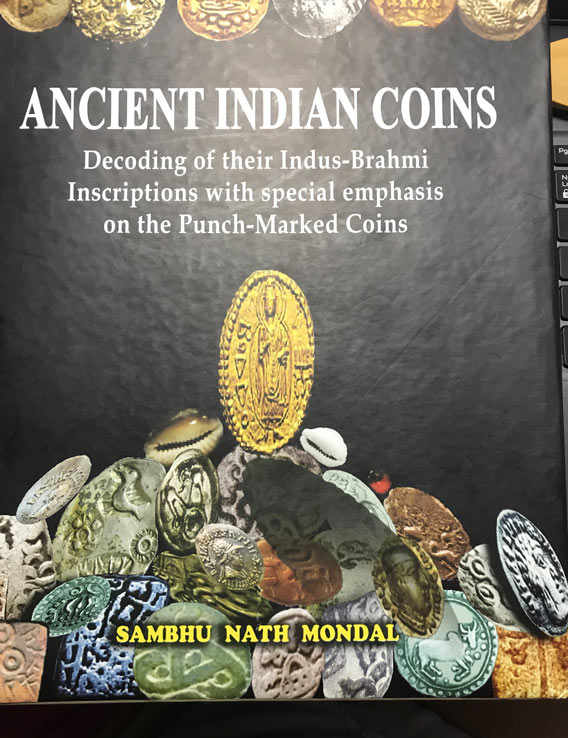
@Ron, Have you had a chance to read his entire argument yet? I am sure he argues a convincing case, but the claim of an elaborate many-to-one system of symbols to Brahmi just seems like an overly complex and non-intuitive system? I would love a summary with examples if you could provide one.
|
|
Pillar of the Community
United States
1554 Posts |
@Finn235 The 3 standing figures types are close to the end of the punchmarked karshapana series. The centipede is an official punch, an earlier reverse symbol. I suspect your coin is struck over an earlier type. Remains of the obverse undertype would have been obliterated by the new punches.
|
|
Pillar of the Community
United States
1554 Posts |
I checked the you-know-where website for the new 2nd edition of Gupta & Hardaker. I almost hyperventilated when I saw $187! It is available from PrintsAsia for $47.50 with free shipping. A good investment, I think. Not only is it the standard reference, it magically turns $3 coins into $30 coins :) http://www.printsasia.com/book/punc...788186786352 Edited by Kushanshah
04/17/2018 12:46 am
|
|
Pillar of the Community
United States
1554 Posts |
@echizento I will admit that I'm a bit skeptical. Mondal lacks formal training in the field yet claims that his work necessitates a rewrite of Indian history. Extraordinary claims require extraordinary evidence, as they say. Interesting. Thanks for the reference.
|
|
Bedrock of the Community
Australia
21792 Posts |
I will keep a lookout for this book and may order it from ex library stock, if that is possible. I am lucky enough to have a professional LCS owner, who is able to track down a copy down for me. I am happy to pay for his efforts. A bit like getting rare spares for classic cars!  I am thinking about the chamfered corner on the rectangular silver panas. Perhaps the clip is a form of weight adjustment. |
|
Pillar of the Community
 Spain
2752 Posts |
Nice coin Steve! and a very interesting thread...
Something I have noticed on your coin and others I've looked at, when a supposed identical punch symbol is used more than once eg the three standing figures, is imo that three different punches were used.The middle symbol on your coin being much smaller and number of dots varying?... Different deities? different meanings?
Paul
|
|
Moderator
United States
23731 Posts |
@Steve I have not read the entire book only areas pertaining to the coins I have. As I said earlier the book is extensive and is about how to read an understand the meaning of the symbols on all ancient Indian coin types. I have to admit there are area's that are way over my head. I've also believed that the punch marks most have had some time of meaning and not just a group of random symbols punched into the coin. Mondal's work verifies that and shows how the punch marks form a readable and logical legend. While I'm sure he doesn't have all the answers and there are mistakes in some of his interpretations, I think this book is going to replace a some of the other references. And be the new go to reference.
@kushanshah, thank for the link to the book I've been wanting a copy but the price was a bit high. At $47 I couldn't pass it up.
|
|
Bedrock of the Community
Australia
21792 Posts |
My LCS is Noble Numismatics in Sydney. They have one of the top five numismatic reference libraries in the World, with somewhere between five to ten thousand volumes.
They public auction upwards of $10 million cons per year, and take their part in the international auction scene.
www.noblenumismatics.com.au
At AUD $60, that is OK for me.
Edited by sel_69l
04/17/2018 8:07 pm
|
|
Moderator
United States
23731 Posts |
Well I ordered the Gupta & Hardarker book on 4/17 from Printsasia. The book has not shipped yet and they don't respond to inquiries. I'm starting to wonder if I will get it.
|
| |
Replies: 23 / Views: 4,032 |










 Posted 04/16/2018 5:35 pm