| Author |
 Replies: 14 / Views: 2,087 Replies: 14 / Views: 2,087 |
|
|
New Member
United States
1 Posts |
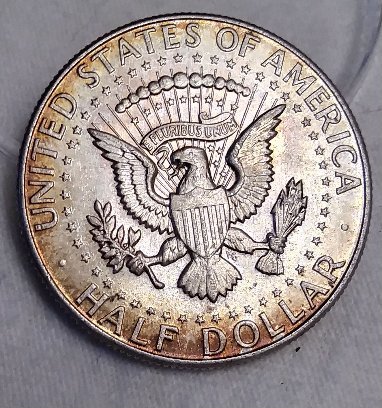
How do you tell if a coin is AT or NT?
|
|
|
|
Moderator
 United States
195203 Posts |
 to the Community! Your reply was split into its own topic and moved to the appropriate forum for the proper attention.  |
|
Bedrock of the Community
Canada
24885 Posts |
To the Forum. |
|
Moderator
United States
56855 Posts |
to CCF. Not to be snarky,but a lot of research. It takes a lot of learning. John1  |
|
Pillar of the Community
United States
8715 Posts |
Edited by SilverDollar2017
04/19/2018 4:15 pm
|
|
Rest in Peace
United States
17900 Posts |
The most common indicator of AT is splotchy and blotchy colors. Natural toning progresses in a predictable pattern, regardless of the cause. Check past Heritage sales to see those that a TPG has determined to be one or the other. PCGS and NGC are right the vast majority of the time. |
|
Bedrock of the Community
United States
20037 Posts |
You don't! A coin either has market acceptable toning or it doesn't.
Lincoln Cent Lover!VERDI-CARE™ INVENTOR https://verdi.care/
|
|
New Member
United States
19 Posts |
What the poster is talking about is Artificial Toning versus Natural Toning.
Toning happens most pronounced with silver coinage and there are a number of factors that allow toning to happen to a coin.
|
|
New Member
United States
19 Posts |
|
|
Bedrock of the Community
Australia
21789 Posts |
BadThad is right.
Nevertheless,
The problem I have with eye catching beautiful multi color toning, is that it is in an unstable state between blast white and an even rich gray color. In most cases, it will become less attractive with age.
I prefer to buy a coin on it's merits, trying to avoid being tempted by it's sometimes beautiful colors.
A bit like a beautiful woman. You are much better off, when you find out about all of the other reasons why you may be interested. Better for her, (or the coin), as well.
|
|
Pillar of the Community
United States
3511 Posts |
I agree with badthad, I really wish we could lose the AT/NT nomenclature and replace it with market acceptable or not...
|
|
Moderator
United States
195203 Posts |
I agree as well. There is not a clear line between natural and artificial. It is better to determine if the coin is marketable or not.
|
|
Pillar of the Community
United States
3479 Posts |
I agree that it takes looking at tens of thousands of coins to develop an eye for it. There are many different variables including know the series history. Morgans were stored in clothe bags for my years so the sides of the lucky coins that were pressed up against the bags developed the toning. That's why you see a lot of morgans with only one side toned.
-Coins with radial toning, meaning toning around the perimeter that gets lighter as it moves to the center of the coin is usually from album toning and is considered natural. IT was stored in a Whitman album or some other type of folder for a length of time.
-Another giveaway for AT is too much dark toning with the darker colors of the rainbow- dark blues, dark purples and reds. The toning will also appear to be thick and 'caked on' and encompass the entire coin.
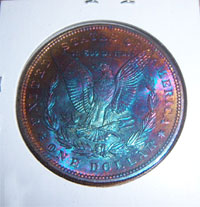
Silver Dollars first coin screams AT to me.
Edited by MikeF
04/20/2018 1:12 pm
|
|
Pillar of the Community
Canada
1267 Posts |
Quote:
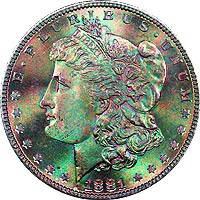
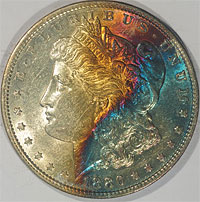
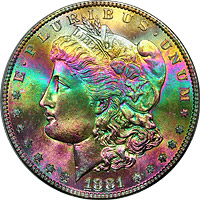
How do you tell if a coin is AT or NT? Research of the series you are interested in. With time, you will develop a feel for it. Personally, I dislike the term market acceptable. I prefer natural and questionable. Unless you keep your coins in a vacuum, from the moment they are minted they will begin the natural process of oxidation and form a thin layer of silver oxide on the coins surface.....we refer to this as thick skinned. No 200 year old silver coin should be blast white. I know of beautifully toned Morgans that have remained unchanged for at least 40 years (since they were removed from the mint bags). It is the accelerated (artificially created) pieces that are known to change. If someone could please show me a naturally toned example that has turned in a holder, I'd love to see it. I've asked that before, and am still patiently waiting for my first reply. Regrading SilverDollars post, coins 1 (most likely heat) and 3 (most likely gas) are artificially created. Coins 2 and 4 are the real deal and quite beautiful imho. I have seen both in hand, and am aware of the provenance of the final piece for the last 20 years or so. It is a true moose. Edited by hadleydog
04/21/2018 05:49 am
|
|
Bedrock of the Community
United States
20753 Posts |
This question comes up often. And the reason why is sometimes it is impossible to tell the difference. And you have to remember what toning really is. For example if I left a coin laying outside for a long period of time and it started to tone, is it AT or NT? If I left a coin on top of a stove where it got heat and then no heat and started to tone, is it AT or NT. In both instances it was done purposely so is that AT? I suspect the worst AT is done in a fast method to tone coins yet what is the difference? If a coin is toned, it is just a toned coin so what. |
| |
Replies: 14 / Views: 2,087 |
|







 Posted 04/19/2018 3:29 pm