| Author |
 Replies: 11 / Views: 2,776 Replies: 11 / Views: 2,776 |
|
|
Pillar of the Community
United States
1415 Posts |
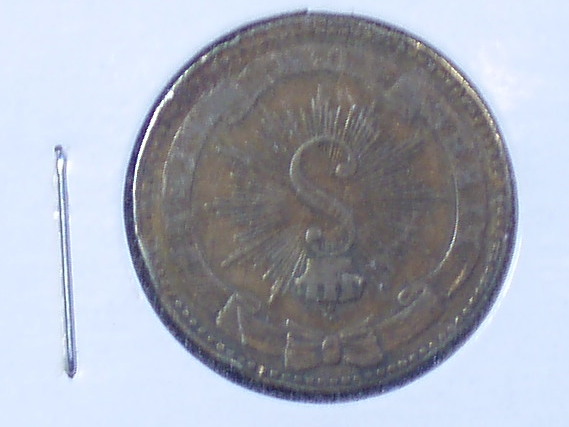
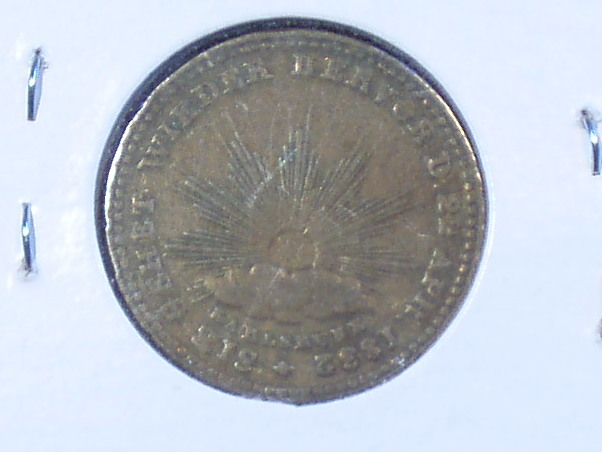
Does anybody know the origin? It is about 20 mm in diameter and made of copper Image:  S_Coin_Obv.jpg S_Coin_Obv.jpg60.13 KB Image: S_Coin_Rev.jpg65.54 KB moved to ID forumEdited by Sap
06/18/2008 08:54 am
|
|
|
|
Moderator
 Australia
16982 Posts |
I'm pretty sure it's not a coin.
The text is archaic German (which is why it doesn't run through the translator very well); I think it says "They go again before". There's a death date mentioned (d. 22 April 1832), so maybe it's a religious text, something like "thou shalt rise again"?
The other side is a crowned monogram (the pic is upside down; the crown is supposed to be on top). The monogram is presumably the initial of the person who died. I had a quick look for a German prince with a name beginning with S who died on that date, and couldn't find anyone.
There seems to be text written on the ribbon, but it's too blurry to read; if you can read it, it might offer another clue as to who and where this came from.
Don't say "infinitely" when you mean "very"; otherwise, you'll have no word left when you want to talk about something really infinite. - C. S. Lewis
|
|
Pillar of the Community
 United States
1415 Posts |
Sap,
Just got home to check ribbon - text is
SIE GEHET WIEDER HERVOR
|
|
Moderator
Australia
16982 Posts |
Ah, it's "hervor", not "bervor". No wonder neither my German dictionary nor the translation websites had the word.
So the same phrase appears on both sides: either "they come out again" or the formal mode: "Thou comest out again".
Googling the phrase doesn't help - the only website that comes up is this very thread.
Don't say "infinitely" when you mean "very"; otherwise, you'll have no word left when you want to talk about something really infinite. - C. S. Lewis
|
|
Pillar of the Community
United States
1415 Posts |
Sap,
I don't know what is on the other side.
Most is worn off.
Tonight I will take a closer look and see if I can make out anything
|
|
Moderator
 United States
6563 Posts |
Well?   |
|
Pillar of the Community
United States
1415 Posts |
Sorry!  Couldn't make anything out on the Obverse |
|
Moderator
Australia
16982 Posts |
AHA! Spotted something else to help narrow down an ID. Beneath the cloud on the reverse, the word "Karlsruhe", which is one of the major mint cities in Germany. Karlsruhe was the capital city of the state of Baden, so now we just need to find someone whose name starts with "S" connected to a significant event in that country at that time (22 April 1832). The Grand Duke of Baden at the time was Leopold I. His wife's name was Sophie, who is the only person I can find whose name starts with "S" at that time. They had their sixth child, Karl, in 1832, so maybe it's a medal commemorating this. That's the best I can do for you at the moment. Don't say "infinitely" when you mean "very"; otherwise, you'll have no word left when you want to talk about something really infinite. - C. S. Lewis
|
|
Valued Member
Netherlands
376 Posts |
After the abdication of Swedish King Gustav IV in 1809 by the Swedish Parliament in 1809 the former King with his Bavarian wife fled to Karlsruhe in Germany. Later Queen Sophie, their daughter, was 11 when she entered the Karlsruhe Palace Life. In 1819 she married to Leopold von Hochberg, Reichsgraf von Hochberg. In 1830 this couple became King and Queen of Bavaria. Their story is each year in the city of Ansbach subject to the Kaspar Hauser Festspiele. 22 april 1832 is the date of Friedrich Immanuel Kant, who is the writer of that particular play. http://www.an-netz.de/home/fam-kramer/fest_an.htmS is monogramm to queen Sophie, who was 31 in 1832. The upcoming sun refers to the growth of the monarchy of Bavaria. Greetings from Holland, Eric. |
|
Pillar of the Community
United States
1415 Posts |
Eric, Thanks for the information. Kinda confused  which is not abnormal for me! Is the coin a token that was issued each year? What would have been the usage of such a token? |
|
Valued Member
Netherlands
376 Posts |
The year is undoubtedly 22 april of 1832.
The use of this token could be to hand over your head and walkingstick when entering the opera or as a refreshment token, which is still in use today at popconcerts and so fort. Probably fabricated in the city of Neurenberg. 10 years ago I saw at an local Dutch collectors fair a similiar token as yours, only with monogram crowned L for Leopold.
I do not know if each year there was a token issued.
Edited by valutarick
10/06/2008 10:20 am
|
|
Pillar of the Community
Canada
650 Posts |
Again I am stunned by your knowledge on coins and tokens well done Valuterick
|
| |
Replies: 11 / Views: 2,776 |
|







 S_Coin_Obv.jpg
 S_Coin_Rev.jpg

 Posted 06/18/2008 5:56 pm





