| Author |
 Replies: 18 / Views: 3,793 Replies: 18 / Views: 3,793 |
|
New Member
United States
3 Posts |
|
|
|
|
Pillar of the Community
United States
7730 Posts |
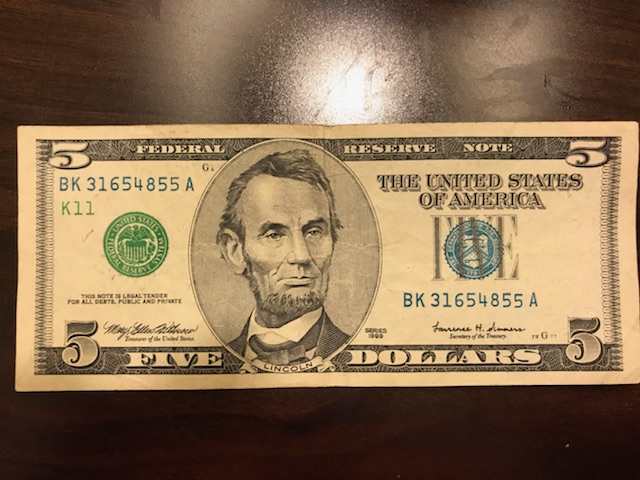
Color changes to the seals and serial numbers is most likely due to exposure to a dry cleaning solvent of some type.
|
|
Pillar of the Community
United States
7730 Posts |
.....and a big  to the Community! |
|
New Member
 United States
3 Posts |
Wouldn't the back also be affected? It seems to be the same as any other bill. And thanks for the welcome!
|
|
Pillar of the Community
United States
7730 Posts |
The back is printed first and does not use the same type of ink that is used on the front.
Bleach can also affect the color pigmentation in funny ways, too. The note might have gone through a laundry cycle with bleach.
Edited by westernsky
05/06/2018 01:04 am
|
|
New Member
United States
3 Posts |
Thank you for the information. Is there any way to find out for sure? Like maybe a test of some sort?
|
|
Bedrock of the Community
United States
94367 Posts |
Believe me, this is a chemically altered note ("false error"). Try some bleach on the seal of one of your own notes to see a typical effect. Different chemicals, different results. to the Paper Money Forum! |
|
Pillar of the Community
United States
717 Posts |
Interesting. I never saw that before.
Your answers were also helpful.
|
|
Moderator
 United States
195183 Posts |
to the Community! |
|
Pillar of the Community
United States
746 Posts |
Don't be so quick to write this off as environmental exposure. 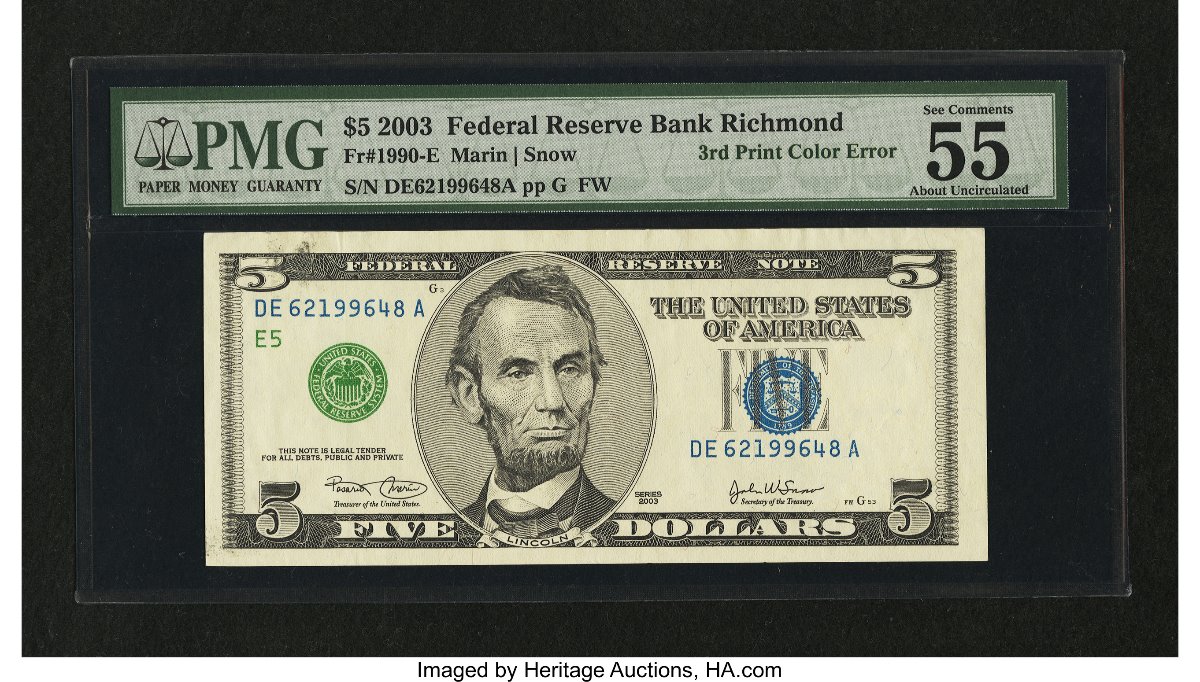 |
|
Pillar of the Community
United States
7730 Posts |
In spite of the pictured PMG "3rd print color error" it is my opinion that the OP's note, along with ANY others that have similiar color changes, were altered outside the BEP through chemical processing.
|
|
Pillar of the Community
United States
746 Posts |
You are right to be skeptical and if I had read the entire discussion on the old PCGS site before posting the picture, I would have been also. Here is a link to it. It confirms that the PMG certified notes were certified in error and the error is not BEP produced. http://www.papermoneyforum.com/post...ror&trail=50 |
|
Pillar of the Community
United States
7730 Posts |
Thanks Lettow for posting the link to the PCGSC thread about these "homemade" errors.
Interesting comment in that thread regarding that Heritage Auctions "would only accept the consignment if PMG would authenticate and grade the notes as genuine". Heritage Auction's disclaimer of "no returns for any reason on this lot" was even more darn ing. It shows that they still had internal doubts that the notes were legitimate errors and they covered it with a disclaimer....but still sold the notes! Money rules, ethics don't.
These altered notes will unfortunately keep turning up in the future just like the OP's....over 15 years after they were created!
|
|
Bedrock of the Community
United States
94367 Posts |
Well, obviously I apologize. I learned something here, and thanks to @lettow for the info.  |
|
Pillar of the Community
United States
7730 Posts |
Frog, Why apologize? You and I both knew from the get-go they were NOT genuine errors. PMG blindly certified them for Heritage without consulting any outside experts. Shame on both of them. Just because something is in a TPG holder does not mean it's "good to go". Question everything and everybody. I still believe that the big auction houses can pretty much get questionable stuff certified. We've seen it with currency errors, counterfeit world crowns, coins on nails and spectacular "errors" deliberately created by criminally minded mint employees. It all revolves around money! |
|
Bedrock of the Community
United States
94367 Posts |
Red-faced. I was astounded by the PMG holder and just caved, though I couldn't believe it.
|
| |
Replies: 18 / Views: 3,793 |









 Posted 05/06/2018 12:09 am





