| Author |
 Replies: 17 / Views: 10,850 Replies: 17 / Views: 10,850 |
|
New Member
United States
4 Posts |
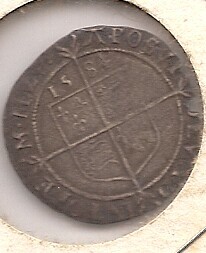
I have attached an image of a coin we found washed up on a beach in North Carolina. Can anyone help me identify it? Thanks! Image:  coin_1_1.jpg coin_1_1.jpg17.22 KB Edited by Sap
06/22/2008 08:27 am
|
|
|
|
Pillar of the Community
Australia
2830 Posts |
G'day & welcome,
I don't recognizr the coin, and I'm having a lot of trouble reading the legend.
I can make out a date (?) of 1584.
The upper left quarter of the shield has three items that remind me of the Fleur-de-Lys, which was used as a badge by the royalty of France well into the 1800s.
However, the lower left quarter is more difficult to make out: It might be three lions, a symbol of England.
The English & British monarchs claimed sovereignty over France upto circa 1801.
So, I'm thinking you might have found an old English coin, perhaps from the reign of Queen Elizabeth, now called "the first".
Peter
|
|
Pillar of the Community
Belgium
651 Posts |
Your coin looks like a silver (0.925) English sixpence, issued in the name of queen Elizabeth I.
You don't post the other side: normally you should see the bust of Elizabeth.
It was part of the fifth issue (1582-1600) during Elizabeth's reign.
|
|
New Member
 United States
4 Posts |
Thanks for your reply. Perhaps I can describe it in a bit more detail than the photograph shows. It was difficult to get a good photograph as the coin is very worn. In the upper left hand quadrant of the shield are three Fleur-de-Lys. The same Fleur-de-Lys pattern is repeated in the lower right hand quadrant as well. There does appear to be three lions in the lower left quadrant. The upper right quadrant is too worn to make out, but it could be a repeat of the lions. The date is, indeed, 1584. On the reverse side of the coin there appears to be a crowned figure, with what might be a rose or other flower to the right side of the figure. The image, however, doesn't look very feminine, but perhaps Elizabeth I didn't either! The legend is difficult to read. Some of the letters are, I think, APOSV. Does this help? If it is, indeed, an English sixpence, does it have any value? Thanks for your help!
|
|
Rest in Peace
United States
2668 Posts |
I don't know. But thank you for bringing an interesting find to CCF, and welcome!  |
|
Pillar of the Community
United States
5318 Posts |
If you ask me, that's a pretty amazing find to wash up recently on a beach!  What do you suppose the source was--are there shoals/banks just offshore? That could be something to investigate with diving friends--because there might be more. Edited by KurtS
06/20/2008 1:47 pm
|
|
Valued Member
United States
57 Posts |
|
|
New Member
United States
4 Posts |
It was found at Cape Hatteras, NC, so I imagine that there are ship wrecks out there that still have not been explored. Hatteras is near the Outer Banks of NC whose waters are called "the graveyard of the Atlantic." It probably came from a ship, wouldn't you think?
|
|
Pillar of the Community
Australia
2830 Posts |
G'day,
that 1582 example looks very similar, doesn't it.
Another thing when posting: tell us a diameter please. That information is lost between the photography and the upload.
quote: "she was kinda homely wasn't she?"
- I think that that is a limitation of the medium. Her portraits, as in oil paintings, show her much better.
About washing up on a beach: I'm surprised that a heavy object, in the sense of being a lot denser than sea water, would move above the waterline.
I'm interested to hear any theories about how a coin, which doesn't appear abraded from contact with sand, nor to have any accreted marine life, might have gotten there ...
And how's this for starters:
coin dropped on beach;
coin covered by sand;
wind blows sand away, revealing coin ...
and insert 424-year delay anywhere in this narrative that you think it might fit.
Peter in Oz
|
|
Pillar of the Community
United States
1231 Posts |
Many possibilities on how the coin ended up on a beach in NC. There are numerous shipwrecks off the coast of NC. Hurricanes visit the NC coast usually every year.
I miss living there, but I dont miss the heat and humidity
|
|
Pillar of the Community
United States
5318 Posts |
Peter, yes--it's a rather dense object to suddenly appear on shore.  That said, someone recently found a very old English coin, possibly attributed to Sir Francis Drake's voyage along our California coast. That coin does look pretty good for its age, so maybe it was buried for centuries and recently surfaced during a storm? It's all guesses here.  I seem to recall tales of Roman coins found in N.America too, but I'm very skeptical without references, lol. Edited by KurtS
06/20/2008 7:16 pm
|
|
Pillar of the Community
Australia
2830 Posts |
G'day Kurt, I agree.
My point is, I accept that the coin was most likely dropped on the beach, and hidden by the sand, until the wind moved the sand.
What I have difficulty with is the theory that the coin was on a ship; the ship sank - even near the shore; and that this dense metal disc migrated across the seabed and up the beach, without becoming abraded, nor covered in marine encrustations.
In my extensive experience, as a boy who grew up spending all summer on the beach, coins dropped on dry sand disappear almost immediately.
I might be assuming that the beach in question here looks like the ones I'm familar with. I've been to beaches in California and Florida - and they were very nice, with plenty of sand.
I've been to what the Poms call a beach: Aussies would call it a quarry.
No matter what the best theory might be, a 1584 coin is an interesting piece in any collection ... AND its provenance is far more interesting than any acquisition in a shop, auction, or internet site.
Peter
|
|
Pillar of the Community
United States
5318 Posts |
Quote:
I've been to what the Poms call a beach: Aussies would call it a quarry.  Yep, I bet they don't quite compare to Australia's. There are stretches here that are both rock and sand--very unlike Los Angeles beaches. On some beaches here, the sand leaves at winter, and returns in spring. I do see your point about abrasion. The wave action here is rough enough to wear a silver coin smooth in perhaps a decade--that is if it doesn't bury itself! |
|
New Member
United States
4 Posts |
As to how the coin got on the NC outer banks at Cape Hatteras, there is another possibility besides a ship wreak. Sir Walter Raleigh, and his compatriots, were exploring the area and trying to establish a colony there in the 1580s, so perhaps it was dropped on the sand, got swallowed up, and resurfaced centuries later. If only the coin could talk and tell us its story .....
|
|
Pillar of the Community
United States
891 Posts |
Here's a thought for you. I was working on a beach house a while back down in South Carolina just south of Wilmington after one of the hurricanes came through. The hurricane had washed alot of sand away from the beach. In order to replenish the beach sand they sucked it out of the inlets and offshore. Then trucked it up and down the beach. One of the truck drivers told us they had a prism on a boat a mile and a half out to shoot the grade on the beach. Pretty cool watching them rebuild the beach. Maybe this has happened at Hatteras and it finally showed itself. I don't know just a thought. Nice find by the way.
|
|
Valued Member
United States
57 Posts |
Peter, you may have the right idea about the coin already being on the beach. Here's a rather lengthy talk from a guy who actually metal detects on NC beaches and his thoughts on how the coins appear. http://www.outerbanksnc.net/beachtips.html |
| |
Replies: 17 / Views: 10,850 |










 coin_1_1.jpg

 Posted 06/20/2008 12:39 pm


