Coin Community Family of Web Sites Join Thousands of Coin, Bullion, & Money Collectors
300,000 items to help build your collection! Royal Estate Auctions - $1 Coin AuctionsSpecializing in Modern Numismatics Royal Canadian Mint products, Canadian, Polish, American, and world coins and banknotes. Vancouvers #1 Coin and Paper Money Dealer Coin, Banknote and Medal Collectors's Online Mall Join Thousands of Coin, Bullion, & Money Collectors


Username:
Password:
Save Password
Forgot your Password?


This page may contain links that result in small commissions to keep this free site up and running.

Welcome Guest! Registering and/or logging in will remove the anchor (bottom) ads. It's Free!

George II 1754 Farthings: Which Is Counterfeit?

To participate in the forum you must log in or register.
Author Previous TopicReplies: 6 / Views: 1,844Next Topic  
Valued Member

Canada
68 Posts
 Posted 05/24/2018  3:35 pm Show Profile   Bookmark this topic Add stliboire to your friends list Get a Link to this Message Number of Subscribers
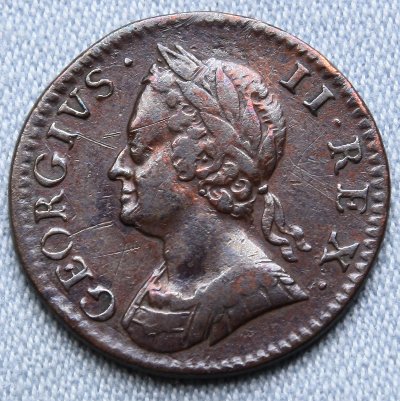
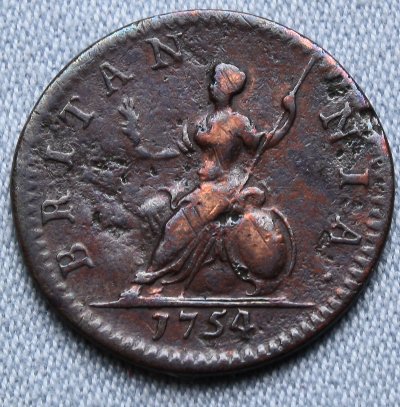
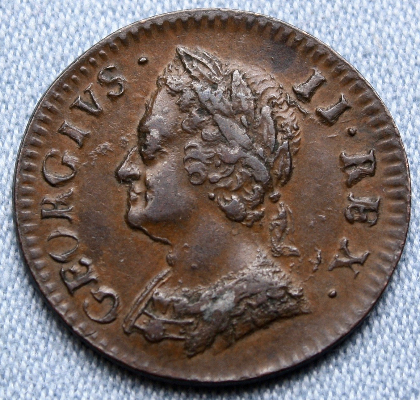
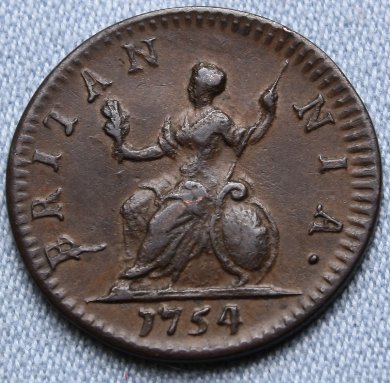
With the recent postings about counterfeit George II copper, I thought I'd post my two 1754 farthings. One is 4.9g and the other is 4.6g. Does one (or both!) look like a counterfeit (and I'm assuming contemporary not modern)?

#1
George-II-1754-Farthings:-Which-Is-Counterfeit?

#2
George-II-1754-Farthings:-Which-Is-Counterfeit?

All comments and discussion welcome!
Pillar of the Community
PaddyB's Avatar
United Kingdom
945 Posts
 Posted 05/24/2018  3:47 pm  Show Profile   Bookmark this reply Add PaddyB to your friends list Get a Link to this Reply
By no means certain, but if either is wrong I would suspect the second one. The face looks a bit odd, particularly under the chin, and the lettering looks irregular and blundered to me. There are quite a few irregularities in these coins anyway as the minting process was still improving, and the difference in weight is small compared to what would usually be expected for a counterfeit, but it still doesn't look quite right.
Pillar of the Community
United Kingdom
1351 Posts
 Posted 05/24/2018  5:16 pm  Show Profile   Bookmark this reply Add peter1234 to your friends list Get a Link to this Reply
IMO they are both currency.
Most counterfeits were George 111 with 1775 being the most common.Any date after this will be evasions up until 1799.
Pillar of the Community
Lucky Cuss's Avatar
United States
4883 Posts
 Posted 05/24/2018  7:36 pm  Show Profile   Bookmark this reply Add Lucky Cuss to your friends list Get a Link to this Reply
Well, you'd think that with all that cavitation on the reverse, #1 ought to be lighter than #2, which in turn looks to have been struck with a pitted obverse die.

With all the variances British coinage of this era (and even well into the 19th century) exhibits, I just don't see anything that'd allow me to pronounce either as bogus.

Colligo ergo sum
Bedrock of the Community
sel_69l's Avatar
Australia
21788 Posts
 Posted 05/24/2018  8:08 pm  Show Profile   Bookmark this reply Add sel_69l to your friends list Get a Link to this Reply
Genuine Farthings of this period had a weight range of 4.5 to 5.3 grams and a diameter range of 22 to 23 mm. The 1754 date was struck over several years, and so is most common date for this series.

Contemporary counterfeits circulated in very large numbers. The authorities of the time didn't seem to much bother about that. The Public of the time didn't seem to bother very much either. These two factors, taken together, explain why so many counterfeits circulated.

The condition of these well above average so not much weight loss due to circulation wear.

They both look OK to me, but in this case, that doesn't mean much, given the above mentioned problems with this issue.


Ref. Coincraft's 1998 Standard Catalogue of English & UK Coins, (page 605).

Valued Member
Canada
68 Posts
 Posted 05/24/2018  8:34 pm  Show Profile   Bookmark this reply Add stliboire to your friends list Get a Link to this Reply
Thanks for the comments. Just to clarify, coin #1 is the lighter of the two, and visibly thinner. They have the same diameter.
Pillar of the Community
United Kingdom
735 Posts
 Posted 05/25/2018  05:17 am  Show Profile   Bookmark this reply Add Hogarth to your friends list Get a Link to this Reply

I would suggest both are legitimate.
As Sel says, these were struck over several years, ten years in fact, and so dies were worked to destruction. I think the anomalies seen on the obverse of your second coin are evidence of rust on the die.
  Previous TopicReplies: 6 / Views: 1,844Next Topic  

To participate in the forum you must log in or register.


Disclaimer: While a tremendous amount of effort goes into ensuring the accuracy of the information contained in this site, Coin Community assumes no liability for errors. Copyright 2005 - 2026 Coin Community Family- all rights reserved worldwide. Use of any images or content on this website without prior written permission of Coin Community or the original lender is strictly prohibited.
Contact Us  |  Advertise Here  |  Privacy Policy / Terms of Use

Coin Community Forum © 2005 - 2026 Coin Community Forums
It took 0.25 seconds to rattle this change. Forums