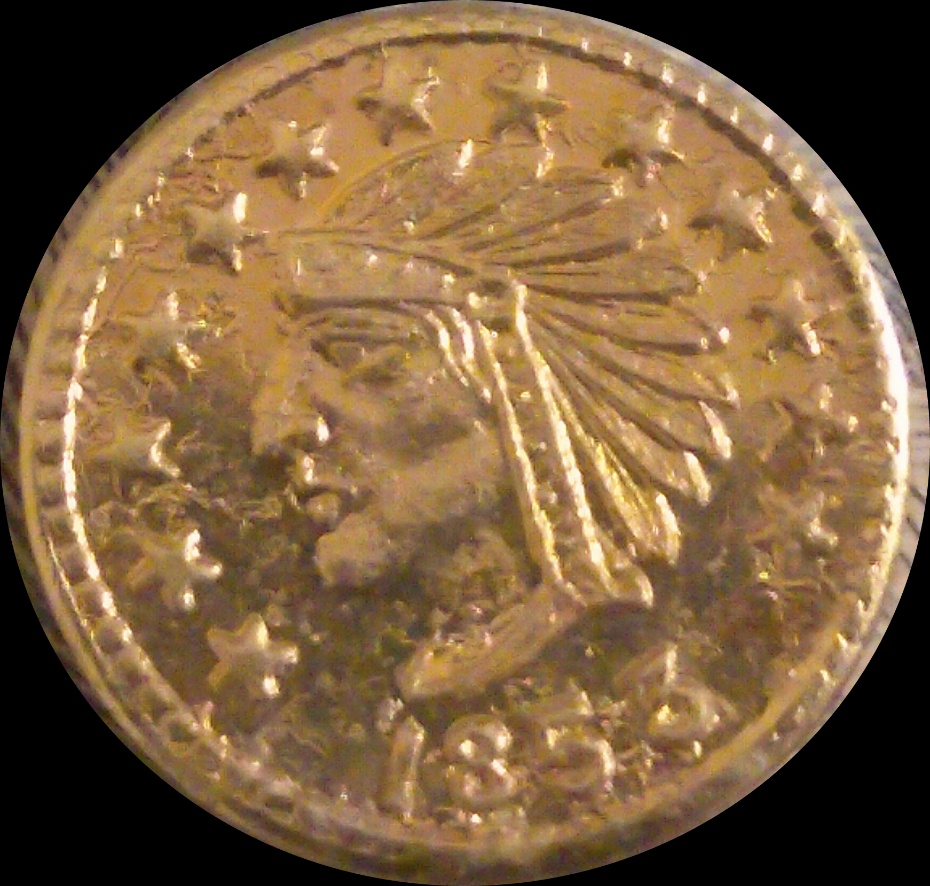
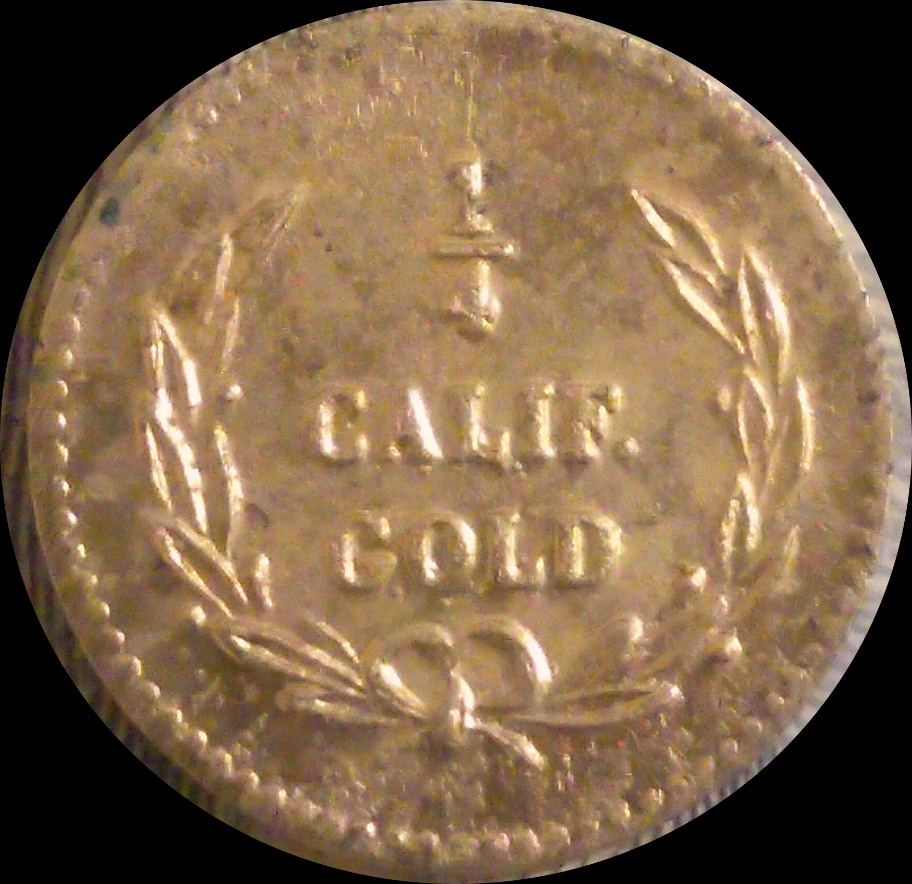
Souvenir gold token. It may not contain any gold at all, or may contain a small amount in low purity alloys from 3kt-11kt; the genuine California gold fractional dollars ranged from 14-22kt. The souvenirs were popular from the 1870s to 1920s and often drilled and worn as charms on necklaces, watch chains and bracelets. Modern tourist copies are still widely available and still being made even today. It is worth whatever gold it contains.
Based on the distinctive surface of your example, it's likely to be gold leaf over a base metal core.
How do you know it's a token and not a real fractional gold issue? The lack of a denomination. Almost all genuine fractional California gold issues carry the denomination in dollars, usually abbreviated "dol.", "doll.", "dollar", etc. with the fraction of a dollar, e.g. 1/4 dol., 1/2 doll., 1 dollar. The tokens do not mention the word dollar or its abbrevations.
In 1909, revisions of the 1877 and earlier anti-counterfeiting laws were passed which made it a crime to issue any tokens or coins bearing a denomination used by, or a resemblance to, any US Mint issued coin when such tokens and coins are intended to pass or have the potential to be passed as circulating monetary issues of the United States. (see USC 35 Stat. 1119, nowadays 18 USC Sec. 485.) "Fractional gold" issues made after these laws cannot mention the word "dollar" in any form, or they are considered unlawful counterfeits.
"M. E. Hart's Coins of the Golden West" was a series of these little gold tokens issued from 1909-1915 or thereabouts by Farran Zerbe; they do not contain the word "dollar" or its abbreviations, to avoid being considered counterfeits.
The original fractional California gold issues with dollar denominations were themselves not sanctioned by the US Government, despite not being unlawful at the time; indeed, along with private and territorial gold issues, their very existence convinced the Government to strengthen anti-counterfeiting laws to block their production and circulation. It's likely that apart from the very earliest issues (1840s and early 1850s) the California fractional gold dollars did not circulate much, perhaps no later than the 2nd half of the 1850s, as mid to low-grade examples dated past 1853 are very rarely seen, with plenty of Uncirculated and Prooflike Uncirculated examples still around for those issues bearing 1870 and later dates.
Member
ANA - EAC - TNA - SSDC - CCT #890
"Most of the things worth doing in the world had been declared impossible before they were done." -- Louis D. Brandeis
Edited by paralyse
06/05/2018 10:18 pm












 Posted 06/05/2018 9:46 pm


