Posting this article I mentioned in the long running recent purchases thread and the tokens.
Harris, Missouri population 61 people according to the 2010 census, is located in the rolling green hills of north central Missouri. The once thriving town has withered away like so many towns around in the area.
Harris was founded by Overton Harris in 1887 when he provided the land for the Chicago, Milwaukee, St. Paul Railway to build through this section on the way to Kansas City. The Harris family bred, showed and sold Hereford cattle. Profitable in their endeavors, led to the founding of the Harris Banking Company located on the east side of the town square. The bank was located in the center of the block with other businesses adjacent. One of these was the J. C. England Company.
The Harris Centennial book contained a brief summary of the business and even showed a sales receipt. Not surprising to me, it didn't mention the tokens. Tokens were handed out with change as a form of advertising and encouraging a person to come back and spend it in the store. Most handed out were likely redeemed as a single nickel or dime had real purchasing power.
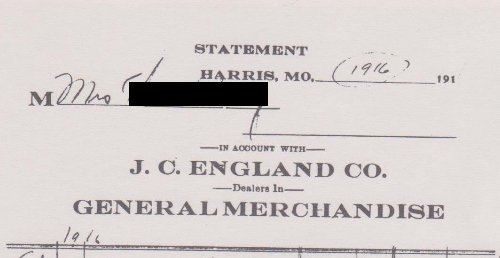
A website listing trade tokens for Missouri a lists a 5 cent and $1.00 tokens from this firm; the 10 cent wasn't listed as the owner was likely unaware of one existing. Other denominations could exist--but haven't surfaced/resurfaced. I know other mercantile stores in other towns used 1 cent, 5 cent, 10 cent, 25 cent, 50 cent and $1,00 tokens. The gap between the 10 cent denomination and $1,00 seems too wide surely one or both of the middle values were used. Maybe not. Until one or both surface there's no way to say definitively.
The firm, known as Deuel & England, began as a partnership between Fred Deuel and John C. England circa 1887 and lasted until 1894 when Deuel left Harris and moved to Oregon. Mr. England bought out his partner and brought his brother in help run the business at the time. The name of the firm was the J.C. England Company. One online source listed the firm as the J.C. England Mercantile Co. in a 1910 publication.
The store operated until 1920 or 1921 according to the author of the England family page in the book. The Englands moved to Colorado. The town's drug store moved into the space afterwards and later a grocery store occupied the space.
In 1970, a fire consumed the bank block. The grocery store built a new building on the west side of the square. The store closed over two decades ago.
The token which spurred this article sold on
ebay in the summer of 2017 for $88.50 including shipping. Unfortunately for me, I missed the auction entirely and only discovered the result when I was browsing the sold listings.
---------------
Now, I know that the 25 cent and 50 cent denominations exist as I have examples of them. These are the seller pictures.
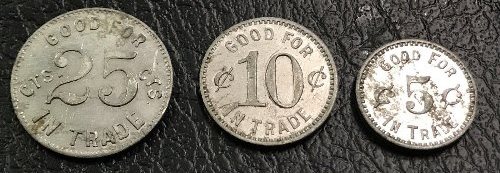
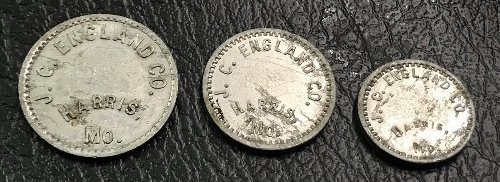
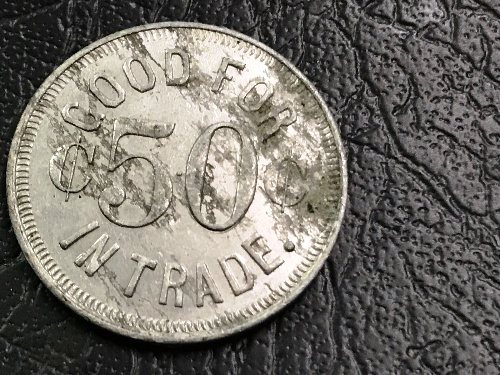
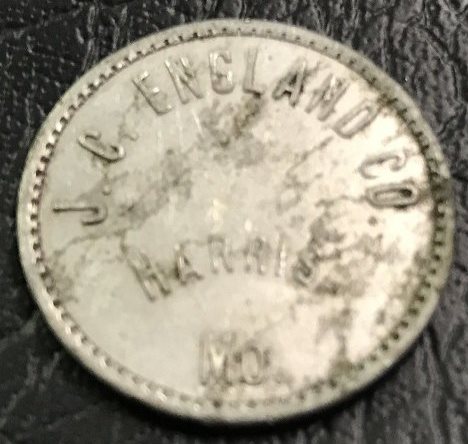
Still on the look out for the $1.00 from this firm. Will one surface? Only time will tell.
-MV







 Posted 08/01/2018 9:44 pm





