Hi,
I have a few thoughts. It is still a little tricky to be entirely sure form a picture but...
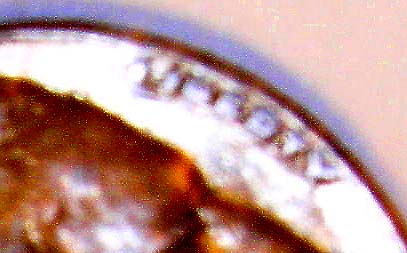
One is as mentioned earlier, counting machine damage that over time and some circulation wear became smooth. There is what could be the remnants of counting machine damage on the LIB in the form of circular marks through those letters.
Two is the possibility of having been struck by a filled die. That would be when details on the die are filled with grease and debris and that stops the details from being struck up on the coin. To me, it does not have the right look for that as the bottoms of what is left of the letters is too consistently straight across. I would think that to be very unusual as filled die errors go.
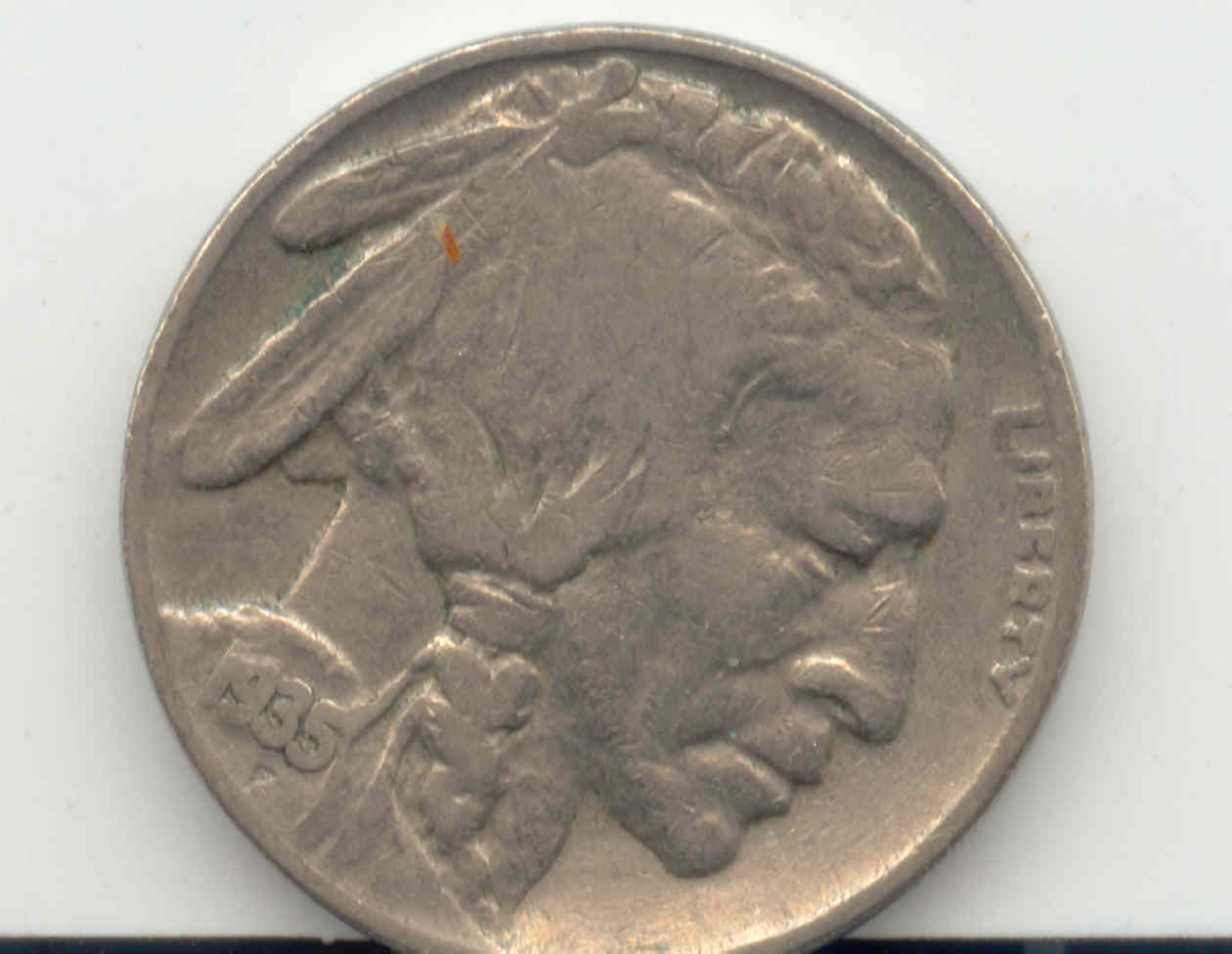
Three is, and I'm sure this will be debated and that's good:-)...In the picture of your coin that I posted, and please compare it with your picture.... I outlined
an area below the word LIBERTY and an area above the word LIBERTY. I think that it is possible that someone tried to remove a deposit of the green corrosion that you see elsewhere on the coin. I see some on the nose and I see it some above the word LIBERTY. I contend that it is reasonable to think that there may have been some on the surface of the coin in the field in front of the Indian's face.
I suspect an abrasive tool like a Dremel tool that got away from the person cleaning the coin. Here is why I think it is possible.
The rim above LIBERTY is slightly flatter and broader then the rim is elsewhere. That indicates the possibility of tooling or at the very least artificial wear.
The area that I outlined seems to have little or no evidence of the green that I suspect was cleaned and that portion of the coin seems to have if you look at it closely, many small gouges that seem to have been smoothed a little over time.
I marked three large scratches on the nose that I propose may have been caused by the tool used clean the coin.
Also, the BERTY letters are the ones mostly missing. If I were going to try to clean green crud from the surface with a tool, I would start at the easiest spot and that would be in the larger area between the Indian's nose and the lettering. As I realized that it wasnt working and that I just scraped away a bunch of the bottom of the letters, I would stop before I completely blew away the LI of LIBERTY.
Lastly, If I were to try to experiment with cleaning a coin abrasively, I would experiment on a coin that has very little numismatic value such as a 1935 nickel.
This is , of course a scenario that may or may not be the case, but I think it has some merit based upon what I see on the coin.
Let's talk about it.
Have Fun,
Bill











 Posted 07/12/2008 1:46 pm


 buffalo.jpg
 buffaloscan2.jpg


