| Author |
 Replies: 21 / Views: 3,975 Replies: 21 / Views: 3,975 |
|
Pillar of the Community
United States
4883 Posts |
I cherrypicked these today out of a tray of better grade Morgans that were deemed to be "commons" for the type. Both are really nice coins, pretty obviously mint state with a minimum of bagmarks. Typically strong San Francisco strikes, and although the photo doesn't show this off, both obverses exhibit enough reflectivity in their fields relative to the devices that you could make a case for their being semi-prooflike. 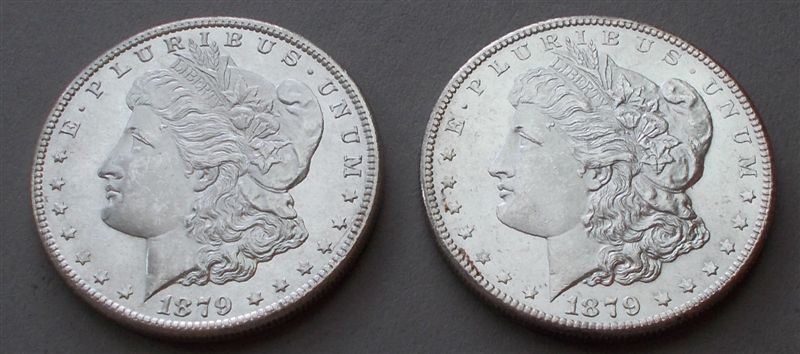 It's looking at the reverses where things get more interesting. The surfaces of the one on the right are comparable to its obverse, but the one on the left looks to be to be a deep mirror prooflike. Although I realize one side really doesn't count, it's still a joy to behold. 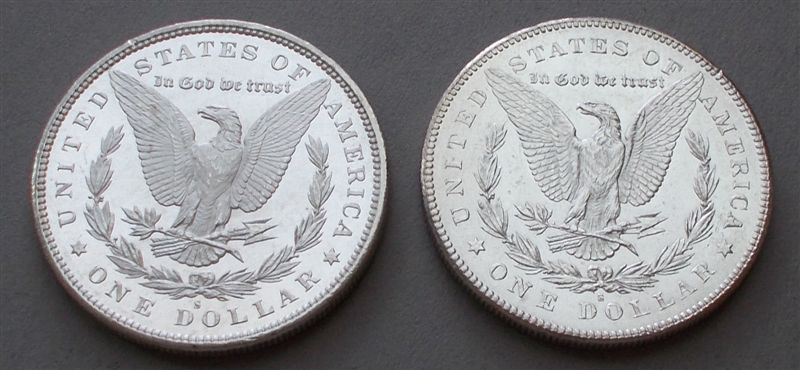 One more image to share that better shows the difference between the fields of these two reverses. The blue lines are a reflection of the sky through nearly closed window blinds. Well-defined on the left while much more muted and diffuse on the right. 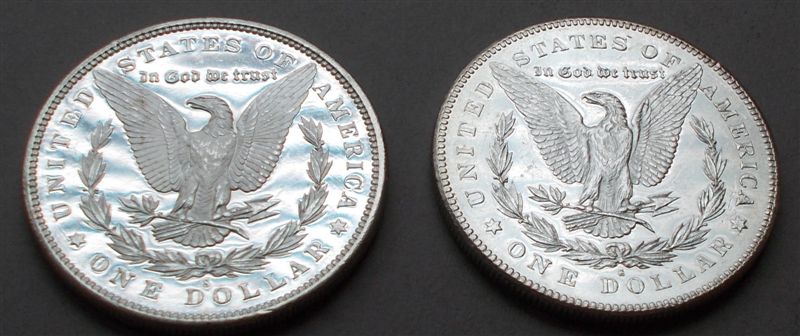 So, then, for what reason does that specimen on the right qualify in any way as a bit special? Look closely and I'll bet you're going to be able to identify why it really shouldn't have been relegated to that "commons" tray. Colligo ergo sum
Edited by Lucky Cuss
09/26/2018 11:21 am
|
|
|
|
Bedrock of the Community
United States
11951 Posts |
Coin on the right is a reverse of 78
|
|
Bedrock of the Community
United States
12057 Posts |
Yup. Good catch. GR.
That's a BEAUTIFUL Reverse of '78 and a very pricey Morgan in that grade. The Prooflike '79-S on the left is also a stunner.
For sheer beauty, you can't often beat the San Francisco Morgans of 1878-1881/1882.
If that dealer has any more of these "commons" around, might as well do him a favor and take them off his hands ;)
Member ANA - EAC - TNA - SSDC - CCT #890 "Most of the things worth doing in the world had been declared impossible before they were done." -- Louis D. Brandeis |
|
Pillar of the Community
United States
2125 Posts |
Your dealer is not very knowledgeable! Advantage: you! Great coins by the way.
|
|
Rest in Peace
United States
10625 Posts |
Nice pick LC! One heck of a cherry pick and yeah, living up to your handle...  |
|
Pillar of the Community
 United States
4883 Posts |
Quote:
If that dealer has any more of these "commons" around, might as well do him a favor and take them off his hands I actually purchased a third coin out of that tray, a 1900-O that probably has an MS65 floor, just really a beauty. Unfortunately not an O/CC which really would've capped this episode off. Colligo ergo sum
|
|
Bedrock of the Community
United States
12478 Posts |
Excellent pick!  In Memory of Crazyb0 12-26-1951 to 7-27-2020
In Memory of Tootallious 3-31-1964 to 4-15-2020
In Memory of T-BOP 10-12-1949 to 1-19-2024
|
|
Pillar of the Community
 United States
5029 Posts |
Wow that is a great pick. Beautiful coins |
|
Pillar of the Community
United States
8715 Posts |
Wow - fantastic finds!  |
|
Bedrock of the Community
Canada
24885 Posts |
Nice coins! Edited by Dorado
09/26/2018 12:35 pm
|
|
Moderator
United States
198363 Posts |
Nice pair! |
|
Pillar of the Community
United States
4883 Posts |
Quote:
That's a BEAUTIFUL Reverse of '78 and a very pricey Morgan in that grade. The Prooflike '79-S on the left is also a stunner. Let me say first I'm not soliciting opinions as to condition. My quickie photos here aren't sufficient for that purpose in any event. That said, I'm pretty confident in my ability to evaluate Morgans as to grade. I critically examined each of these today both in sunlight and my "grading" desk lamp. There remains no doubt that both are uncirculated with original surfaces and no significant nicks or dings. The Reverse of '78 one has just enough light chatter and superficial scuffing on the obverse for me to assign it a floor of MS63. The one with the DMPL reverse is slightly better in this regard, and I'd call it at a solid MS64. I doubt either would receive a PL annotation, but as I said before both obverses (plus the reverse of the Reverse of '78) are at least semi-prooflike, and thus present extremely well. Frankly, I've seen notably worse than these recently slabbed by both NGC and PCGS as MS64, which I attribute to a current bias in favor of "market" over "technical" grading. Taking that reality into consideration, I really wouldn't be surprised if either of these had a "  " or a "  " tacked onto the grades I'm seeing them as a surefire bet for, or if they even might get bumped up a whole point, were I to submit them for certification. Colligo ergo sum
|
|
Pillar of the Community
United States
4883 Posts |
I have a couple last things to add here, both questions, actually.
1879-S production is recorded as totaling 9,110,000. With regards to those struck with the Reverse of 1878, there seems to be little consensus on what proportion of that total they constituted. I've seen estimates ranging all the way from fifty to several hundred thousand, and even a million. The certified population suggests something like 4% (roughly 350 to 400 thousand) but that's not the most precise way to come up with a true figure, since the Reverse of 1878 could arguably be considerably more likely to be submitted, or it may reflect a differential in one type over the other surviving the Treasury wartime melts. Does anybody have a sense of what the reality was, or is this going to be one of those perpetually unresolved Morgan mysteries?
Also, lore has it that there were three bags of them found in the Redfield hoard, and that most extant examples today came from that source. Legend or fact?
Colligo ergo sum
|
|
Rest in Peace
United States
10625 Posts |
I think I read that the 3 bags from the Redfield Hoard account for most of the known uncirculated examples. Who knows if there's another bag or more hidden somewhere.  |
|
Pillar of the Community
United States
4883 Posts |
With respect to the quantity struck with the Reverse of 1878 -
It occurred to me that one way a reasonable estimate might be made would be to see how many of those reverse dies were used, assuming that under close scrutiny they're distinguishable from one another. If you could then determine a lifespan for each, then its a matter of simple multiplication to come up with a total. My source materials in this regard are not up to date, but as I understand it there's a version with a small "III S" mint mark, another with the same mint mark but with a small defect in the "r" in "trust" (which might be only a deterioration of that first die), yet another with the mint mark tilted slightly left, and finally another with a doubled mint mark (which could be a restamp of a die already in use). That'd be at least two and maybe four different dies right there, the exact number perhaps being possible to sort out. Maybe additional distinct dies can be identified. The question would then be reduced to how many coins were produced with a particular die before it would've been switched out for a new one? This last figure might be somewhat variable, but an average would still allow for a sum to be easily calculated.
Colligo ergo sum
|
|
Pillar of the Community
United States
4883 Posts |
Since nobody has yet opined on how many of the 1870-S Reverse of 1878 might have been struck, I've continued to cogitate on the question.
I left off last with the unknown factor in the equation, that being how many coins might have been struck with a single set of dies. There're actually some clues to the answer if you look at the lower mintage issues in the history of Morgan production.
The 100,000 of the 1893-S were struck with a single set of dies. Ditto for the 110,000 made at Philadelphia for 1894. The 333,000 of the 1899 appear to have used up three distinct die pairs. So 110,000 wouldn't seem unreasonable for the life span of a die.
What makes that number less than definitive is that practices could obviously vary from year to year and/or mint to mint. There are two identifiable die pairs for the 1889-CC of which 350,000 were made, and three die pairs for the 1895-S and 1895-O of which 400,000 and 450,000 were churned out, respectively. Those three issues suggest that die life might be extended out to something on the order of 133,000 to 175,000 coins. On the other hand, at least five die pairs were used in putting out the 389,000 of the 1893, and three die pairs apparently were consumed in making the 228,000 1885-CC's. That works out to only 75 to 80,000 coins per die pair.
The only conclusion I can draw from all this is that the low end estimates (merely several tens of thousands) for how many 1879-S Reverse of 1878's were struck looks to be wishful thinking and not defensible. A number more like a quarter up to a half million would seem more probable, which actually isn't out of line with the estimate I made above based upon the relative populations of certified specimens.
Colligo ergo sum
Edited by Lucky Cuss
10/01/2018 7:25 pm
|
| |
Replies: 21 / Views: 3,975 |







 Posted 09/25/2018 8:56 pm


