| Author |
 Replies: 8 / Views: 5,386 Replies: 8 / Views: 5,386 |
|
|
Pillar of the Community
United States
6130 Posts |
I had been wanting a replacement for the ratty one I sold last year, and got a nice lot from CNG to cherrypick from. Umayyad Caliphate Abd al-Malik ibn Marwan, r. 685-705 AE "Standing Caliph" fals, minted 690s Damascus mint Obv: Caliph standing facing, hand resting on long saber in sheath, Kufic surrounding (would love a translation!) Rev: "Modified cross" on steps, mint name to right, Kufic surrounding (again, can't find a translation)  Al-Malik was the fifth Umayyad caliph, presiding over a period of growing pains and cultural identity crisis for the world's newest and largest superpower. Seven decades after the Hijra and four decades after the fall of the Sassanians, the Muslim economy was still being fueled by Byzantine copper and gold, Sassanian silver, and whatever imitations had been made as the supply ran thin. Although Arabic had already been in use on the imitations, the new empire lacked a cohesive and distinctly Muslim currency. Al-Malik initiated a massive coinage reform that spanned most of the 690s, coordinated between as many as 18 mints, and sought to erase Christian and Zoroastrian symbology from the coinage. Loosely based on Byzantine solidi, these coins replaced the robed Byzantine emperor with the Arab caliph, and erased the Christian cross on the reverse, replacing it with a circle on a pole - the meaning is still hotly contested. Although met with success, the other leaders of the Caliphate still felt the reformed coinage to be blasphemous, and so in 77 AH (696 AD) this type was dropped entirely and replaced by the more familiar post-reform coinage with a purely epigraphic design containing the Islamic professions of faith (in addition to mint and year information:  |
|
|
|
Moderator
 United States
23731 Posts |
Beautiful example of the Standing Caliph, don't usually see these in this nice a condition.
|
|
Pillar of the Community
United States
1554 Posts |
Very interesting coin! The legend, repeated on both sides, is the kalima ("there is no god but Allah, Muhammad is the apostle of Allah"), badly blundered. On the obverse, the final Allah is missing. On the reverse, the mint name Dimashq is in right field downward. Also of note, the extra circle at the top of the transformed cross. See SICA-1, 711 for an example with the same oddities, likely by the same hand, possibly the same obverse die.
Edited by Kushanshah
10/17/2018 01:11 am
|
|
Pillar of the Community
 United States
6130 Posts |
Thanks guys. @KS, I was able to find this example of SICA 711, which does look like it could be a die match: http://holylandauction.bidinside.co...-malik-ibn-/I didn't give much thought to the extra circle at the top of the pole; I had assumed it to be part of the legend. I did a little research, and have heard that some scholars argue the pole and circle are supposed to represent a spear and shield. Personally I think it's a tootsie pop. |
|
Pillar of the Community
United States
1554 Posts |
One of the best ways to interpret the reverse may be not what it is, but rather what it is not. The 'standing caliph' coppers were preceded by a gold dinar with a virtually identical standing caliph design. The reverse of the dinar (below right) was a modification of the design used on the contemporary gold solidi of Justinian II (below left), which had seen wide circulation throughout the caliphate. On a very basic level, the reverse of the dinar has been "de-Christianized" by removing the cross-bar from the cross. On a subtler level, Justinian's cross seems to imply the Trinity with its three equal T-shaped arms joined at the center, not unlike St. Patrick's analogy of the shamrock. The Umayyad coin on the other hand ends in a single orb, perhaps to emphasize the oneness of God from the perspective of Islam. Indeed, the doctrine of the Trinity was the primary theological "sticking point" between early Islam and early Christianity. This is borne out by the kalima, especially in its longer form: "there is no god but God alone, there are no others with Him". Now back to the standing caliph coppers, which as already noted are very similar to the dinars in size and design. It has been suggested that the large circle was added to the modified cross as a denominational marker, preventing the coppers from being plated with gold and passed as dinars.  Edited by Kushanshah
10/17/2018 2:50 pm
|
|
Valued Member
Canada
167 Posts |
Umayyad is one of area I am specializing in. Here are some highlights of my Umayyad collection. Al-Walid I: 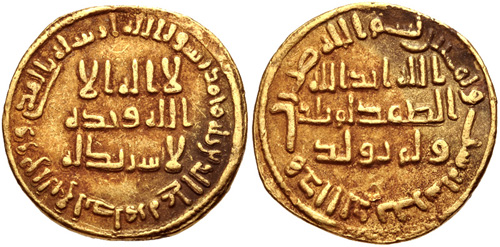 Hisham I (Balkh mint with Balkh on margin) 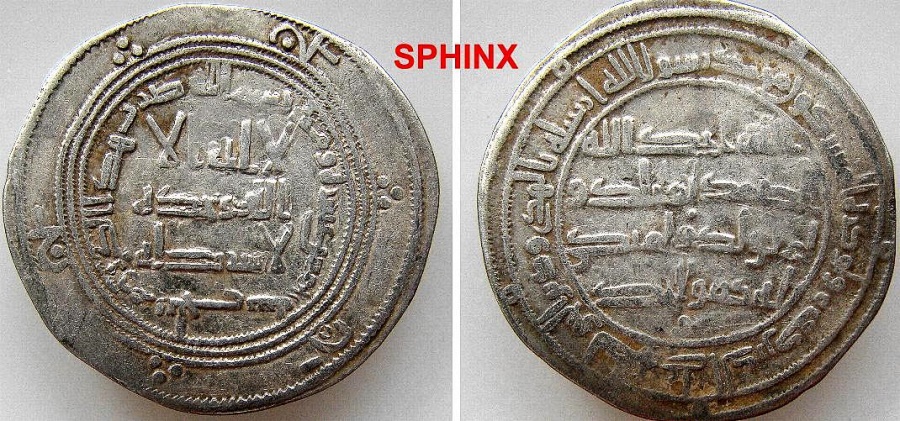 Unaydallah ibn Ziyad (Govornor under Yazid I ) 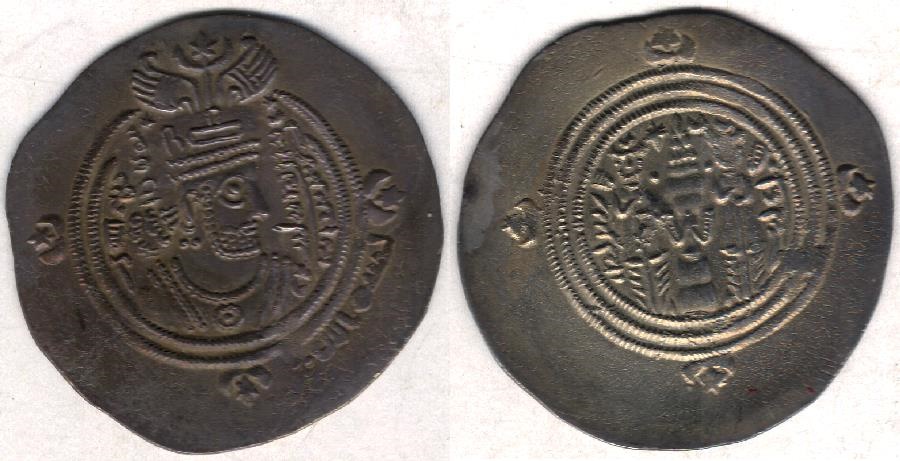 Muawiyah I (the first coin with name of Umayyad caliph in Pahlavi) 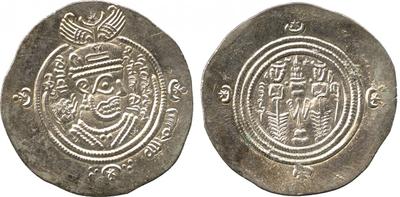 |
|
Pillar of the Community
United States
6130 Posts |
Beautiful coins, AlRashid! Figured I would share this standing caliph as well; I had intended to keep this one for my collection since it shows the figure's face and has a really nice sand patina, but I opted for the more complete strike. Haven't worked out the mint name, but to the left of the "not cross" is "waf" meaning "full weight". 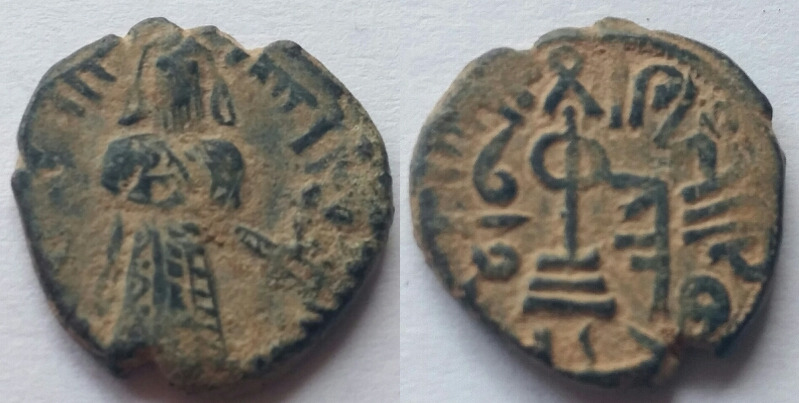 |
|
Pillar of the Community
United States
1554 Posts |
The mint name on this second one is bi-Halab (Aleppo), the particle " bi-" meaning "of" or "in". 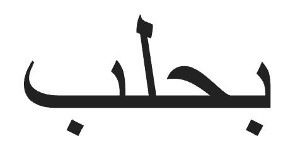 Edited by Kushanshah
10/18/2018 5:26 pm
|
|
Pillar of the Community
United States
1554 Posts |
One more thought. Earlier today I happened by pure coincidence upon a paper which suggests that the ellipse added to the pole on the reverse of the standing caliph coppers turns the pole into the Greek letter Φ for φολλις / follis / fals. Quite insightful, I think!
Edited by Kushanshah
10/19/2018 01:19 am
|
| |
Replies: 8 / Views: 5,386 |
|










 Posted 10/16/2018 3:51 pm


