Coin Community Family of Web Sites Join Thousands of Coin, Bullion, & Money Collectors
300,000 items to help build your collection! Join Thousands of Coin, Bullion, & Money Collectors Royal Canadian Mint products, Canadian, Polish, American, and world coins and banknotes. Specializing in Modern Numismatics Vancouvers #1 Coin and Paper Money Dealer Coin, Banknote and Medal Collectors's Online Mall Royal Estate Auctions - $1 Coin Auctions


Username:
Password:
Save Password
Forgot your Password?


This page may contain links that result in small commissions to keep this free site up and running.

Welcome Guest! Registering and/or logging in will remove the anchor (bottom) ads. It's Free!

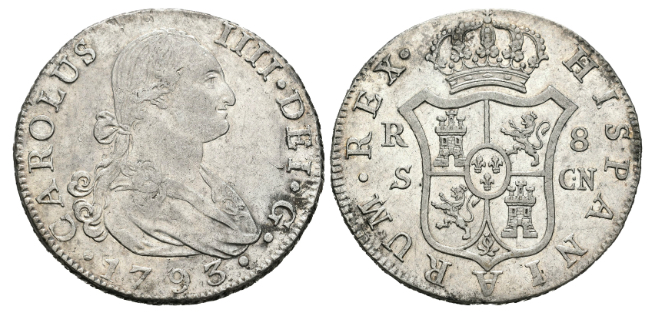
An 8 Reales. Fake Or Not?

To participate in the forum you must log in or register.
Author Previous TopicReplies: 5 / Views: 2,800Next Topic  
New Member

United States
5 Posts
 Posted 11/22/2018  11:02 pm Show Profile   Bookmark this topic Add goodgoddog to your friends list Get a Link to this Message Number of Subscribers
Hi, this is my first post here. Happy Thanksgivings.

I am new as a coins collector. I am particularly interested in the 8 reales of Spain.

It was nice to see you guys who have the same interests and understand the 8 reales much more than me.

The following is one coin I want badly. I haven't bought it but I want to know what your thoughts on it. Is it genuine?

Thank you very much in advanced.

An-8-Reales.-Fake-Or-Not?
Edited by goodgoddog
11/22/2018 11:03 pm
Pillar of the Community
oriole's Avatar
Canada
5246 Posts
 Posted 11/23/2018  07:22 am  Show Profile   Bookmark this reply Add oriole to your friends list Get a Link to this Reply
Do you know the weight? There is only so much you can tell from a picture.

However, just from the look I see nothing obviously wrong. There are some real experts in this series in the CCF though.

I am assuming that you are contemplating a purchase. Is the seller promising a return if it is not genuine?
Pillar of the Community
Learn More...
tdziemia's Avatar
United States
7955 Posts
 Posted 11/23/2018  07:55 am  Show Profile   Bookmark this reply Add tdziemia to your friends list Get a Link to this Reply
26.83 g.

According to the terms of sale, the authenticity of the coin is guaranteed.

Also, you should be aware of this in the terms of sale:
"an exportation license will be required for those coins aged more than 100 years. For coins sent outside EU, besides the exportation license given by the Spanish Ministry of Culture, an export tax will be applied."

At a minimum, this can add some time for you to receive the coin in the event you win it.

And ...
Edited by tdziemia
11/23/2018 08:27 am
New Member
United States
5 Posts
 Posted 11/23/2018  10:13 am  Show Profile   Bookmark this reply Add goodgoddog to your friends list Get a Link to this Reply
Thank you for the both replies. Yes it is 26.83 g. Thank you for referring the terms of sale. I haven't read it carefully. I like this particular year because I have a 8 reales mo coin and it would be interesting to compare it with this one which is made in Europe ;-)

Thank you again and have a nice thanksgivings.
Pillar of the Community
swamperbob's Avatar
United States
5362 Posts
 Posted 11/23/2018  7:36 pm  Show Profile   Bookmark this reply Add swamperbob to your friends list Get a Link to this Reply
Nice to meet a new collector of 8R coins.

The peninsular issues you show an interest in are much harder to locate than the colonial types. This was because not only were fewer made originally but also because the locally made coins (European mints) were not accepted worldwide as Trade dollars. In addition few of the issues dated before 1809 survived due to Spanish revaluation of the reale.

The early works of the US mint are interesting to read about with regard to the reliability of the various mints. The Mexico City mint made millions of 8Rs each year and they were consistent in average assay. In fact on world markets the coins of Charles III and Charles IV often carried a premium value (highest being in mainland China). The peninsular issues carried a lower premium than the Mo issues in most cases but these coins were still far superior to the revalued issues of Ferdinand VII. US mint assay results for Mexico yielded 898 fine and for Spain 900 fine. Standard for the issue was 903 but that was rarely met. Remember these are average figures - so individual assays and weight varied more for peninsular coinage than did Mexico city issues.

The China premium which reached 20% by 1820 caused some countries like England to embark on large scale forgery of the Mexican 8R in 1820. In 1835 tests done at The Royal Mint showed that the UK issues were 850 fine silver and no less. They competed with lower assay forgeries made in China itself which rarely met 800 fine. It was at that time (1835) that the British encouraged the Chinese schroffs to adopt specific gravity testing. The scales available at that time could not detect the English shortage of 5% but could detect a 10% shortfall. This test eliminated the 800 fine and lower coins. This worked to the benefit of the UK they did not have to worry about accepting any other fakes in trade.

The reason England started making the silver counterfeits was that the UK had a balance of payments defecit to China of about 20 million pounds a year. The 20% premium helped offset that debt until such time as the opium wars allowed England to sell opium to China with no restrictions (in 1850).

The US entered into the same production of Mexican 8Rs some time after 1873 (after the mint act of 1873 and the impact of the Comstock silver lode in Nevada. This production continued until sometime shortly after 1930. Peak production occurred in the period 1893 to 1895.

The Manual of Silver and gold coins by Eckfeld and DuBois from 1842 is available as a PDF file from Google books. On pages 117 to 122, this book gives some interesting facts about Spanish 8Rs (the Mexican 8Rs are discussed on pages 77 to 85). By 1842 Spanish silver coinage was of minimal impact worldwide. Peninsular coins were almost unknown in the US in 1842. The reason most Peninsular 8Rs of the type you illustrate were removed from circulation and melted was that during the reign of Ferdinand VII the standard used for circulation changed by 20 percent from 8 reales to a dollar to 10 reales making the older 8Rs of Charles III more valuable as silver than as current coins.

Good hunting in your search. Remember at the early stages of your search you need to do some serious research - otherwise you are likely to discover Numismatic Forgeries more often than not.

Moderator
Learn More...
jbuck's Avatar
United States
189110 Posts
  Previous TopicReplies: 5 / Views: 2,800Next Topic  

To participate in the forum you must log in or register.


Disclaimer: While a tremendous amount of effort goes into ensuring the accuracy of the information contained in this site, Coin Community assumes no liability for errors. Copyright 2005 - 2026 Coin Community Family- all rights reserved worldwide. Use of any images or content on this website without prior written permission of Coin Community or the original lender is strictly prohibited.
Contact Us  |  Advertise Here  |  Privacy Policy / Terms of Use

Coin Community Forum © 2005 - 2026 Coin Community Forums
It took 0.34 seconds to rattle this change. Forums