| Author |
 Replies: 18 / Views: 4,506 Replies: 18 / Views: 4,506 |
|
New Member
United States
18 Posts |
Hello, This is my first post to this forum (I promise all of my posts will not be seeking help). I have been trying to conclusively identify this Spanish maravedis for several years. It was found at a Spanish Colonial American settlement site in St. Augustine, FL approximately 33 years ago. I have never found an exact match to this coin. I think it might be either Felipe II or Felipe III based on style. Can anyone confirm? And I would appreciate any additional information on the coin. Diameter: 15.53mm (0.79mm thick) Weight: 0.69 grams Material: copper Thanks for any help. 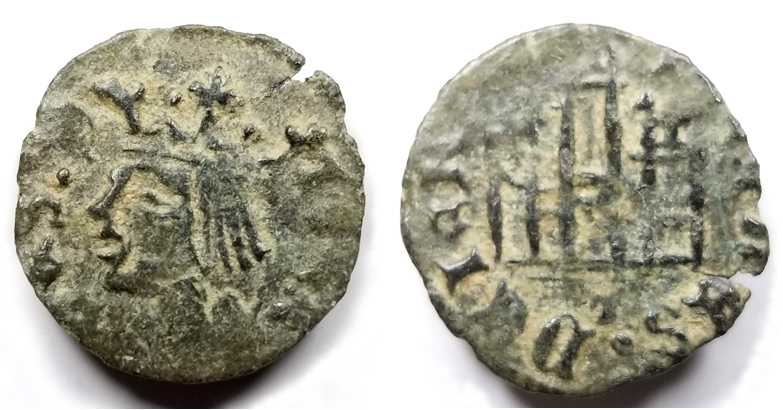 |
|
|
|
Pillar of the Community
778 Posts |
Welcome to the Forum!
You have an interesting coin, but I've not seen it's like.
Have you any thoughts on the Mint?
Happy collecting,
Bill
Edited by BillSnyder
12/11/2018 8:00 pm
|
|
Pillar of the Community
 United States
8051 Posts |
Edited by tdziemia
12/11/2018 8:54 pm
|
|
Moderator
 United States
34546 Posts |
@maravedis, I'm tending to agree with @tdz that your piece is from the 14th-15th Centuries. I'm looking in my Clemente and Cayon, but not getting a hit right away. That open mouth on the portrait is a bit perplexing.
As for the mint, it might be underneath the castle (T for Toledo as a first guess). I'll keep looking over the next couple days and post if I find anything more definitive.
"If you climb a good tree, you get a push."
-----Ghanaian proverb
"The danger we all now face is distinguishing between what is authentic and what is performed."
-----King Adz
|
|
New Member
 United States
18 Posts |
Thank you for the replies.
I am not certain on the mint, but I do see the "T" Spence mentions, so I think this is for Toledo? I am not entirely sure what the legend says at this point.
I thought this a maradevi because of where it was found and the temporal timeline of that site (circa 1565), but I think this could well be a cornado after looking at (@tdziemia) the provided link.
I wonder, could this be a late-Medieval counterfeit?
I'm also wondering if this might have made its way to the New World in the purse of one of Menendez's men.
I have been directed to a couple of books (in Spanish) on the maradevis, one of which is OOP (but I am told an updated edition is forthcoming in 2019).
I appreciate the help.
|
|
Pillar of the Community
United States
8051 Posts |
I realize an earlier coin is more problematic (or perhaps more exciting) from the historical context viewpoint. I don't know how long coins tended to stay in circulation in late medieval times. Was this a documented find? Because if the coin turns out to be 15th c. or earlier, I am wondering if it has any kind of archaeological/historical significance (if nothing else, "earliest Spanish coin found in U.S.?") Also those earlier cornados were made in billon which can be all kinds of colors, but if yours really looks like bronze or copper, then maybe that guess is not correct either. I don't have access to a reference other than Numista for early Spain. As you say the other option is that it is not authentic. That could mean late medieval, but also more modern if it was buried for some time (sure looks authentic to me  |
|
New Member
United States
18 Posts |
Quote:
I realize an earlier coin is more problematic (or perhaps more exciting) from the historical context viewpoint. I don't know how long coins tended to stay in circulation in late medieval times. Was this a documented find? Good morning, tdziemia... In the strictest sense, it is not an officially documented find. The person who recovered it was an avid metal detector hobbyist, and he spent around 40 years traveling the US and world to dig for artifacts. In the late 1970s to mid 1980s, he lived in St. Augustine, and he dug almost exclusively at Florida sites during those years. He was meticulous about where things were found, but he cared not as much for what the items were, and coins and buttons seemed to be of little interest to him (unless they were gold or silver). I met him on a volunteer project in the late 1990s, and he offered to teach me the metal detecting side of site work (I spent all of my time in libraries and behind a magnifier on the conservation side). Shortly after, he actually started his own archaeological site survey business, which I believe he ran until he passed away. A few years back, I was able to purchase his entire collection of early colonial Americas buttons. This included a lot of very early Spanish material from some of their first occupation sites such as Seloy, Ucita, St. Augustine, etc., buttons from wrecks that had washed ashore after large storms, etc. - if you can picture small filthy bags of buttons with sites scribbled on them in black marker. So, I've spent the last few years meticulously documenting, measuring, and conserving these. I had a short article on buttons from the Menendez expedition to St. Augustine published not long ago. I am still in awe when I handle these buttons from the expeditions of DeSoto and Menendez, and it pleases me that people are beginning to understand that colonial history in the United States began in the 1520s and not the 1600s (Jamestown), as I was taught in school. Along with the buttons, he sent a smaller bag of coins - maradevis - all from the St. Augustine area, a few of which were beach recoveries. I have tried over the past few years to learn more about them, as they are fascinating, but having no real reference material, I can do little better than to read the dates and sometimes the royal crest. Still, I am very fond of them, and I have begun to actively collect more examples when I see nice ones offered. I've always been most curious about this one though because it is so very different from the others. I have managed just this morning to acquire a reference book from Spain. I'm hoping this and some of the others might be shown, or at least some of the markings so that I may get a little more info. I would not be displeased to learn that this was a 14th/15th century forgery, to be honest.  Edited by maravedis
12/12/2018 10:30 am
|
|
Pillar of the Community
United States
900 Posts |
@maravedis
That is a fascinating story. As a fellow detectorist, I would have love to find historically significant items such as those. It sounds like you have acquired a great collection. You should show some of it off here. I'm sure people would love to see some of these items.
|
|
Pillar of the Community
United States
8051 Posts |
@maravedis, thank you for the background. What a great personal history! The reason I posed the question is because I ran across this statement about a 1540s Spanish coin found in an organized dig at Jamestown: These 16th century coins from the early European colonization are extremely rare in North American archaeological contexts. https://historicjamestowne.org/sele...ish-coins-2/Jamestown's site leaves no doubt that the coin was deposited by a resident, rather than washed up from a shipwreck. It's also interesting that this coin would have been at least 65 years old when dropped by someone at Jamestown. Which leads me to believe it's certainly possible for a 15th century Spanish coin to have been in the pocket of a mid-1500s St. Augustine resident. If you want concrete (catalog) attributions of any other coins, it's likely they can be provided here by forum members who have the reference materials and expertise (I have neither ... but can at least manage a quick search in an online database like Numista). Edited by tdziemia
12/12/2018 4:59 pm
|
|
Pillar of the Community
United States
3360 Posts |
"Two minutes ago I would have sold my chances for a tired dime." Fred Astaire
Edited by thq
12/12/2018 9:31 pm
|
|
Pillar of the Community
United States
8051 Posts |
@thq, that is super detective work! I would not have recognized it from the Numista listing: https://en.numista.com/catalogue/pieces145369.htmlReverse legends are very supportive, as we can clearly see "...neS Dei gr .. " from 3:00 to 10:00 around the castle. @maravedis, if the experts here agree this is the best attribution, you've got a pretty sweet find there: a pre-Columbian coin in post-Columbian North America. (Time for another publication  ) |
|
New Member
United States
18 Posts |
Quote:
The reason I posed the question is because I ran across this statement about a 1540s Spanish coin found in an organized dig at Jamestown:
These 16th century coins from the early European colonization are extremely rare in North American archaeological contexts. I did not realize that these were rare. I believe I have five or six that were found in St. Augustine. I will take some photos to share. Quote:
You should show some of it off here. I'm sure people would love to see some of these items. I will be happy to do this. I am not sure if I can post those here (in this thread), or if there is a more proper sub forum (I am still learning my way around the site). Quote:
Here's a Juan II piece (maravedi? cornado?) ca 1400-1450 with a bust and castle similar in appearance and diameter to your coin. I think you have found it. Thank you so very much! May we attribute the small differences to different molds/engravers? Thanks to everyone for the help on this! |
|
New Member
United States
18 Posts |
I've spent several minutes comparing @thq's identification to the coin in hand, and I think (s)he has it exactly (thank you again).
Does anyone know what the obverse and reverse legends read originally?
I've done a Google image search looking for the same coin, but the few I found were in a little worse condition and were not readable.
I have no reference material for this coin, and so I cannot look it up.
Thank you...
|
|
Pillar of the Community
United States
3360 Posts |
"Two minutes ago I would have sold my chances for a tired dime." Fred Astaire
|
|
New Member
United States
18 Posts |
Quote:
While Juan I is not Juan II, this shows you what Castile cornado inscriptions read on better-preserved coins. Thank you. I will check these against this coin. I have just purchased the other maravedis (Austrias) book by this author; I plan to purchase this one (Borbones) also, eventually. |
|
Pillar of the Community
United States
8051 Posts |
@maravedis, please be careful about interpreting that quote from the Jamestown foundation. It specifically mentions 16th century coins, and "archaeological context." Your coin appears to be even earlier (15th c), but lacks the archaelogical context.
On legends, if you look at the Numista link I posted for a Juan II cornado (thq's attribution), it gives the legends.
On your coin, I see very good matching of the reverse legends with what you see in the Numista listing. For the obverse, fewer letters are visible on your coin, which makes it tough.
|
| |
Replies: 18 / Views: 4,506 |









 Posted 12/11/2018 8:50 pm


