










 Posted 12/21/2018 3:47 pm


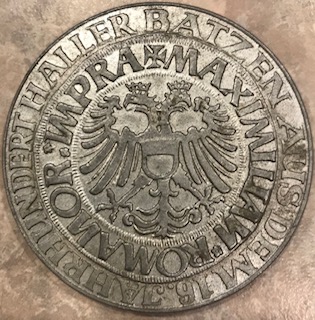
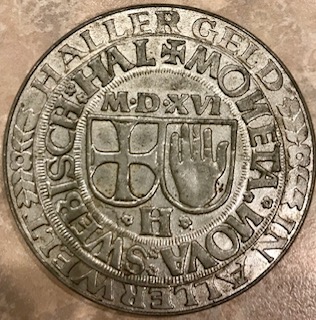
@carolina85, first welcome to CCF. Second, that backward N isn't as much of a concern to me, as in the middle ages the shape and orientation of letters was sometimes a bit fluid (perhaps because the die cutters were often illiterate).
It would be nice if you could also post the diameter and weight of this piece. It should be big I think--more than 50 mm in diameter. As you may have discovered in your own interwebs searching, the central 2/3 of this piece is similar to a 1516 AD dated Batzen of the German City State of Hall. Here is a link to that coin:
https://www.NGCcoin.com/price-guide...-duid-397464
The outer third of your piece contains a couple inscriptions which roughly translate into English as "Haller Batzen from the 16th century" and Haller money in the world". Evidently these medals were made in the 1970s (at least some from silver), but I'm not 100% sure that yours is from that original mintage due to the fact that these appear to have separable parts: the "coin" and the outer ring. Here is a link to a discussion on a German bulletin board:
http://www.numismatikforum.de/viewt...f=21&t=50311
I can find a couple examples of the original pieces showing up as exonumia in German auctions with the asking price being around 30 euros. I'd say that the value of your piece depends almost solely on intrinsic value of the metal alloy.
It would be nice if you could also post the diameter and weight of this piece. It should be big I think--more than 50 mm in diameter. As you may have discovered in your own interwebs searching, the central 2/3 of this piece is similar to a 1516 AD dated Batzen of the German City State of Hall. Here is a link to that coin:
https://www.NGCcoin.com/price-guide...-duid-397464
The outer third of your piece contains a couple inscriptions which roughly translate into English as "Haller Batzen from the 16th century" and Haller money in the world". Evidently these medals were made in the 1970s (at least some from silver), but I'm not 100% sure that yours is from that original mintage due to the fact that these appear to have separable parts: the "coin" and the outer ring. Here is a link to a discussion on a German bulletin board:
http://www.numismatikforum.de/viewt...f=21&t=50311
I can find a couple examples of the original pieces showing up as exonumia in German auctions with the asking price being around 30 euros. I'd say that the value of your piece depends almost solely on intrinsic value of the metal alloy.
"If you climb a good tree, you get a push."
-----Ghanaian proverb
"The danger we all now face is distinguishing between what is authentic and what is performed."
-----King Adz
-----Ghanaian proverb
"The danger we all now face is distinguishing between what is authentic and what is performed."
-----King Adz

 the edge looks like it came from a modern coining press.

 To the Forum.


