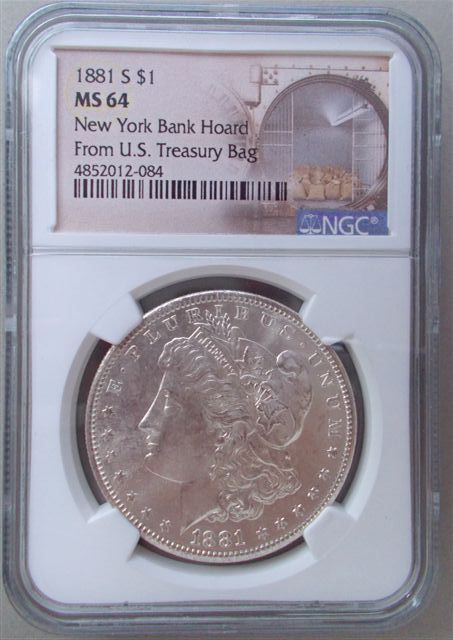
Today I got to scrutinize about a dozen NGC certified Morgans. All were "common" dates/mints graded MS64, and slabbed with the label shown below (I wonder if this was done pursuant to their being hawked via one of the televised coin shows). The certification numbers indicated that this group numbered in the hundreds.
One of the premises of responsible third party grading is to allow for "sight unseen" transactions with some assurance that a coin is valued fairly. What appalled me about this sampling I examined was a real lack in uniformity in their condition, identical grade notwithstanding. The one I picked out (pictured here) is so far as I can see a solid 64, maybe on a good day even a low end 65 (not too significant either way for an 1881-S). But several of the others were rather obviously not 64's, and in some cases that wasn't at all much of a subjective call. Too many of them exhibited an awful lot of chatter, consistent with what I'd judge to be as low as the MS62 range. One New Orleans example, besides having a good deal of the aforementioned chatter, was so incompletely struck that the hair above Liberty's ear was really flat (it's my understanding that in and of itself used to be sufficient cause for denying a coin a "gem" grade). Another in particular was simply dreadful, having a large scrape across the middle of the obverse, rather like what you see on a
Lincoln Cent after it's been run over in the
Walmart parking lot. Maybe it went through the coin counter from hell, I don't know, but for it to have been assigned a straight MS64 grade is utterly ridiculous.
I wish I could've taken photos of these, but circumstances didn't permit it. But if what I observed is to any degree representative, you might want to see in hand any of NGC's output stemming from this hoard before taking their grading as gospel. The level of critical evaluation of these coins on an individual basis seems to have been wanting.








 Posted 01/16/2019 8:04 pm


