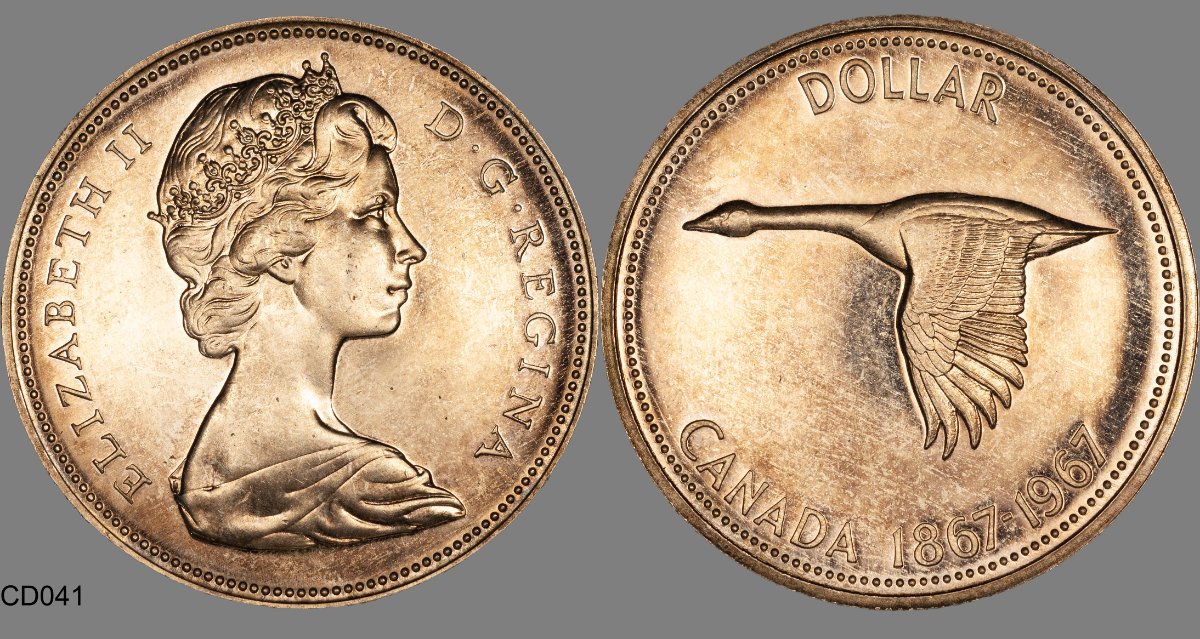
[rant] So I spent a good part of my day studying Canadian silver dollars from 1958 through 1967. I was searching Coin Community, Google, and Coins and Canada (which is a really good site IMO). After that time, I have very little confidence in my ability to distinguish between a business strike, PL, and SP. I can't tell you how many times I asserted "that has to be SP", or "that has to be a business strike", and then later doubt myself.
What is wrong with you Canadians? Eh? Throw us a bone here. Can't you just make it obvious like your southern neighbors?
Anyway, tomorrow I will post some coins that "have to be an SP", and "have to be PL", and "have to be business strike", and see if I get any of them right. [/rant]
I'm so new to this that I don't know what "specimen" means, though I know what "proof" and "uncirculated" mean.
And apparently ignorance is bliss, since I don't have to worry about whether a Canadian coin is specimen.
By coincidence, I got a Canadian cent in change yesterday, and was looking at it harder today, trying to figure out how many sides it has. (12, I think...)
@PaulDog Apparently, from my brief experience, if a Canadian dollar looks like a proof, then it is equally likely to be a regular strike, PL, specimen, or proof. I hope that helps
It's clear as mud. I've sent known SP coins in and gotten a PL grade (on more than one occasion). I've had MS coins grade as PL. Some of the older SP and PL coins have a beautiful, deep cameo...as do some of business strike coins. The honest truth is, certain dates of coins are indistinguishable between PL and SP...I don't believe anyone who tries to tell me they can accurately differentiate 100% of the time.
"True" proof coins were introduced in Canada in 1981, and are simple to identify with their mirror fields, full strike, and ultra cameo frosting. Anything prior to 1981 is not a proof.
To muddy the waters even more, specimen dies were used for PL strikes, PL dies were used for business strikes. And, business strike dies were highly polished and refurbished for SP strikes - the scarce 1951 SP cent with incredible trail dies is an example of the latter.
"Discovery follows discovery, each both raising and answering questions, each ending a long search, and each providing the new instruments for a new search." -- J. Robert Oppenheimer
After hearing opinions that the 1964 coin in this post is a business strike, I've decided to try again with this differentiation.
Here is a video I made
f6MGT_vogRY
Trying to capture the reflection of a red, white, and blue flyer in various coins. The coin in the middle is a 1984 proof for reference. One interesting thing I noticed about the proof coin is that it actually magnifies the flyer.
I believe the top two are 1967 specimen coins (because of the strength of the strike on the shoulder), the bottom left is a 1964 business strike, and the others are 1964 PL.
That could be very useful. Are you aware of any online resource that would show that distinction? I really can't find anything online that actually shows images to try and identify these coins. I can see that the edges of my 1966 coins look different than my 1967 and 1964, and I just found a couple of 1964 that I would deem to be business strikes, and the reeds appear a bit shorter and the rim slightly rounded. Maybe that is the distinction I am looking for. I would love to see some pictures to confirm it.
Based on the video I shared, is the reflectivity of the coins effectively immaterial to identifying a coin as PL? This seems like this should be much simpler to figure out.
Quote: one distinction of the PL strike is a complete flat reeded edge, where the circulation coin has a rounded edge.
This is not always true. That is purely a function of a full or weak strike of the collar die...
There is no easy marker... experience is the best teacher with late 1960s to early 1980s business, PL and SP strikes. You have to study and handle lots of coins, to develop an eye (and feel) for it.
"Discovery follows discovery, each both raising and answering questions, each ending a long search, and each providing the new instruments for a new search." -- J. Robert Oppenheimer
I have lots of coins to study, but I'm lacking the specifics, and have not found a good resource to reference. I need help getting started. Can you tell anything about the 1967 dollar I posted above? Can you tell anything about the coins in the video I posted? Can you clearly read newsprint from a business strike from 4-6 inches away?
These are common coins. Take/cut them out of the sets, handle them, study them, study the rims, edges, devices near the edge and centre of the coin, fields, quality of the strike, etc... that is how you learn.
Note that 1967 is a silver year set, it actually gets a little tougher differentiating PL and SP nickel composition strikes after 1973, until 1981.
"Discovery follows discovery, each both raising and answering questions, each ending a long search, and each providing the new instruments for a new search." -- J. Robert Oppenheimer
If I understand you correctly, I should be able to differentiate a PL from a business strike by recognizing that a PL will exhibit a certain "je ne sais quoi". That leaves me feeling a bit like "je ne sais rien".
Disclaimer: While a tremendous amount of effort goes into ensuring the accuracy of the information contained in this site, Coin Community assumes no liability for errors. Copyright 2005 - 2026 Coin Community Family- all rights reserved worldwide. Use of any images or content on this website without prior written permission of Coin Community or the original lender is strictly prohibited. Contact Us | Advertise Here | Privacy Policy / Terms of Use







 Posted 02/16/2019 9:35 pm