| Author |
 Replies: 7 / Views: 7,825 Replies: 7 / Views: 7,825 |
|
|
Pillar of the Community
2087 Posts |
This coin issued by the Royal Dutch mint had me thinking hard: https://www.royaldutchmint.com/offi...oduct/10025/I have perused the many definitions of restrikes ( including the ANA's definition) and have problems with nearly all official definitions as they all state a restrike is a coin struck at a later date using the original dies. I have conducted mini-seminar at the ANA Summer seminar on the Maria Theresa Thaler. For that seminar I offered this definition: A restrike is a genuine coin, of correct dimensions and alloy that has been struck again at a later date. The year it bears is that of the original striking instead of the actual striking year. A restrike can be produced from original dies or new dies. What differentiates a restrike from a counterfeit, fantasy issue, copy, or replica, is that it is legally authorized by a government and is compliant with the relevant international laws (or accepted international coinage principles) current at the time of its striking. The reason I offered this definition is under all the official definitions I have seen ( Including the ANAs definition) the 1780 Maria Theresa Thaler cannot be counted as a restrike as it was never restuck using original dies ( all dies were destroyed on her death as was standard practice in European mints at that time). Even so, everyone regards the modern issues of the 1780 MTT as restrikes though they were never produced with the original dies In regards to the Royal Dutch mint. They are dating their so-called restrikes with the current year of striking. ( not the original striking date), in which case I do not believe they can be rightly called restrikes. They are commemorative strikes, not restrikes. I am all too aware that many mints producing NCLT are extremely loose with their definitions being more interested in marketing than using terms correctly... it is on these occasions that the opinions of collectors trump those of the manufacturers What do other people think? Edited by austrokiwi
02/23/2019 08:12 am
|
|
|
|
Bedrock of the Community
United Kingdom
18693 Posts |
 I think that's more of a commemorative / bullion coin than a restrike. It's good value however compared to what The Royal Mint asks for its silver proof crownsized coins! |
|
Pillar of the Community
 United States
8044 Posts |
I like your definitions.
I'm not so familiar with the background of the modern MTT restrikes (though I have a couple, obtained 40 or 50 years ago). Are they indeed struck under authority of a government (presumably that of Austria)?
|
|
Pillar of the Community
 2087 Posts |
Without going into the full history. Modern restrike 1780 MTTs started being struck between 1816 and 1820( depending on mint). They are identifiably different from Early restrikes as they are produced by modern minting techniques. the Early restrikes were produced between 1781 and 1812/20. All varieties of modern restrikes, excluding 2 varieties, were produced by legally authorised authorities. Those legally authorised authorities( Austria objected to some of the nation Austrian production but they had stuffed up after the first world war and had no clear international-legal right to the MTT through leaving it out of their, then, new monetary laws) were, Austria, Italy, UK, France Belgium and the Netherlands. The two unapproved strikes were produced in Switzerland by the medalists Heugenin ( I may have spelt that incorrectly) one of those "counterfeits" was 900 standard gold strike( 2oz pure) Produced for sale to the USA in the mid 20th century( as a means to get around gold ownership restrictions) and a silver example. When Austria found out about the Swiss silver strike they complained to the Swiss and the dies were seized by the Swiss government and transferred to the Vienna Mint. The Soviets produced a debased counterfeit for use in Syria, Egypt and other middle eastern interests. Given its lower silver content I wouldn't call it a restrike
Edited by austrokiwi
02/23/2019 10:44 am
|
|
Bedrock of the Community
United States
20753 Posts |
I would think any coin struck a second time is a restrike. Now wouldn't that mean a Proof is a restrike? They are supposed to be struck a second time during the minting. Now when you see a coin with a Mint Mark done over about 3 times, wouldn't that be a restike/restrike/restrike?  When a coin is a doubled die on the obverse but not on the reverse, would that be a Obv/restrike/no reverse?  |
|
Pillar of the Community
Belgium
1185 Posts |
here a few thoughts: the "Official Restrike Lion Dollar 2019 Silver Proof" is a continuation of the Mint: in 2017 (first year, it was Utrecht, in 2018, Zeeland indeed a piece that never existed before (weight silver purity) but the design is similar to the original Leeuwendaalders the restrikes are sold out, the price was about 3 times metal value, not cheap the minted number (5000 pieces) may seem low to some, but curiously 5000 is a huge number compared to the number of survivors of some of the original Leeuwendaalders especially some years from Ghelders, or Utrecht, or Friesland; some of these originals are on the market for about the same price as the "restrikes" (little less than 60€); that is interesting ! if one wishes to spend much more on the modern fantasy, one can also buy gold versions and "piedfort" versions that never existed as originals . |
|
Pillar of the Community
2087 Posts |
Quote:
Leeuwendaalders One of my pedantic peeves is the tendency in the USA for people to call Lion dollars "Leeuwen talers/dollars". you either translate the whole word ( as the royal dutch mint does) or as 1c5d7n5m has done use the word untranslated. You may think this is overly pedantic but let's understand the first Lion taler( in this case I use the word taler because the American colonists were yet to create the word "Dollar" from "daalder") was not struck in the Netherlands. It was struck in Bohemia in Joachimstal. The Dutch Lion dollar was an imitation of the Joachimsthaler guldengroschen. IMO When you half translate the word you obscure the pedigree. Edited by austrokiwi
02/24/2019 03:20 am
|
|
Pillar of the Community
Belgium
1185 Posts |
point well taken, austrokiwi, the pedigree of this coin, starting from the US dollar and going back to the first German talers is exciting so here is one of my 1576 type 2 pieces minted at a time the revolt needed cash to pay the rebel soldiers ; decades before this type of silver piece became an international trading unit 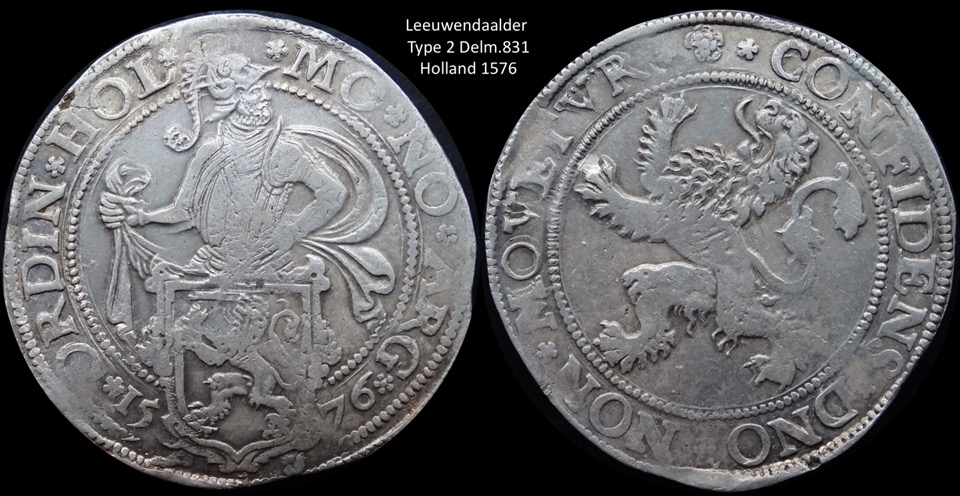 the face of the knight and head of the lion are well struck compared to most other pieces of the same type |
| |
Replies: 7 / Views: 7,825 |
|










 Posted 02/23/2019 09:45 am


